
UGC NET Paper 2 Computer Science – June 2024 (Re-Exam) – Question Paper with Answer Key
Solved by The Binary Brothers: every question has the correct answer and an explanation. Open any question for its full solution, or practise it in the unit-wise mock tests.
S → A
A → $B$ | id
B → B, A | A
If I₀ = CLOSURE({[S → ·A]}), then how many items will be in the set GOTO(I₀, $)?
- 3
- 4
- 5
- 6
- In 1NF, but not in 2NF
- In 2NF, but not in 3NF
- In 3NF, but not in BCNF
- In BCNF
Which of the following statements about pointers in C are TRUE.
(A) Pointers can be used to access array elements
(B) Pointers can store the address of another pointer
(C) Pointers are automatically deferenced in expression
(D) Pointers cannot be used to access structure members
- (A) and (C) Only
- (A) and (B) Only
- (B) and (C) Only
- (C) and (D) Only
- 20 m
- 30 m
- 50 m
- 40 m
(A) Mutual exclusion ensures that only one process can be in a critical section at any given time.
(B) Mutual exclusion is designed to prevent conflicts and ensure that only one process can access shared resources at a time.
(C) Mutual exclusion can use various algorithms to ensure that processes do not enter the critical section simultaneously.
(D) Mutual exclusion allows multiple processes to access the critical section simultaneously to improve performance.
Choose the correct answer from the options given below:
- (A), (B), (C) Only
- (B), (C), (D) Only
- (B), (D), (A) Only
- (A), (C), (D) Only
Cal(a, b) {
  if (b != 1) {
    if (a != 1) {
      printf("*");
      Cal(a/2, b);
    }
    else {
      b = b - 1;
      Cal(10, b);
    }
  }
}
How many times will * be printed if the function is called with Cal(10, 10)?- 25
- 23
- 24
- 27
Consider the following relations on {1, 2, 3, 4}. Which of them are reflexive? (A) R₁ = {(1,1), (1,2), (2,1), (2,2), (3,4), (4,1), (4,4)} (B) R₂ = {(1,1), (1,2), (2,1)} (C) R₃ = {(1,1), (1,2), (1,4), (2,1), (2,2), (3,3), (4,1), (4,4)} (D) R₄ = {(2,1), (3,1), (3,2), (4,1), (4,2), (4,3)} (E) R₅ = {(1,1), (1,2), (1,3), (1,4), (2,2), (2,3), (2,4), (3,3), (3,4), (4,4)}
- (A), (B) and (C) Only
- (A), (D) and (E) Only
- (D) and (E) Only
- (C) and (E) Only
- UY, VY
- UY, VY, XY
- UYZ, VYZ, VWZ
- UYZ, VYZ, XYZ
int *func (int, int);int (*func) (int, int);int (func*) (int, int);int *func* (int, int);
Arrange the following steps of Feature Drive Development (FDD) process in the correct sequence :
(A) Develop an overall model
(B) Build by feature
(C) Plan by feature
(D) Design by feature
(E) Build a feature list
- (A), (C), (B), (E), (D)
- (A), (E), (C), (D), (B)
- (B),(A),(D),(E),(C)
- (A), (B), (C), (E), (D)
Consider the number (45)ᵧ, where y is the base. Some possible values of y are: (A) 5 (B) 6 (C) 7 (D) 8
- (A), (B) and (C) Only
- (B), (C) and (D) Only
- (A), (C) and (D) Only
- (A), (B), (C) and (D)
#include<stdio.h>
int main() {
  int x[] = {2,4,6,8,10};
  int a, b = 0, *y = x + 4;
  for (a = 0; a < 5; a++) {
    b = b + (*y - a) - *(y - a);
  }
  printf("%d\n", b);
  return 0;
}
What will be the output of the above C program?- 4
- 6
- 8
- 10
Match List - I with List - II.
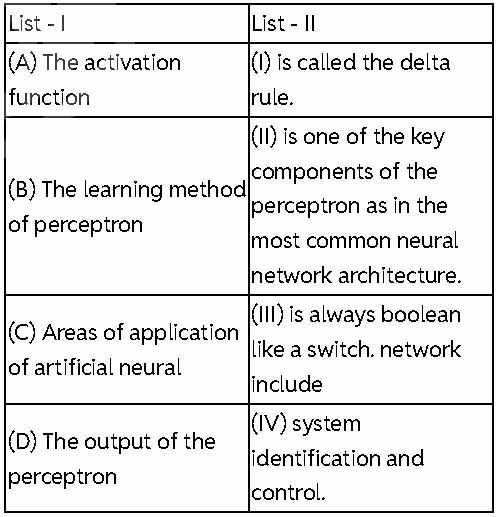
- (A)-(II), (B)-(IV), (C)-(III), (D)-(I)
- (A)-(IV), (B)-(III), (C)-(II), (D)-(I)
- (A)-(II), (B)-(I), (C)-(IV), (D)-(III)
- (A)-(III), (B)-(IV), (C)-(II), (D)-(I)
Match List - I with List - II.
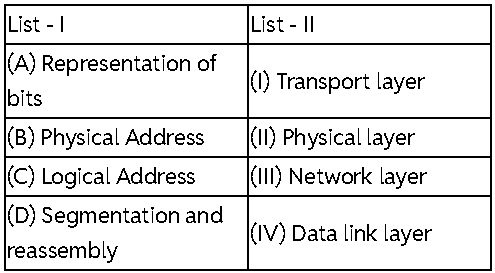
- (A)-(I), (B)-(II), (C)-(III), (D)-(IV)
- (A)-(II), (B)-(IV), (C)-(III), (D)-(I)
- (A)-(III), (B)-(II), (C)-(IV), (D)-(I)
- (A)-(I), (B)-(IV), (C)-(III), (D)-(II)
Which of the following are Agile Process Models ?
(A) Extreme Programming (XP)
(B) Waterfall
(C) Scrum
(D) Spiral
(E) Incremental
- (A) and (C) Only
- (B) and (C) Only
- (A) and (D) Only
- (B) and (E) Only
(A) They can only be executed by the operating system kernel and not by user applications.
(B) They are designed to perform operations that can directly affect the hardware or system state, such as I/O operations or changing memory-management settings.
(C) User applications can execute privileged instructions if they have the correct permissions set by the operating system.
(D) They are usually executed in user mode to ensure the safety and security of the system.
Choose the correct answer from the options given below:
- (A) and (B) Only
- (A), (B) and (C) Only
- (B) and (C) Only
- (B), (C) and (D) Only
- 8000
- 16000
- 12000
- 20000
Consider the Grammar:
T → Qx
Q → RS
R → y ∣ ϵ
S → z ∣ ϵ Here x, y, z are terminals and T, Q, R, S are non- terminals. What will be the follow set of the non-terminal R?
- {x,y}
- {y,z}
- {z,x}
- {ϵ}
Host A (on TCP/IPv4 Networks) send an IP Datagram D to host B (also on TCP/IPv4 network). Assume that no error occured during transmission of D, when D reaches B. Which of following header field may differ from that of original datagram D ?
(A) TTL
(B) Checksum
(C) Fragment offset
(D) Source IP
(E) Destination IP
- (A) and (B) Only
- (A), (B) and (C) Only
- (A), (B), (C) and (D) Only
- (A), (B), (C) and (E) Only
(A) All production rules are of the form A → xB or A → x, where A and B are non-terminal symbols and x is a terminal symbol.
(B) Regular grammars are more powerful than context-free grammars and can express any type of language.
(C) There is a direct correspondence between regular grammars and finite automata.
(D) Regular grammars can generate languages that are not recognised by any type of automata.
Choose the correct answer from the options given below:
- (A) and (B) Only
- (B) and (C) Only
- (C) and (D) Only
- (A) and (C) Only
- Dependency preserving and lossless join
- Lossless join but not dependency preserving
- Dependency preserving but not lossless join
- Not dependency preserving and not lossless join
Arrange the following phases of the Agile process in the correct sequence :
(A) Design
(B) Release
(C) Testing
(D) Development
(E) Planning
- (A), (B), (D), (E), (C)
- (A), (D), (E), (B), (C)
- (E), (A), (D), (C), (B)
- (E), (D), (A), (C), (B)
Which of the following are TRUE about constructors in C++ ?
(A) A constructor can be overloaded.
(B) A constructor does not have a return type.
(C) A constructor must be declared as a friend function.
(D) A constructor is called when an object is destroyed.
- (B), (C), (D) Only
- (B), (C) Only
- (A), (B), (C) Only
- (A), (B) Only
Let P be "It is hot day" and q be "The temperature is 48°C". Write in simple sentences the meaning of ¬p∧¬q.
- It is hot day or temperature is 48°C
- It is cold day or temperature is 48°C
- It is neither a hot day nor temperature is 48°C
- It is not a hot day
- 100
- 150
- 200
- 250
Arrange the following steps in proper sequence involved in a Genetic Algorithm :
(A) Selection
(B) Initialization
(C) Crossover
(D) Mutation
(E) Evaluation
- (A), (B), (C), (D), (E)
- (E), (A), (B), (D), (C)
- (B), (E), (A), (C), (D)
- (A), (C), (B), (D), (E)
#include<stdio.h>
void f1(char *x, char *y) {
char *t1;
t1 = x;
x = y;
y = t1;
}
void f2(char **x, char **y) {
char *t1;
t1 = *x;
*x = *y;
*y = t1;
}
int main() {
char *a = "ONE", *b = "TWO";
f1(a, b);
printf("%s %s ", a, b);
f2(&a, &b);
printf("%s %s", a, b);
return 0;
}- ONE TWO TWO ONE
- TWO ONE ONE TWO
- ONE TWO ONE TWO
- TWO ONE TWO ONE
- To design user interfaces
- To create and manipulate databases
- To display data on web pages
- To format printed reports
class A { virtual void show() = 0; };class A { void show() = 0; };class A { void show() { }; };class A { show() = 0; };
Arrange the following recurrence relations in increasing order of their time complexity: (A) T(n) = T(n/2) + 1 (B) T(n) = 2T(n/2) + n (C) T(n) = 3T(n/3) + n (D) T(n) = 2T(n/2) + √n (E) T(n) = T(n−1) + 1
- (E), (A), (B), (D), (C)
- (A), (E), (D), (B), (C)
- (E), (A), (D), (B), (C)
- (A), (B), (D), (E), (C)
- By encrypting all data stored
- By enforcing rules defined in the schema
- By compressing data for efficient storage
- By allowing unrestricted access to all users
Match List - I with List - II.
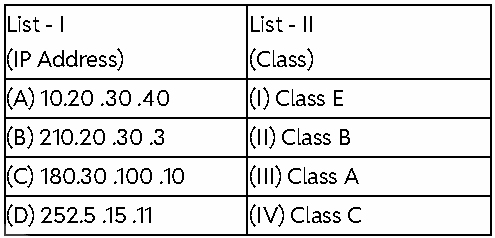
- (A)-(II), (B)-(III), (C)-(I), (D)-(IV)
- (A)-(I), (B)-(IV), (C)-(II), (D)-(III)
- (A)-(I), (B)-(II), (C)-(IV), (D)-(III)
- (A)-(III), (B)-(IV), (C)-(II), (D)-(I)
Find the correct sequence of the storage devices in descending order based on their access time.
(A) Registers
(B) Magnetic Disk
(C) Magnetic Tapes
(D) Main memory
(E) Optical Disk
- (B), (A), (D), (C), (E)
- (B), (A), (E), (D), (C)
- (C), (B), (A), (E), (D)
- (C), (E), (B), (D), (A)
A graph G with number of vertices greater and equal than three i.e. (n ≥ 3) is a Hamiltonian graph, if the degree of each vertex is greater and equal to . . . .
- Equal to number of vertices
- Double of number of vertices
- Half of number of vertices
- Four times of number of vertices
- Join Dependency
- Domain-Key
- Multivalued dependency
- Functional dependency
Consider transactions T1: r1(x); r1(z); w1(z) T2: r2(y); r2(z); w2(z) T3: r3(y); r3(x); w3(y), and schedules S1: r1(x); r3(y); r3(x); r2(y); r2(z); w3(y); w2(z); r1(z); w1(x); w1(z) and S2: r1(x); r3(y); r2(y); r3(x); r1(z); r2(z); w3(y); w1(x); w2(z); w1(z). Which statement is TRUE?
- Only S₁ is conflict-serializable
- Only S₂ is conflict-serializable
- Both S₁ and S₂ are conflict-serializable
- Neither S₁ nor S₂ is conflict-serializable
- 10
- 14
- 15
- 19
Match List - I with List - II.
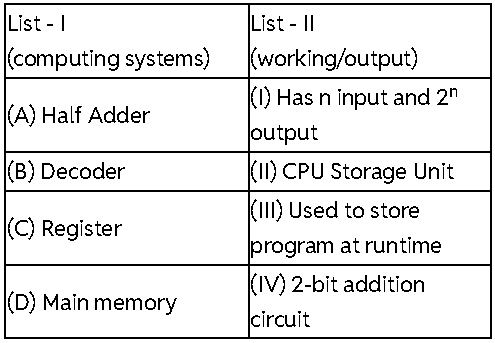
- (A)-(II), (B)-(III), (C)-(IV), (D)-(I)
- (A)-(IV), (B)-(II), (C)-(III), (D)-(I)
- (A)-(IV), (B)-(I), (C)-(II), (D)-(III)
- (A)-(II), (B)-(IV), (C)-(III), (D)-(I)
Arrange the following steps in a proper sequence for the process of training a neural network.
(A) Weight initialization
(B) Feed forward
(C) Back Propagation
(D) Loss Calculation
(E) Weight Update
- (A), (B), (D), (C), (E)
- (D), (B), (A), (C), (E)
- (A), (C), (D), (B), (E)
- (E), (C), (B), (D), (A)
Consider the following statements regarding combinational and sequential circuits.
(A) Output of combinational circuits depends on the only current input.
(B) Output of combinational circuit depends on the both current input and previous output.
(C) Output of sequential circuit depends on the current input.
(D) Output of sequential circuit depends on both current input and previous output.
- (A) and (C) Only
- (A) and (D) Only
- (B) and (D) Only
- (B) and (C) Only
- R(V, W, X, Y, Z) {VW → X, WX → V, VX → W, W → Y, Y → Z}
- R(V, W, X, Y, Z) {VW → W, X → Y}
- R(V, W, X, Y, Z) {VW → X, X → VY}
- R(V, W, X, Y, Z) {VW → X, X → Y, Y → Z, Z → V}
#include<iostream.h>
using namespace std;
void swap(int &x, int &y)
{
int temp=x;
x=y;
y=temp;
}
int main()
{
int a=5, b=10;
swap(a,b);
swap(a,b);
cout<<a<<" "<<b;
return 0;
}
What will be the output of the above code?
- 5, 10
- 10, 5
- 5, 5
- 10, 10
Which of the following are typical activities in the software process lifecycle?
(A) Requirement Analysis
(B) System Design
(C) Code Refactoring
(D) Deployment
(E) Substructure
- (A), (B), (C) Only
- (B), (C), (D) Only
- (A), (B), (D) Only
- (A), (D), (E) Only
- Data organized into tables with rows and columns
- Data organized into files and folders
- Data organized into a hierarchical tree structure
- Data organized into a network of interconnected nodes
A coin is tossed successively three times. Find the Probability (P), Event (E), Sample space (S) of getting exactly one head or two heads, where n is number of occurrence.
(A) n(S) = 8 and n(E) = 4
(B) n(E) = 6 and n(S) = 8
(C) P(E) = 3/4
(D) P(E) = 1/2
- (A), (B), (C) and (D)
- (B) and (C) Only
- (A) and (D) Only
- (C) and (D) Only
(A) Identify and group the largest possible clusters of 1's
(B) Draw the K-map for the given Boolean function
(C) Write the simplified Boolean expression from the grouped clusters
(D) Transfer the truth table values to the K-map
Choose the correct answer from the options given below:
- (B), (D), (A), (C)
- (D), (B), (A), (C)
- (B), (A), (D), (C)
- (A), (B), (C), (D)
If p and q are two statements, which of the following equivalences hold? (A) ~(p ∧ q) ≡ ~p ∨ ~q (B) ~(p ∨ q) ≡ ~p ∧ ~q (C) p ∧ ~p ≡ T (D) ~(p ⇒ q) ≡ p ∧ ~q (E) p ∨ q ≡ ~p ∨ ~q
- (A), (B) and (D) only
- (A), (C) and (D) only
- (C), (D) and (E) only
- (A), (B) and (C) only
#include<iostream>
using namespace std;
class Base {
public:
  Base() { cout << "Base Const"; }
  virtual ~Base() { cout << "Base dest"; }
};
class Derived : public Base {
public:
  Derived() { cout << "Derived Const"; }
  ~Derived() { cout << "Derived dest"; }
};
int main() {
  Base *b = new Derived();
  delete b;
  return 0;
}- Base Const Derived Const Derived dest Base dest
- Base Const Derived Const Base dest Derived dest
- Derived Const Base Const Base dest Derived dest
- Base Const Derived Const Base dest
- L₁ ∩ L₂ is context free
- L₁ ∩ L₂ is regular
- L₁ ∩ L₂ is recursively enumerable
- L₁ ∩ L₂ is context sensitive
#include<stdio.h>
int temp = 0;
int fun(int x, int y) {
  int z; temp++;
  if (y == 3) return (x*x*x);
  else {
    z = fun(x, y/3);
    return (z*z*z);
  }
}
int main() {
  fun(4, 81);
  printf("%d", temp);
}
What will be the output of the code?- 3
- 4
- 5
- 6
Which of the following tasks could be attained using syntax trees in compiler design ?
(A) Type Checking
(B) Code Generation
(C) Code Optimization
(D) Error Handling
- (A), (B), (C) Only
- (B), (C), (D) Only
- (A), (C), (D) Only
- (A), (B), (D) Only
Match List - I with List - II.
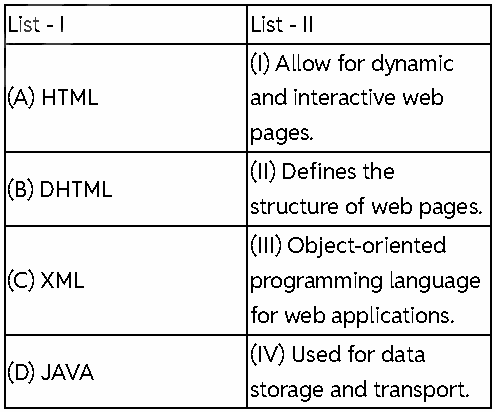
- (A)-(I), (B)-(III), (C)-(II), (D)-(IV)
- (A)-(II), (B)-(III), (C)-(IV), (D)-(I)
- (A)-(II), (B)-(I), (C)-(IV), (D)-(III)
- (A)-(III), (B)-(I), (C)-(IV), (D)-(II)
Match List - I with List - II.
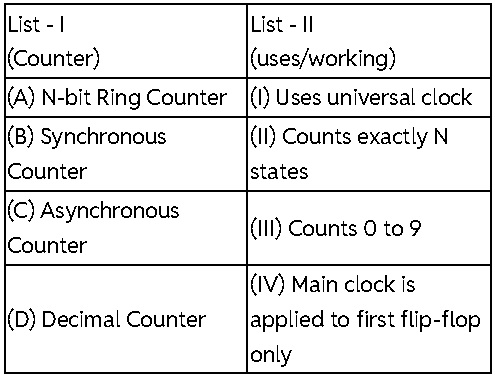
- (A)-(II), (B)-(IV), (C)-(I), (D)-(III)
- (A)-(IV), (B)-(II), (C)-(III), (D)-(I)
- (A)-(II), (B)-(I), (C)-(IV), (D)-(III)
- (A)-(IV), (B)-(I), (C)-(II), (D)-(III)
Arrange the following steps of file handling in C in the correct order :
(A) Close the file
(B) Read from or write to the file
(C) Open the file
(D) Check for error
- (A), (C), (D), (B)
- (D), (B), (C), (A)
- (C), (D), (B), (A)
- (B), (D), (A), (C)
Match List - I with List - II.
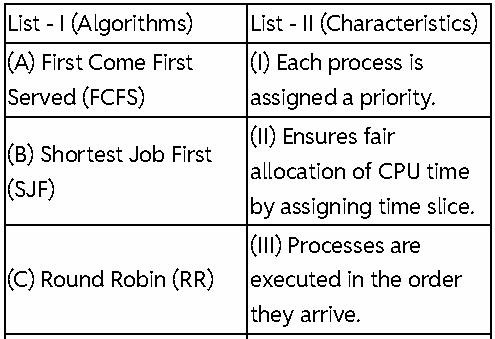
(D) Priority Scheduling (IV) Select the process for execution with smallest next Burst time.
- (A)-(II), (B)-(III), (C)-(IV), (D)-(I)
- (A)-(II), (B)-(IV), (C)-(III), (D)-(I)
- (A)-(III), (B)-(IV), (C)-(II), (D)-(I)
- (A)-(III), (B)-(IV), (C)-(I), (D)-(II)
Arrange the following steps in a proper sequence for the typical process of a DNS query :
(A) Query authoritative DNS Server
(B) Query local DNS Server
(C) Local DNS Server Check Cache
(D) Query root DNS Server
(E) Query TLD DNS Server
- (A), (C), (E), (B), (D)
- (E), (A), (C), (B), (D)
- (A), (B), (C), (D), (E)
- (B), (C), (D), (E), (A)
Match List - I with List - II.
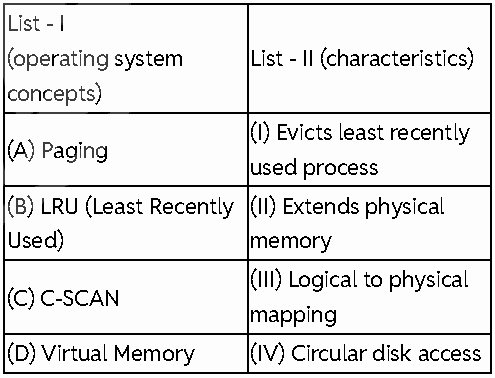
- (A)-(III), (B)-(IV), (C)-(I), (D)-(II)
- (A)-(III), (B)-(I), (C)-(IV), (D)-(II)
- (A)-(I), (B)-(III), (C)-(IV), (D)-(II)
- (A)-(I), (B)-(IV), (C)-(III), (D)-(II)
- 1022
- 1023
- 2046
- 2047
Select the Sorting Algorithms that are stable.
(A) Quick Sort
(B) Bubble Sort
(C) Insertion Sort
(D) Merge Sort
(E) Shell Sort
- (A), (B), (C) and (E) Only
- (A), (D) and (E) Only
- (B) and (C) Only
- (B), (C) and (D) Only
- Expression tree
- Game tree
- Red-Black tree
- Threaded tree
- ∀x L(x, Joy)
- ∀y L(Joy, y)
- ∃y ∀x L(x, y)
- ∃x ¬L(Joy, x)
#include<stdio.h>
void main() {
  int arr[5] = {10,20,30,40,50};
  int *p = (int*)(&arr + 1);
  printf("%d %d", *(arr+1), *(p-1));
}- 10 50
- 20 50
- 30 40
- 20 40
(A) Writing a symbol on the tape
(B) Moving the tape head left or right
(C) Reading a symbol from the tape
(D) Transitioning to a new state based on the current state and symbol read
(E) Halting and accepting or rejecting the input
Choose the correct answer from the options given below:
- (C), (A), (B), (D), (E)
- (C), (B), (A), (D), (E)
- (C), (D), (A), (B), (E)
- (C), (D), (B), (A), (E)
Match List - I with List - II.
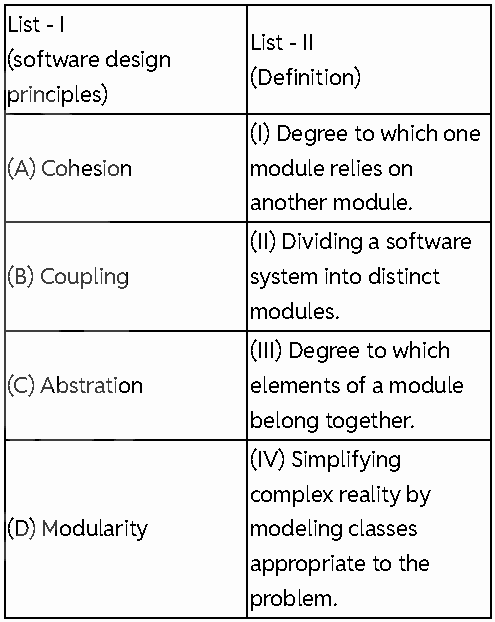
- (A)-(I), (B)-(II), (C)-(III), (D)-(IV)
- (A)-(II), (B)-(III), (C)-(IV), (D)-(I)
- (A)-(III), (B)-(I), (C)-(IV), (D)-(II)
- (A)-(III), (B)-(IV), (C)-(II), (D)-(I)
(A) L₁ = {w ∈ {0,1}* | the length of w is even}
(B) L₂ = {w ∈ {0,1}* | the length of w is odd}
(C) L₃ = {w ∈ {0,1}* | all 0's come before all 1's in w}
(D) L₄ = {w ∈ {0,1}* | w contains an equal number of 0's and 1's}
(E) L₅ = {w ∈ {0,1}* | all 1's come before all 0's in w}
- (A) and (B) Only
- (B) and (C) Only
- (C) and (D) Only
- None of the above
- 30
- 37.5
- 40
- 45.5
Arrange the following phases of database design in the correct order :
(A) Physical Design
(B) Conceptual Design
(C) Logical Design
(D) Requirement Analysis
- (B), (D), (A), (C)
- (C), (A), (B), (D)
- (D), (B), (C), (A)
- (A), (D), (C), (B)
Consider the three way hand shaking process followed during TCP connection establishment between two hosts A and B . Let S and R be two random 32 -bit starting sequence numbers chosen by A and B, respectively. Suppose A sends a TCP segment having SYN bit =1, SEQ number = S and ACK bit =0 and B accepts the connection request. Which one of the following choices represents the information present in the TCP segment header that is sent by B to A ?
- SYN bit =1, SEQ number =S+1, ACK bit =0, ACK number =R, FiN bit =0
- SYN bit =0, SEQ number =R, ACK bit =1, ACK number =S+1, FiN bit =0
- SYN bit =1, SEQ number =R, ACK bit =1, ACK number =S+1, FiN bit =0
- SYN bit =1, SEQ number = R, ACK bit =1, ACK number =S, FiN bit =0
Two computers A and B are configured as follows : A has IP address 203.197.2.53 and subnet mask 255.255.128.0, B has IP address 203.197.75.201 and subnet mask 255.255.192.0. What one of the following statement is true?
- A and B both assume they are on the same network
- B assumes, A is on same network, A assumes B is on different network
- A assumes, B is on same network, but B assumes, A is on a different network
- A and B both assume they are on different network
- To control the changes made to software
- To document user requirements
- To estimate project cost
- To design the software architecture
Arrange the following stages of parsing in the correct order as they typically occur in the compilation process.
(A) Lexical Analysis
(B) Sematic Analysis
(C) Syntax Analysis
(D) Intermediate Code Generation
(E) Code Optimization
- (A), (B), (C), (D), (E)
- (A), (C), (B), (D), (E)
- (A), (D), (B), (C), (E)
- (A), (C), (D), (B), (E)
Match List - I with List - II.
List - I (Queries) List - II (Probability)
(A) A bag contains 6 (I) 3 / 68 white and 4 red balls. Two balls are drawn at random. What is the chance they will the same color?
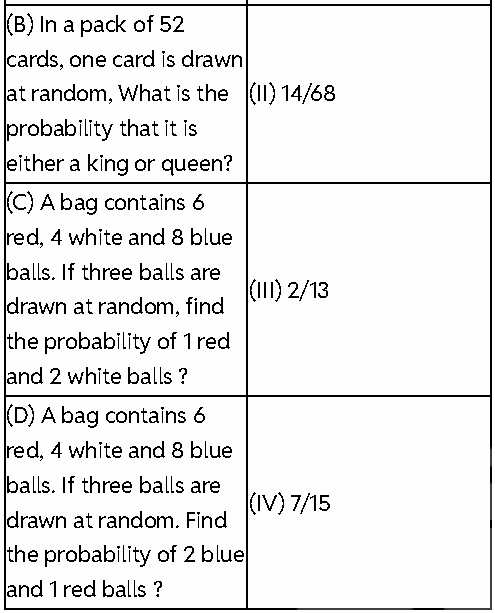
- (A)-(III), (B)-(IV), (C)-(I), (D)-(II)
- (A)-(III), (B)-(IV), (C)-(II), (D)-(I)
- (A)-(IV), (B)-(III), (C)-(II), (D)-(I)
- (A)-(IV), (B)-(III), (C)-(I), (D)-(II)
Match List - I with List - II.
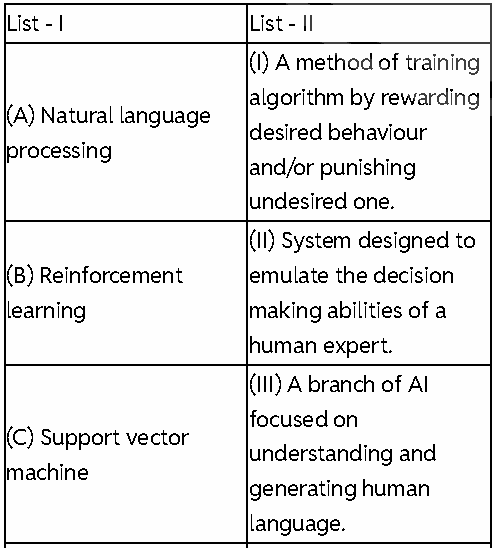
(D) Expert system (IV) A machine learning technique that finds the hyper plane that best separates different class in a feature space.
- (A)-(I), (B)-(II), (C)-(IV), (D)-(III)
- (A)-(III), (B)-(II), (C)-(I), (D)-(IV)
- (A)-(III), (B)-(I), (C)-(IV), (D)-(II)
- (A)-(II), (B)-(IV), (C)-(III), (D)-(I)
Match List - I with List - II.
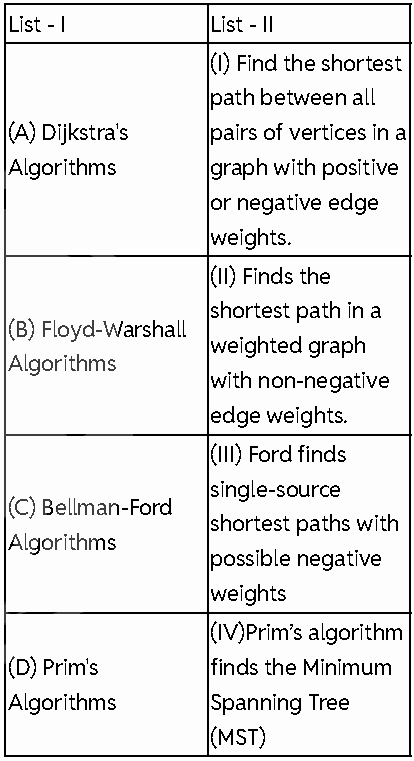
- (A)-(I), (B)-(II), (C)-(III), (D)-(IV)
- (A)-(II), (B)-(I), (C)-(III), (D)-(IV)
- (A)-(I), (B)-(II), (C)-(IV), (D)-(III)
- (A)-(III), (B)-(II), (C)-(IV), (D)-(I)
(A) The PCB contains information about the process state, such as whether it is running, waiting or terminated.
(B) The PCB includes the program code and data segments of the process.
(C) The PCB stores the process's memory-management information, such as page tables and segment tables.
(D) The PCB is used to track process scheduling information and CPU registers for process execution.
Choose the correct answer from the options given below:
- (A), (B) and (C) Only
- (B), (C) and (D) Only
- (A), (C) and (D) Only
- (A) and (B) Only
#include<stdio.h>
void main()
{
int arr[ ] = {1, 2, 3, 4, 5};
int *p = arr;
printf("%d", *p++);
printf("%d", *(p+1));
}
Find the output of the above code?
- 1,2
- 1,3
- 2,3
- 1,4
Arrange the following Language Classes in ascending order according to their expressive power, as defined by Chomsky hierarchy:
(A) Context-free languages
(B) Context-sensitive languages
(C) Regular languages
(D) Unrestricted Grammars
- (C), (A), (B), (D)
- (C), (A), (D), (B)
- (A), (C), (B), (D)
- (A), (D), (B), (C)
- 2l
- l/2
- l²
- √l
- 12
- 53
- 10
- 88
(A) In IPv4 addressing, a block of addresses can be defined as x.y.z.t/n, in which x.y.z.t defines one of the addresses and /n defines the mask.
(B) The first address in the block can be found by setting the rightmost 32 − n bits to 0s.
(C) Class C addresses are used for multicast communication.
(D) There are five classes in IPv4 addressing.
(E) Supernetting combines several networks into one large network.
Choose the correct answer from the options given below:
- (A), (B) and (C) Only
- (A), (B), (D) and (E) Only
- (A), (C), (D) and (E) Only
- (C), (D) and (E) Only
Match List - I with List - II.
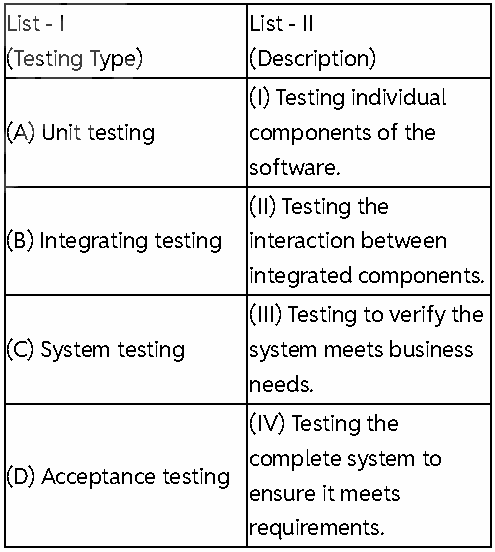
- (A)-(I), (B)-(II), (C)-(III), (D)-(IV)
- (A)-(I), (B)-(II), (C)-(IV), (D)-(III)
- (A)-(I), (B)-(III), (C)-(II), (D)-(IV)
- (A)-(I), (B)-(IV), (C)-(II), (D)-(III)
(A) The Program Counter (PC) keeps track of the next instruction to be executed.
(B) The Instruction Register holds the address of the first instruction to be executed.
(C) The Accumulator holds the output of the ALU.
(D) The Program Counter (PC) keeps track of only the first instruction of the program.
Choose the correct answer from the options given below:
- (A) and (C) Only
- (A) and (D) Only
- (B) and (D) Only
- (A), (B) and (C) Only
(A) Define the base case when the capacity is zero or no items are left to consider
(B) Compute the maximum value that can be obtained using items up to the i-th item and a knapsack capacity of W
(C) Identify subproblems and their dependencies based on item weights and values
(D) Initialize a table to store results of subproblems
(E) Iterate through each item and each possible capacity to fill the table
Choose the correct answer from the options given below:
- (C), (D), (A), (E), (B)
- (D), (C), (A), (E), (B)
- (A), (C), (D), (E), (B)
- (D), (A), (C), (E), (B)
- 250
- 300
- 400
- 450
Arrange the given steps required for a Direct Memory Access (DMA) transfer in the correct order.
(A) Initiate DMA transfer request
(B) Transfer data directly between peripheral and memory
(C) Processor grants DMA control over the system bus
(D) DMA controller completes data transfer and signals completion
- (C), (A), (B), (D)
- (A),(C),(B),(D)
- (A), (B), (C), (D)
- (C), (B), (A), (D)
Match List I (recurrence) with List II (complexity). List I: (A) T(n) = 2T(n/2) + n, (B) T(n) = T(n/2) + 1, (C) T(n) = 2T(n/2) + 1, (D) T(n) = T(n−1) + n. List II: (I) T(n) = Θ(n log n) (exact), (II) O(n²), (III) T(n) = Θ(n) (exact), (IV) O(n).
- (A)-(I), (B)-(IV), (C)-(III), (D)-(II)
- (A)-(IV), (B)-(II), (C)-(I), (D)-(III)
- (A)-(I), (B)-(III), (C)-(IV), (D)-(II)
- (А)-(III), (B)-(I), (C)-(IV), (D)-(II) ∀x ∃ y(x < y)
Translate into English: ∀x ∃y (x < y), where the domain of both variables is the real numbers.
- For all real numbers x, there exists a real number y such that x is less than y
- For every real numbers y, there exists a real number x such that x is less than y
- For some real numbers x, there exists a real number y such that x is less than y
- For each and every real numbers x and y, x is less than y
- 64
- 80
- 100
- 128
- 200
- 400
- 100
- 50
Which of the following is a context-free language? (A) {wⁱ xʲ yᵏ zˡ | i + k = j + l, i, j, k, l ≥ 0} (B) {wⁱ xʲ yᵏ zˡ | i = j, k = l} (C) {wⁱ xʲ yᵏ zˡ | i = j = k and k ≠ l} (D) {wⁱ xʲ yᵏ zˡ | i = j = k + l} (E) {wⁱ xʲ yᵏ zˡ | i = j = l and k ≠ l}
- (A) and (B) Only
- (B) and (C) Only
- (C) and (D) Only
- (D) and (E) Only
Directions (Q91–95): Artificial Neural Networks (ANNs) are computational models inspired by the human brain's neural networks. They consist of interconnected nodes, or neurons, organized into layers: an input layer, one or more hidden layers and an output layer. Each connection between neurons has a weight that adjusts as learning progresses, allowing the network to adapt and improve its performance. ANNs are particularly effective in recognizing patterns, making them valuable for tasks such as image and speech recognition, natural language processing and predictive analytics. Learning in ANNs typically involves training algorithms like backpropagation, which minimize the error by adjusting the weights. As a subset of machine learning, ANNs have revolutionized the field of Artificial Intelligence by providing solutions to complex problems that traditional algorithms struggle with.
What is the role of Back Propagation Algorithm?
- To reduce error
- To secure network
- To control speed of data
- To add different layers
Directions (Q91–95): Artificial Neural Networks (ANNs) are computational models inspired by the human brain's neural networks. They consist of interconnected nodes, or neurons, organized into layers: an input layer, one or more hidden layers and an output layer. Each connection between neurons has a weight that adjusts as learning progresses, allowing the network to adapt and improve its performance. ANNs are particularly effective in recognizing patterns, making them valuable for tasks such as image and speech recognition, natural language processing and predictive analytics. Learning in ANNs typically involves training algorithms like back propagation, which minimize the error by adjusting the weights. As a subset of machine learning, ANNs have revolutionized the field of Artificial Intelligence by providing solutions to complex problems that traditional algorithms struggle with.
- To store data
- To adjust and improve network performance
- To control the speed
- To secure the network
Which of the following is/are the application area(s) of ANN ?
(A) Natural Language Processing
(B) Image Processing
(C) Pattern Recognition
(D) Speech Recognition
- (A) and (B) Only
- (B) and (C) Only
- (A), (B) and (C) Only
- (A), (B), (C) and (D)
Artificial Neural Networks (ANNs) are inspired by :
- Quantum mechanics
- Human brain's neural network
- Computer Hardware architecture
- Genetic algorithm
Which of the following layers may be more than one in number ?
- Input layer
- Hidden layer
- Output layer
- Physical layer Directions (96-100) Read the following passage and answer the given questions. Read the below passage and answer the questions . The Banker's Algorithm is a critical deadlock avoidance method in operating systems, designed to facilitate resource allocation without causing deadlock. It operates by maintaining information about the maximum resources. Each process may require, the current allocated resources and the available resources in the system. The algorithm checks each resource request to determine, if granting it would leave the system in a safe state, meaning that there is always a sequence in which all processes can complete their execution without getting stuck due to resource unavailability. Each process must specify its maximum demand for each resource type before it starts execution. When a process requests additional resources, the algorithm checks if granting the request will keep the system in a safe state. If so, the resources are allocated otherwise the process must wait until its request can be safely fulfilled.
Directions (Q96–100): The Banker's Algorithm is a deadlock-avoidance method in operating systems, designed to facilitate resource allocation without causing deadlock. It maintains information about the maximum resources each process may require, the currently allocated resources and the available resources in the system. The algorithm checks each resource request to determine whether granting it would leave the system in a safe state, meaning that there is always a sequence in which all processes can complete their execution without getting stuck due to resource unavailability. Each process must specify its maximum demand for each resource type before it starts execution. When a process requests additional resources, the algorithm checks if granting the request will keep the system in a safe state. If so, the resources are allocated; otherwise the process must wait until its request can be safely fulfilled.
- The requested resources must be available.
- The system must be in a safe state after granting the request.
- The request must not exceed the maximum resources the process can request.
- The process must be the only one requesting resources.
- Priority Queue
- Hash table
- Wait-for Graph
- Matrices and Vectors
Directions (Q96–100): The Banker's Algorithm is a deadlock-avoidance method in operating systems. It maintains information about the maximum resources each process may require, the resources currently allocated and the resources available. Each process must declare its maximum demand for each resource type before it starts. When a process requests additional resources, the algorithm checks whether granting the request leaves the system in a safe state — one in which there is a sequence that lets all processes complete. If so, the resources are allocated; otherwise the process must wait until its request can be safely fulfilled.
What is the significance of the Banker's algorithm in terms of resource management?
- It enures that all processes can finish their execution without deadlock.
- It eliminates the need for processes to request resources.
- It accelerates the execution of critical sections in processes.
- It minimizes the number of context switches between processes.
- To allocate resources optimally
- To prevent processes from requesting resources
- To detect and recover from deadlocks
- To maximise CPU utilization
- Available resources and current allocation of each process
- CPU utilization of each process
- Number of processes waiting for resources
- Arrival time of each process
Answer key
- 1 – C
- 2 – A
- 3 – B
- 4 – A
- 5 – A
- 6 – D
- 7 – D
- 8 – D
- 9 – B
- 10 – B
- 11 – B
- 12 – D
- 13 – C
- 14 – B
- 15 – A
- 16 – A
- 17 – D
- 18 – C
- 19 – B
- 20 – D
- 21 – A
- 22 – C
- 23 – D
- 24 – C
- 25 – C
- 26 – C
- 27 – A
- 28 – B
- 29 – A
- 30 – B
- 31 – B
- 32 – D
- 33 – D
- 34 – C
- 35 – A
- 36 – A
- 37 – B
- 38 – C
- 39 – A
- 40 – B
- 41 – A
- 42 – A
- 43 – C
- 44 – A
- 45 – B
- 46 – A
- 47 – A
- 48 – A
- 49 – C
- 50 – B
- 51 – A
- 52 – C
- 53 – C
- 54 – C
- 55 – C
- 56 – D
- 57 – B
- 58 – C
- 59 – D
- 60 – C
- 61 – A
- 62 – B
- 63 – C
- 64 – C
- 65 – D
- 66 – B
- 67 – C
- 68 – C
- 69 – C
- 70 – A
- 71 – B
- 72 – D
- 73 – C
- 74 – B
- 75 – C
- 76 – B
- 77 – A
- 78 – A
- 79 – A
- 80 – B
- 81 – B
- 82 – A
- 83 – C
- 84 – A
- 85 – B
- 86 – A
- 87 – A
- 88 – A
- 89 – B
- 90 – A
- 91 – A
- 92 – B
- 93 – D
- 94 – B
- 95 – B
- 96 – D
- 97 – D
- 98 – A
- 99 – A
- 100 – A