
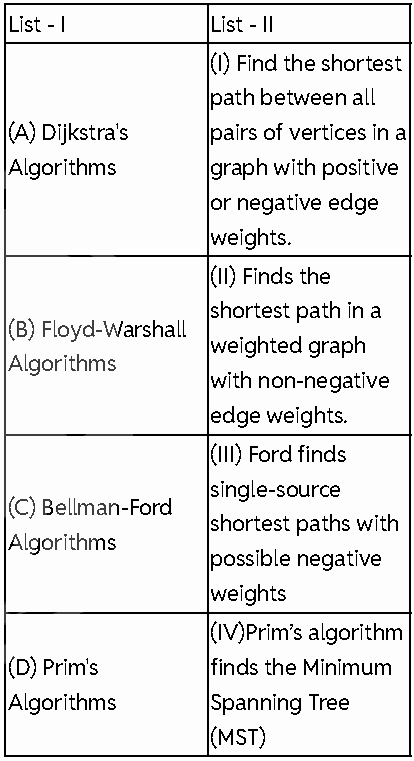
Match List - I with List - II.
Pick an option to check yourself, or open the answer below.
Show answer & explanation
Correct answer: B. (A)-(II), (B)-(I), (C)-(III), (D)-(IV)
Explanation
Dijkstra: single-source shortest paths with non-negative weights. Floyd–Warshall: all-pairs shortest paths. Bellman–Ford: single source with negative weights allowed. Prim: minimum spanning tree.
More Data Structures and Algorithms questions
- Match List I (recurrence) with List II (complexity). List I: (A) T(n) = 2T(n/2) + n, (B) T(n) = T(n/2) + 1, (C) T(n) = 2T(n/2) + 1, (D) T(n…
- Let n be the least integer such that f(x) is O(xⁿ). Arrange the following functions in increasing order of n: A. f(x) = 3x³ + (log x)⁴ B. f…
- Match List - I with List - II. f(n) = a f(n / b) + g(n) is a divide-and- conquer recurrence relation for the Listed-I algorithms, match the…
- The height of a binary search tree for the words banana, peach, apple, pear, coconut, mango and papaya using alphabetical order is :
- How much time does an algorithm using 2⁵⁰ bit operations need if each bit operation takes 2⁻³⁸ seconds?
- A lower-triangular sparse matrix is one :