
Match List I with List II
List I List II
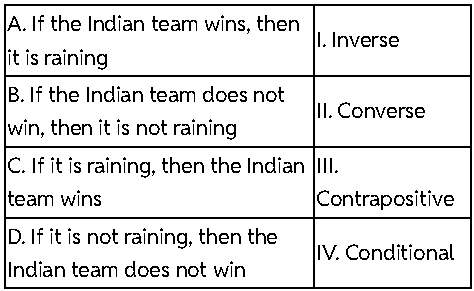
Pick an option to check yourself, or open the answer below.
Show answer & explanation
Correct answer: C. A-IV, B-I, C-II, D-III
Explanation
Take A (p → q: team wins → raining) as the conditional. B (¬p → ¬q) is its inverse, C (q → p) its converse, and D (¬q → ¬p) its contrapositive.
More Discrete Structures and Optimization questions
- Choose the correct statement for a group G :
- Which one of the following is not a basic solution of the system of linear equations x₁ + 2x₂ + x₃ = 4, 2x₁ + x₂ + 5x₃ = 5?
- Match the logically equivalent propositions. List I: A. p → q, B. ¬(p ∨ (¬p ∧ q)), C. p ↔ q, D. ¬(p ↔ q). List II: I. (p ∧ q) ∨ (¬p ∧ ¬q),…
- The probability that A hits a target is 1/4 and the probability that B hits it is 2/5. Both shoot at the target. What is the probability th…
- Arrange the following graphs in increasing order of number of edges (for n > 3): A. Kₙ (complete graph), B. Cₙ (cycle graph), C. Wₙ (wheel…
- An LPP: Minimize z = 30x − 18y subject to 3x + 4y ≤ 60, 5x − 3y ≥ 20, x, y ≥ 0. In this feasible region, the solution(s) of the LPP is/are:…