
UGC NET Paper 2 Computer Science – June 2025 – Question Paper with Answer Key
Solved by The Binary Brothers: every question has the correct answer and an explanation. Open any question for its full solution, or practise it in the unit-wise mock tests.
- 1722
- 1752
- 68880
- 6880
A. The process could issue an I/O request and then be placed in the Ready Queue
B. The process could create new subprocesses & wait for the termination of the subprocesses
C. The time slice of the process expires and it may join the waiting queue
D. The process is forcibly removed from the CPU and is put in the Waiting queue due to arrival of an interrupt
Choose the correct answer from the options given below:
- B Only
- D Only
- A and C Only
- A, C and D Only
Match List I with List II
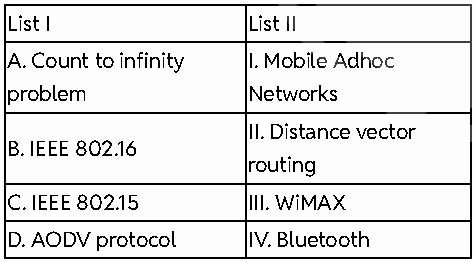
- A-II, B-III, C-I, D-IV
- A-II, B-III, C-IV, D-I
- A-II, B-IV, C-III, D-I
- A-IV, B-III, C-I, D-II
- 03 seconds
- 02 seconds
- 18 seconds
- 09 seconds
A. Agent system comprises of an agent and an environment on which it acts
B. The controller part of an agent receives percepts from its body and sends commands to the environment
C. Agents act in the world through actuators which are non-noisy and always reliable.
D. The actuators of an agent convert stimuli into percepts
Choose the correct answer from the options given below:
- A, B Only
- B, D Only
- C, D Only
- B, C, D Only
- Data exchange
- Data transformation
- Mapping
- Matching
A. Selects atoms to represent propositions
B. Ask questions about intended interpretation
C. Choose a task domain
D. Axiomatizing the domain
Choose the correct answer from the options given below:
- C → A → D → B
- C → A → B → D
- B → C → A → D
- A → C → B → D
int i, j;
for(i=1; i<5; i+=2)
  for(j=1; j<i; j+=2)
printf("%d", j);- 1
- 1 2
- 1 3
- 1 1 3
- xyz + x′yz′ + x′y′z′
- xyz′ + x′yz′ + x′y′z′
- xyz′ + xy′z + x′y′z′
- xyz + xyz′ + xy′z′
Match List I with List II
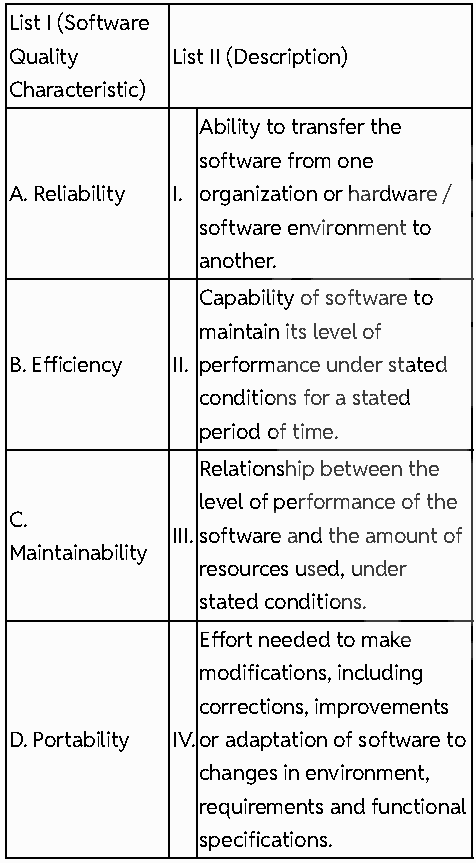
- A-II, B-III, C-I, D-IV
- A-II, B-III, C-IV, D-I
- A-III, B-II, C-I, D-IV
- A-IV, B-II, C-I, D-III
Match List I with List II

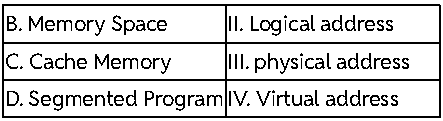
- A-IV, B-III, C-I, D-II
- A-I, B-II, C-IV, D-III
- A-III, B-IV, C-I, D-II
- A-II, B-IV, C-I, D-III
Match List I with List II
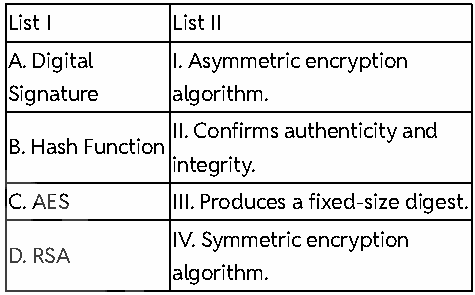
- A-II, B-III, C-I, D-IV
- A-II, B-III, C-IV, D-I
- A-III, B-II, C-I, D-IV
- A-IV, B-II, C-I, D-III
What would be the equivalent pointer expression for referring the array element ar[ m ][ n ][0]
- * (* (* (ar) +m+n)+0 )
- (* (* (*ar + m) + n) + o)
- ( * (* (ar+m)+n)+o)
- *(*(*(ar+m)+n)+0)
Which of the following Grammars is/are only Context Free?
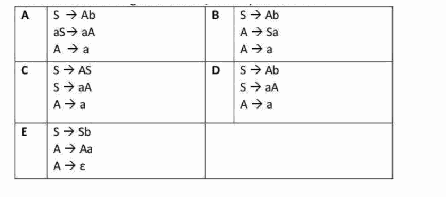
- A, B Only
- C, D Only
- C, E Only
- A, B, D, E Only
- 52100
- 13
- 28
- 52000
Match List I with List II
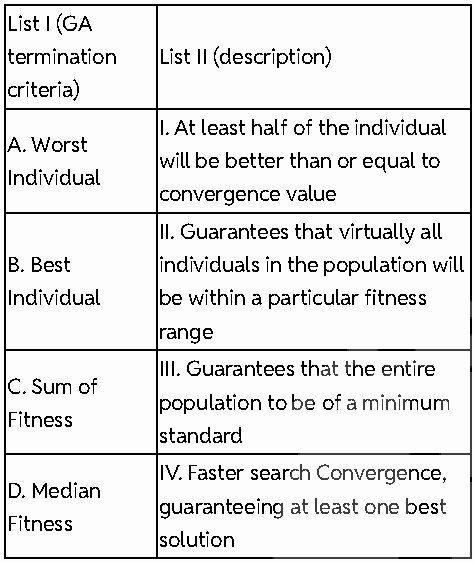
Choose the correct answer from the options given below:
- A → III, B → IV , C → II, D → I
- A → IV , B → III, C → I, D → II
- A → II, B → I, C → III, D → IV
- A → II, B → III, C → IV , D → I
Consider the following three relations Employee(eid, eName), Comp(cid, cName), Own(eid, cid). Which of the following relational algebra expressions returns the set of eids who own all brands?
- π_eid( π_eid,cid(Own) ÷ π_cid(Comp) )
- π_eid( π_eid(Own) × π_cid(Comp) )
- π_eid( π_eid,cid(Own) × π_cid(Comp) )
- π_eid( π_eid(Own) × (π_cid,Name(Own) ÷ π_cid(Comp)) )
- Software Engineering
- Software Re-Engineering
- Reverse Engineering
- Inverse Engineering
A. Logical File System
B. File Organization Module
C. Basic File System
D. I/O Control
E. Application Programs
Choose the correct answer from the options given below:
- A → B → D → C → E
- D → E → C → A → B
- E → A → B → C → D
- E → C → B → A → D
Which of the followings is NOT a software characteristic?
- Software does not wear out
- Software is flexible
- Software is not manufactured
- Software is always correct
Which of the following cohesions are better than the Procedural Cohesion
A. Functional Cohesion
B. Sequential Cohesion
C. Temporal Cohesion
D. Communicational Cohesion
E. Logical Cohesion
- A and D Only
- A, B and D Only
- C, D and E Only
- A, D and E Only
- AB + D ∗ EF ↑ −
- AB + D ∗ − ↑ EF
- AB + DE ∗ F − ↑
- AB + D ∗ EF − ↑
Which of the following trees are height balanced?
A. Binary Search Tree
B. AVL Tree
C. Red-Black Tree
D. B Tree
- A and D Only
- A, B and D Only
- C and D Only
- B, C and D Only
- 15,000 bits
- 20,000 bits
- 30,000 bits
- 60,000 bits
Which of the followings belongs to MaCall's quality factors?
A. Maintainability
B. Usability
C. Integrity
D. Functionality
- A and D Only
- A, B and D Only
- C and D Only
- A, B and C Only
A. Hypervisor installed on physical server
B. Virtual machines created
C. Resources allocated to Virtual machines
D. Virtual machines run isolated workloads
Choose the correct answer from the options given below:
- B, C, A, D
- A, B, C, D
- A, C, B, D
- B, C, D, A
- 2/5
- 3/5
- 4/5
- 1/5
Match List I with List II
List I List II
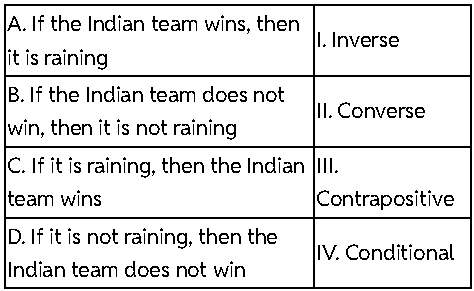
- A-II, B-I, C-IV, D-III
- A-III, B-I, C-II, D-IV
- A-IV, B-I, C-II, D-III
- A-III, B-II, C-IV, D-I
- 111000111
- 101001111
- 101000001111
- 111100001010
A. User-Mode Programs (Preemptible)
B. Bottom Half Interrupt Handlers
C. Top Half Interrupt Handlers
D. Kernel System Service Routines (Preemptible)
Choose the correct answer from the options given below:
- B → A → C → D
- C → B → A → D
- C → A → B → D
- A → D → B → C
Which of the following technique is used for Clipping?
- Stack based Seed
- Scan Line Seed
- Sutherland-Cohen
- Inverse Scaling
- E = 2.4 (KLOC)1.05 PM
- E = 3.4 (KLOC)1.06 PM
- E = 2.0 (KLOC)1.05 PM
- E = 2.4 (KLOC)1.07 PM
Consider R(A, B, C, D, E) be relation with following dependencies: C->F, E->A, EC->D, A->B. Which of the following is a key for R ?
- CD
- EC
- AE
- AC
(a) If she is intelligent, then she is unhappy.
(b) She is neither intelligent nor happy.
(c) It is necessary to be not intelligent in order to be happy.
(d) To be not intelligent is to be unhappy.
Which of the following is the correct propositional expression for the above statements?
- (a) P → ¬Q; (b) P ∧ ¬Q; (c) Q → ¬P; (d) P → ¬Q
- (a) P → Q; (b) ¬P ∧ ¬Q; (c) ¬Q → P; (d) ¬P → ¬Q
- (a) P → ¬Q; (b) ¬P ∧ ¬Q; (c) Q → ¬P; (d) ¬P → ¬Q
- (a) P → ¬Q; (b) P ∧ ¬Q; (c) Q → P; (d) ¬P → ¬Q
- 56
- 100
- 92
- 65
Consider the following table defining the sample inputs and corresponding target values for a perceptron model.
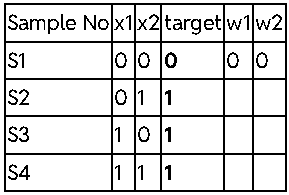
What shall be the value of updated weights after applying all the samples S 1 to S 4 (in the order S 1, S 2, S3, S4) to this model. Given that the initial weights w 1=0, w 2=0, learning rate =0.1 and no bias is involved in the perceptron. The activation function for this perceptron is given below 1, if y > 0 y_observed = { in 0, if y < 0 in
- w1=0.1, w2=0.1
- w1=0.0, w2=0.2
- w1=0.0, w2=0.1
- w1=0.2, w2=0.2
Which of the following algorithms use Greedy strategy?
A. Dijkstra's algorithm
B. Kruskal's algorithm
C. Huffman coding
D. Bellman-Ford algorithm
- A, B and D Only
- A, B and C Only
- C and D Only
- A and D Only
- Explicit
- Backpressure
- Choke
- Retransmission
Which of the following are controlled-access protocols
A. Reservation
B. Polling
C. TDMA
D. Token Passing
E. CSMA/CA
- A and D Only
- A, B and D Only
- C, D and E Only
- A, D and E Only
A. Select a pair of parents from the population
B. Apply mutation at each locus with probability pm
C. Calculate fitness of each member of the population
D. Apply crossover with probability pc to form offsprings
Choose the correct answer from the options given below describing the correct order of the above steps:
- A → C → B → D
- C → A → D → B
- C → A → B → D
- A → D → B → C
- 2,1,2,3
- 1,3,2,1
- 2,3,2,1
- 2,3,1,2,1
A. Data transformation is involved in the Data mining process.
B. Online database is used in Data warehouse.
C. Classification is a measure of accuracy.
D. K-means clustering algorithm is based on the concept of minimizing the within-cluster variance.
E. Pattern evaluation is a process to identify knowledge based on interestingness measure.
Choose the correct answer from the options given below:
- B, C, E Only
- A, D, E Only
- A, C, E Only
- A, C, D Only
Match List I with List II
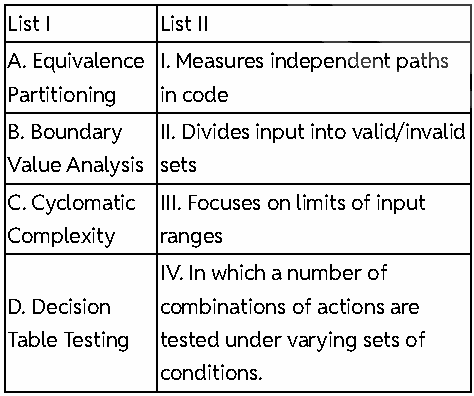
- A-II, B-III, C-I, D-IV
- A-II, B-III, C-IV, D-I
- A-III, B-II, C-I, D-IV
- A-IV, B-II, C-I, D-III
Match List I with List II
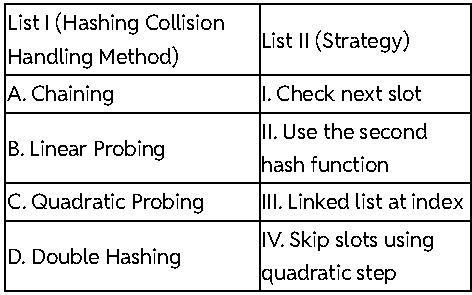
- A-II, B-III, C-I, D-IV
- A-II, B-III, C-IV, D-I
- A-III, B-I, C-IV, D-II
- A-IV, B-II, C-I, D-III
The write operation in I/O operation does the following-
- Transfer data from I/O device to memory
- Transfer data from memory to I/O device
- Transfer data from CPU register to memory
- Transfer data from CPU register to I/O device
- Radial
- Tournament
- Boltzmann
- Rank
- Complete Representation
- Linked Representation
- Circular Representation
- Sequential Representation
Match List I with List II
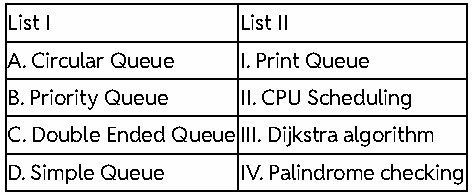
- A-II, B-III, C-I, D-IV
- A-II, B-III, C-IV, D-I
- A-III, B-II, C-I, D-IV
- A-IV, B-II, C-I, D-III
Consider the following DFA
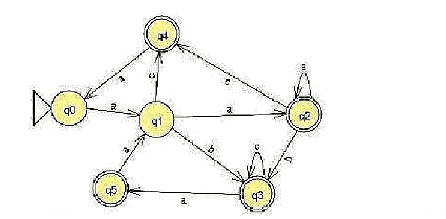
Which of the following NFA is valid for the given DFA ?
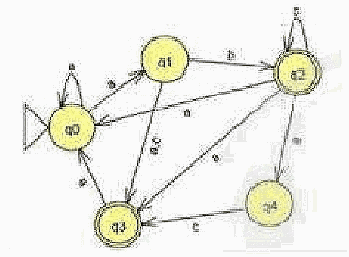
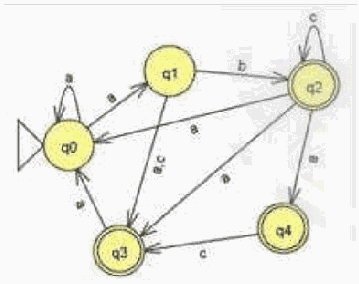
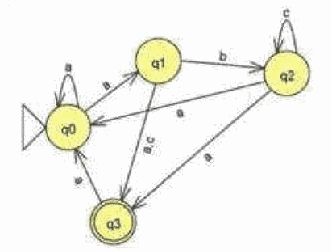
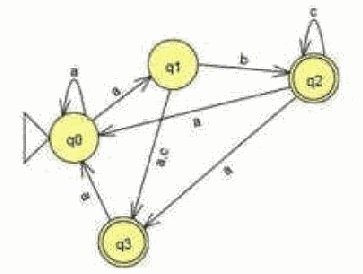
Which of the following gates do not give output 1 when both the inputs are 0 -
A. NAND gate
B. NOR gate
C. X-OR gate
D. X-NOR gate
- A, B Only
- B, C Only
- C, D Only
- C Only
- T1 is in 3NF
- T2 is in 3NF
- T1 is not in 3NF
- T1 is in 2NF
Choose the correct statement for a group G :
- If for all x, y ∈ G, (xy)² = x²y², then G is commutative.
- If for all x ∈ G, x³ = 1, then G is commutative (1 is the identity of G).
- If for all x ∈ G, x⁵ = 1, then G is commutative (1 is the identity of G).
- If G is commutative, a subgroup of G need not be commutative.
int x=128, y=110;
do
{
  if(x>y)
    x=x-y;
  else
    y=y-x;
} while(x!=y);
printf("%d",x);
Which one will be the output?- 18
- 2
- 92
- 74
A. DNS resolution
B. HTTP request sent
C. URL entered in the browser
D. IP address obtained
E. Webpage displayed
Choose the correct answer from the options given below:
- B, A, C, E, D
- C, B, A, E, D
- B, C, D, A, E
- C, A, D, B, E
Match List I with List II
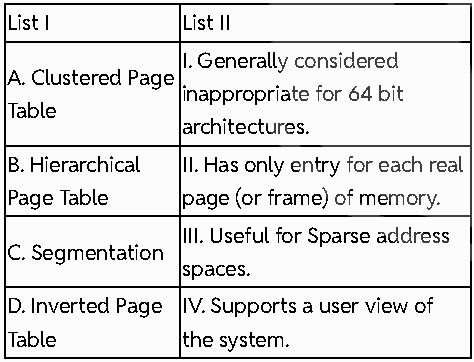
Choose the correct answer from the options given below:
- A → III, B → IV , C → II, D → I
- A → III, B → I, C → IV , D → II
- A → II, B → III, C → I, D → IV
- A → IV , B → III, C → II, D → I
Match List I with List II
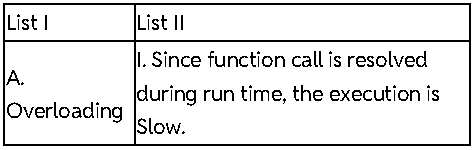
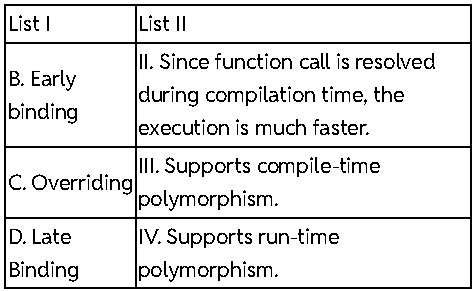
- A-III, B-II, C-I, D-IV
- A-IV, B-II, C-III, D-I
- A-III, B-II, C-IV, D-I
- A-IV, B-I, C-III, D-II
A. The name refers to busy waiting semaphores.
B. They are not useful when the locks are to be held for a short duration of time.
C. It may require multiple context switches when a process waits on a lock.
D. They are often employed on Uniprocessor systems.
Choose the correct answer from the options given below:
- A Only
- D Only
- B, D Only
- A, C and D Only
A. The number of tags decreases and users can define their own tags.
B. It is used for Presentation.
C. It is case sensitive.
D. It is dynamic.
Which of the above statements are true?
- B, C, D Only
- A, B, D Only
- A, C, D Only
- B, D Only
Match List I with List II
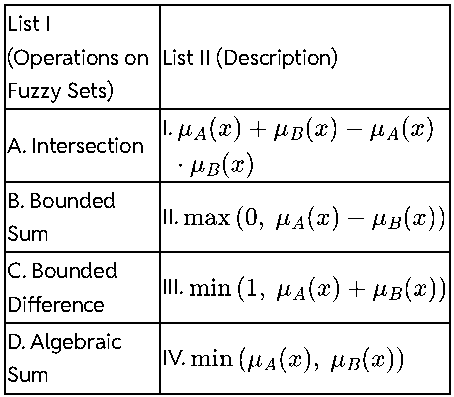
Choose the correct answer from the options given below:
- A → III, B → I, C → II, D → IV
- A → III, B → II, C → IV , D → I
- A → IV , B → III, C → II, D → I
- A → II, B → I, C → III, D → IV
Which of the following is not the characteristics of packet switching?
- Data is broken into packets
- Each packet may take a different rout
- Requires a dedicated path
- Supports dynamic routing
- 1.024 sec
- 1.00 sec
- 0.512 sec
- 12 sec
Match List I with List II
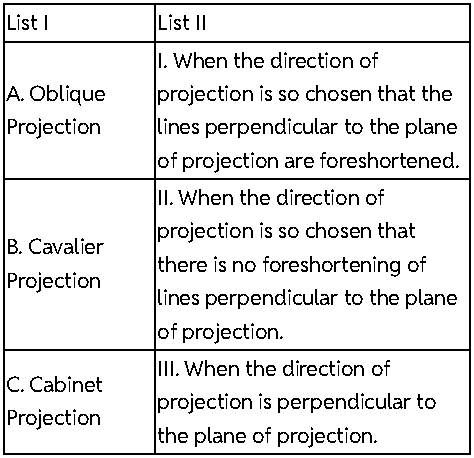
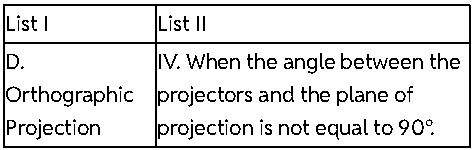
- A-III, B-II, C-IV, D-I
- A-IV, B-II, C-I, D-III
- A-III, B-I, C-IV, D-II
- A-IV, B-I, C-III, D-II
Match List I with List II
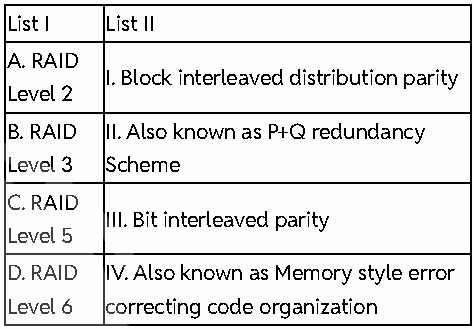
Choose the correct answer from the options given below:
- A → IV , B → III, C → I, D → II
- A → III, B → IV , C → I, D → II
- A → I, B → III, C → IV , D → II
- A → II, B → IV , C → I, D → III
void main()
{
  int *i, a=12, b=2, c;
  c = (a=a+b, b=a/b, a=a*b, b=a-b);
  i = &c;
  printf("%d", --(*i));
}- 91
- 90
- 98
- 92
- Interviews
- The use case approach
- Facilitated Application Specification Technique (FAST)
- Data Flow diagram
Consider the following table about processes, their burst time and arrival time
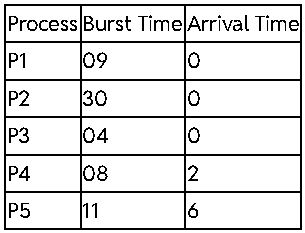
Now which of the process shall finish second last as per the respective GANTT charts for the nonpreemptive SJF and Round Robin (time quantum =10 ) scheduling methods.
- SJF: P4; RR: P4
- SJF: P5; RR: P4
- SJF: P4; RR: P3
- SJF: P5; RR: P5
Only legal pointer operations: →
A. pointer + number pointer →
B. pointer - number number →
C. pointer + pointer pointer →
D. pointer - pointer pointer →
E. pointer - pointer number
- A, B, C Only
- A, B, D Only
- A, B Only
- A, E Only
A. Common Coupling
B. Stamp Coupling
C. Control Coupling
D. External Coupling
E. Content Coupling
Choose the correct answer from the options given below:
- E, A, C, B, D
- D, B, A, E, C
- B, C, D, A, E
- C, A, B, D, E
In a relational database, which one of the following is CORRECT:
- A relation with only two attributes is always in BCNF.
- If all attributes of a relation are prime attributes then the relation in BCNF
- Every relation has at least one non-prime attribute.
- BCNF decomposition preserves functional dependencies.
Which of the following statement is correct for Pthreads?
- It refers to POSIX standard (IEEE 1002.1c)
- This standard defines API for thread creation only
- This is a specification only for thread behavior and not its implementation
- Operating systems like Solaris, Linux Mac OS X, except Tru64 UNIX, implement Pthreads
A. &&
B. +=
C. >>
D. >=
E. ?:
Choose the correct order of precedence of the operators given above (higher to lower):
- C, D, E, B, A
- C, A, D, E, B
- C, D, A, E, B
- D, C, A, B, E
A. Calculate the effective address
B. Fetch the instruction from memory
C. Decode the instruction
D. Fetch the operands from the memory
E. Execute the instruction
Choose the correct answer from the options given below:
- A, B, C, D, E
- B, A, D, A, E
- B, C, A, D, E
- C, B, A, D, E
Which of the followings is not a valid property R˜ S ˜ over two fuzzy relations and which must be λ obeyed for performing -cut defuzzifications?
- (R̃ ∪ S̃)λ = R̃λ ∪ S̃λ
- (R̃ ∩ S̃)λ = R̃λ ∩ S̃λ
- (complement of R̃)λ ≠ complement of R̃λ, except when λ = 1
- For any λ ≤ β, where 0 ≤ β ≤ 1, it is true that R̃β ⊆ R̃λ
Consider the following DFA that generates set of Σ = {a, b, c} strings over
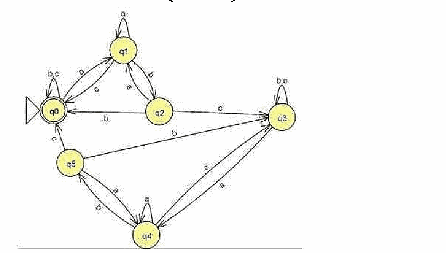
Now identify that which of the followings is the best description of the language for the above DFA
- L = (a* + b* + c*)⁺
- L = (a + b + c)* (abc)⁺ (a + b + c)*
- L = { strings starting with a, b or c but ending with c }
- L = { strings having an even count (including 0) of the substring 'abc' }
Match List I with List II. List I: A. Type 3 Grammar, B. Type 2 Grammar, C. Type 1 Grammar, D. Type 0 Grammar. List II: I. V → (V ∪ Σ)*; II. λVβ → λ(V ∪ Σ)*β, where λ, β ∈ (V ∪ Σ)*; III. (V ∪ Σ)* → (V ∪ Σ)*; IV. V → VΣ | Σ
- A → II, B → III, C → IV, D → I
- A → III, B → I, C → IV, D → II
- A → IV, B → I, C → II, D → III
- A → III, B → II, C → I, D → IV
A. A non-serial schedule is said to be conflict serializable if it is conflict-equivalent to some serial schedule.
B. A non-serial schedule is said to be view serializable if it is view-equivalent to some serial schedule.
C. A schedule is said to be serial if instructions of participating transactions are chronologically interleaved with each other.
D. A conflict-serializable schedule will be view-serializable also but vice-versa may not be true.
Choose the correct answer from the options given below:
- A, B, C, D
- A, B, C Only
- A, B, D Only
- B, C, D Only
A. In symmetric key cryptography, the secrecy/protection of the key generating function must be of higher level than the decrypting function.
B. The DES technique works by taking a 64 bit chunk value and 56 bit key over a series of transformations.
C. The Twofish symmetric block algorithm works on variable key length of up to 196 bits over a block of 128 bits.
D. RC4 is the most commonly used stream cipher that encrypts & decrypts a stream of bits/bytes instead of blocks.
Choose the correct answer from the options given below:
- B, C Only
- A, D Only
- A, C Only
- B, D Only
Which of the following statements are true ?
A. In the write-through policy, only the cache is updated
B. In the write-back policy, both cache and main memory are updated
C. Cache coherence problems exist in multiprocessors with private caches because of the need to share writable data
D. Cache coherence problem can be solved by means of hardware-only scheme
Choose the correct answer from the options given below:
- A, B Only
- B, C Only
- C, D Only
- A, B, C Only η
Given that refers to learning rate and x refers i ith to the input to the neuron, Which of the followings most suitably describes the weight updation rule of a Kohonen SOM? (where ' j ' jth refers to the neuron in the lattice)
- w_ij(new) = (1 − η)·w_ij(old) + η·x_i
- w_ii(new) = η·w_ii(old) + (1 − η)·x_i
- w_ij(new) = (1 − η)·w_ij(old) + x_i
- w_ij(new) = w_ij(old) + η·x_i
A. STRIPS is a Feature-centric representation
B. The features describing the state of the world are divided into Primitive and Derived
C. The STRIPS representation of an action comprises Precondition and Effect
D. STRIPS can directly define conditional effects.
Choose the correct answer from the options given below:
- A, C Only
- B, C Only
- A, D Only
- B, C, D Only
- Θ(√n)
- Θ(n log n)
- Θ(√n log n)
- Θ(n log √n)
A. Construct an optimal solution from computed information.
B. Recursively define the value of an optimal solution.
C. Characterize the structure of an optimal solution.
D. Compute the value of an optimal solution, typically in a bottom-up fashion.
Choose the correct answer from the options given below:
- B, C, A, D
- B, A, C, D
- C, B, A, D
- C, B, D, A
Which of the following are examples of data encoding schemes?
A. Non-Return to Zero (NRZ)
B. Manchester Encoding
C. Amplitude Modulation
D. Hamming code
E. Bipolar AMI
- A, C and D Only
- A, B and D Only
- C, D and E Only
- A, B and E Only
A. Integration testing
B. Unit testing
C. System Testing
D. Acceptance Testing
Choose the correct answer from the options given below:
- B, C, A, D
- B, A, C, D
- C, B, A, D
- C, B, D, A
A. Repeat until root formed
B. Create leaf nodes
C. Build priority queue
D. Combine lowest frequency nodes
Choose the correct answer from the options given below:
- B, C, A, D
- D, B, A, C
- B, C, D, A
- C, A, B, D
(A) If n ≠ 1, then m < mn.
(B) If k is composite, then k = mn where 1 < m, n > k.
(C) If mn = 1, then m = 1 and n = 1.
(D) If k is composite, then k = mn where 1 < m, n < k.
Which of the following is correct?
- (A), (C), (D)
- (B), (C), (D)
- (A), (B)
- (A), (B), (C)
Arrange the following parsers in increasing order of their power of handling grammars i.e. from the least powerful parser to the most powerful parser.
A. LR (0)
B. LR (1)
C. LALR(1)
D. LL (0)
E. SLR
- LL(0) → LR(0) → SLR → LR(1) → LALR(1)
- SLR → LR(0) → LL(0) → LR(1) → LALR(1)
- LL(0) → LR(0) → SLR → LALR(1) → LR(1)
- LR(0) → LL(0) → SLR → LR(1) → LALR(1)
A. Read status register
B. Check flag bit
C. Read data register
D. Transfer data to memory
Choose the correct answer from the options given below:
- A, B, C, D
- B, A, C, D
- C, B, A, D
- A, C, B, D
The right sequence of suboperations that are performed in arithmetic pipeline is-
A. Align the mantissas
B. Add or subtract the mantissas
C. Normalize the result
D. Compare the exponents
Choose the correct answer from the options given below:
- D, A, B, C
- D, B, A, C
- B, C, A, D
- B, C, D, A Directions (91-95) Read the following passage and answer the given questions. Consider the following Three Address code sample for solving the questions : 100:t1=y+2 101 : initial = x/t1 102: limit = 10 103: if i >j goto 105 104 : goto 111 105: if num > b goto 107 106: goto 111 107: num = limit-1 108:b=y+2 109: i = i - num 110: goto 103 111: j= i - num 112:k=j+b
Directions (Q91–95): Consider the following Three Address Code sample for solving the questions:
100: t1 = y + 2
101: initial = x / t1
102: limit = 10
103: if i > j goto 105
104: goto 111
105: if num > b goto 107
106: goto 111
107: num = limit - 1
108: b = y + 2
109: i = i - num
110: goto 103
111: j = i - num
112: k = j + b
- 100, 102, 103, 104, 105, 107, 110
- 100, 103, 105, 107, 111, 112
- 100, 103, 105, 106, 107, 111
- 100, 103, 104, 105, 106, 107, 111
Directions (Q91–95): Consider the following three-address code.
100: t1 = y + 2
101: initial = x / t1
102: limit = 10
103: if i > j goto 105
104: goto 111
105: if num > b goto 107
106: goto 111
107: num = limit − 1
108: b = y + 2
109: i = i − num
110: goto 103
111: j = i − num
112: k = j + b
Which of the following is the Optimized version for the given TAC in the passage
- 100:t1 =y+2 101 : initial = x/t1 102: limit = 10 103: if i >j goto 105 104 : goto 111 105: if num > b goto }10 106: goto 111 107:b=y+2 108: i=i - limit-1 109: goto 103 110:k=i+b
- 100:t1=y+2 101 : initial = x/t1 102: limit = 10 103: if i >j goto 105 104: if num < b goto }11 105: num = limit-1 106:b = t1 107: i=i -num 108: goto 103 109:k=i+b
- 100: t1 = y + 2 101: limit = 10 102: num = 9 103: b = t1 104: if i > j goto 106 105: goto 110 106: if num > b goto 108 107: goto 110 108: i = i - num 109: goto 104 110: j = i - num 111: k = j + b
- 100:t1=y+2 101 : initial = x/t1 102: limit = 10 103: if i >j goto 105 104 : goto 111 105: if num < b goto 111 106: num = limit-1 107:b=t1 108: i=i -num 109 : goto 103 110:k= i+b
t1 = y+2;
init = x/t1;
limit = 10;
if (i>j || num>b)
{
  num = limit-1;
  b = y+2;
  i = i-num;
}
j = i-num;
k = k+b;
init = x/(y+2); limit = 10; while (i>j || num>b) { num = limit-1; b = y+2; i = i-num; } j = i-num; k = k+b;init = x/(y+2); limit = 10; if (i>j) { while (num>b) num = limit-1; } else { b = y+2; i = i-num; } j = i-num; k = k+b;init = x/(y+2); limit = 10; while (i>j && num>b) { num = limit-1; b = y+2; i = i-num; } j = i-num; k = k+b;
What all blocks does Block 3 and Block 5 dominate in the Flow graph for the TAC given in the passage?
- Block 3:3 ; Block 5:5
- Block 3: 3,4,5,6; Block 5: 5,6
- Block 3: 3,7; Block 5: 5,7
- Block 3: 3,4,7; Block 5: 5,6,7
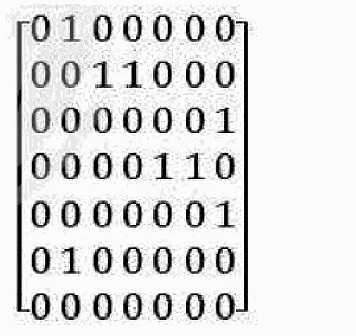
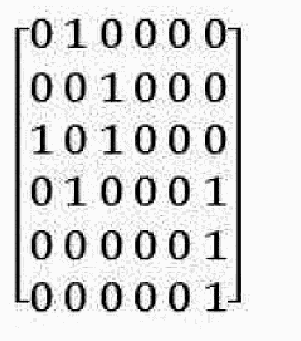
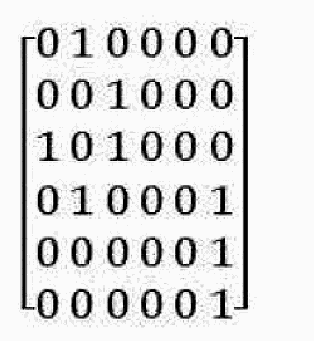
Which of the followings is the correct Flow graph for the TAC given in the passage?
Directions (Q96–100): Consider the following disk queue with requests for I/O to blocks on cylinders:
45, 81, 185, 33, 175, 99, 150, 77
(Consider that the head starts from location 58.)
- 81
- 45
- 77
- 33
- 327
- 307
- 525
- 385
- 81
- 15
- 33
- 175
- 160
- 124
- 177
- 240
- 536
- 594
- 647
- 700
Answer key
- 1 – C
- 2 – D
- 3 – B
- 4 – B
- 5 – A
- 6 – C
- 7 – A
- 8 – A
- 9 – D
- 10 – B
- 11 – A
- 12 – B
- 13 – D
- 14 – B
- 15 – A
- 16 – A
- 17 – A
- 18 – C
- 19 – C
- 20 – D
- 21 – B
- 22 – D
- 23 – D
- 24 – C
- 25 – D
- 26 – B
- 27 – B
- 28 – C
- 29 – C
- 30 – D
- 31 – C
- 32 – A
- 33 – B
- 34 – C
- 35 – B
- 36 – A
- 37 – B
- 38 – C
- 39 – B
- 40 – B
- 41 – C
- 42 – B
- 43 – A
- 44 – B
- 45 – C
- 46 – B
- 47 – A
- 48 – D
- 49 – B
- 50 – D
- 51 – D
- 52 – C
- 53 – A
- 54 – B
- 55 – D
- 56 – B
- 57 – C
- 58 – A
- 59 – C
- 60 – C
- 61 – C
- 62 – A
- 63 – B
- 64 – A
- 65 – B
- 66 – D
- 67 – D
- 68 – D
- 69 – C
- 70 – A
- 71 – C
- 72 – C
- 73 – C
- 74 – C
- 75 – D
- 76 – C
- 77 – C
- 78 – D
- 79 – C
- 80 – A
- 81 – B
- 82 – C
- 83 – D
- 84 – D
- 85 – B
- 86 – C
- 87 – A
- 88 – C
- 89 – A
- 90 – A
- 91 – D
- 92 – C
- 93 – D
- 94 – A
- 95 – A
- 96 – A
- 97 – D
- 98 – C
- 99 – C
- 100 – C