
Directions (Q91–95): Consider the following three-address code.
100: t1 = y + 2
101: initial = x / t1
102: limit = 10
103: if i > j goto 105
104: goto 111
105: if num > b goto 107
106: goto 111
107: num = limit − 1
108: b = y + 2
109: i = i − num
110: goto 103
111: j = i − num
112: k = j + b
Which of the followings is the correct Flow graph for the TAC given in the passage?
Pick an option to check yourself, or open the answer below.
Show answer & explanation
Correct answer: A. 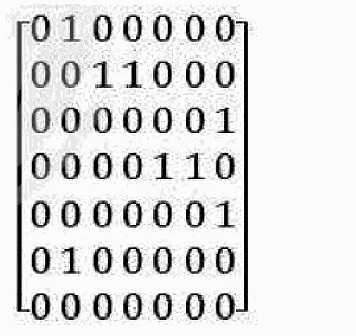
Explanation
Edges: B1→B2; B2→B3, B4; B3→B7; B4→B5, B6; B5→B7; B6→B2; B7 has none. As a 7×7 adjacency matrix the rows are 0100000, 0011000, 0000001, 0000110, 0000001, 0100000, 0000000 — option A.
More Theory of Computation and Compilers questions
- Match the LIST-I with LIST-II
- Match List I with List II. List I: A. Type-0 grammar, B. Type-1 grammar, C. Type-2 grammar, D. Type-3 grammar. List II: I. Linear grammar;…
- For the above mentioned passage which of the following is correct?
- Which of the following represented the minimum state DFA for the above specified passage?
- For the above specified passage, which of the following is DFA for the language represented/accepeted by machine?
- For the above specified passage, which of the following represents the regular expression?