
UGC NET Paper 2 Computer Science – December 2024 – Question Paper with Answer Key
Solved by The Binary Brothers: every question has the correct answer and an explanation. Open any question for its full solution, or practice it in the unit-wise mock tests.
A. Start
B. Develop Prototype
C. Deliver to customer
D. Quick Design
E. Quick Plan
Choose the correct answer from the options given below:
- A, B, C, D, E
- A, E, D, B, C
- A, B, D, E, C
- A, B, E, D, C
Consider the conditional statement if (m == 20 − 10 || n > 10). The order of execution of the following operations is: A. == B. − C. || D. >
- D, B, A, C
- B, D, C, A
- B, D, A, C
- A, B, D, C
A. ALOHA is used for multiple access on a shared medium
B. TDMA uses WALSH TABLES for time slot allocation
C. CSMA/CD was invented for wireless networks
D. CDMA codes are sequences of numbers generated by orthogonal codes
Choose the correct answer from the options given below:
- A & B only
- B & C only
- C & D only
- A & D only
Which of the following are key features of Mobile Adhoc Networks (MANETs)
A. Self - Organizing and decentralized.
B. High Mobility of nodes.
C. Requires fixed Infrastructure for operation.
D. Network Topology is dynamic and constantly changing.
E. It requires a central controller to manage network traffic.
- A, B & E only
- B, C, D & E only
- A, B & D only
- A, B & C only
- The values of the global variables which are sent to the called function may be changed inadvertently by the called function.
- Functions are supposed to be independent and isolated modules. This character is lost if they use global variables.
- It is not immediately apparent to the reader which values are being sent to the called function.
- A function that uses global variables does not suffer from reusability.
In Software Engineering Jackson's Principle based on
A. Designation
B. Definitions
C. Refutable Assertions
D. Formal Review
E. Requirement Elicitation
- A, B & C Only
- B, C & D Only
- C, D & E Only
- B, D & C Only
Which one of the following is not a basic solution of the system of linear equations x₁ + 2x₂ + x₃ = 4, 2x₁ + x₂ + 5x₃ = 5?
- x₁ = −1, x₂ = 2, x₃ = 1
- x₁ = 2, x₂ = 1
- x₁ = 5, x₃ = −1
- x₂ = 5/3, x₃ = 2/3
Match List I (software risk) with List II: A. Predictable risk, B. Business risk, C. Project risk, D. Past risk. List II: I. Strategic risk, II. Staffing and organization, III. Implementation, IV. Past project experience.
- A-IV, B-III, C-I, D-II
- A-III, B-II, C-I, D-IV
- A-I, B-IV, C-III, D-II
- A-IV, B-I, C-II, D-III
Stage A: Consists of two CSAs and it merges four numbers from the previous stage.
Stage B: Is a CPA, which adds up the two numbers.
Stage C: Is made up of two levels of four CSAs.
Stage D: Generates eight partial products.
Choose the correct answer from the options given below:
- C, A, B, D
- D, C, A, B
- B, D, C, A
- A, C, D, B
A. Physical Design
B. Conceptual Design
C. Logical Design
D. Requirement collection and analysis
Choose the correct answer from the options given below:
- D, A, B, C
- D, B, C, A
- D, B, A, C
- D, A, C, B
An alternate key in database table is also called
- Primary key
- Candidate key
- Super key
- Foreign key
- Hit Ratio
- Latency
- Cache Traces
- Transfer Rate
- E = [LOC × B0.222 / P]2 × (1/t4)
- E = [LOC × B0.333 / P]3 × (1/t4)
- E = [LOC × B0.444 / P]4 × (1/t3)
- E = [LOC × B0.111 / P]6 × (1/t3)
Match the logically equivalent propositions. List I: A. p → q, B. ¬(p ∨ (¬p ∧ q)), C. p ↔ q, D. ¬(p ↔ q). List II: I. (p ∧ q) ∨ (¬p ∧ ¬q), II. ¬p ∨ q, III. ¬(p ∨ q), IV. ¬p ↔ q.
- A-I, B-III, C-II, D-IV
- A-I, B-II, C-III, D-IV
- A-II, B-III, C-I, D-IV
- A-II, B-III, C-IV, D-I
Match List I with List II. List I: A. Decision Tree, B. Supervised Learning, C. Artificial Neural Network, D. Instance Based Learning. List II: I. Delta Learning Rule, II. Self Organizing Map, III. C4.5 Algorithm, IV. Non-linear Regression Algorithm.
- A-I, B-II, C-III, D-IV
- A-II, B-III, C-IV, D-I
- A-III, B-IV, C-I, D-II
- A-IV, B-I, C-II, D-III
- 2500 bps
- 10000 bps
- 5000 bps
- 20000 bps
A. Solid State Drive
B. Optical Disks
C. DRAMs
D. SRAMs
E. Registers
Choose the correct answer from the options given below:
- D, C, A, B, E
- B, D, C, A, E
- A, E, B, D, C
- E, D, C, A, B
- It is a property used to prove that languages are not regular
- It applies only to infinite regular languages
- It applies to all context-free languages
- It applies to all recursively enumerable languages
- A′B′C′ + A′B′C + A′BC + ABC
- A′B′ + A′BC + ABC
- A′B′ + BC
- A′B′ + BC′
Arrange the 2-D viewing transformation pipeline.
A. Convert world-coordinates to viewing coordinates
B. Map viewing coordinates to normalized viewing coordinates using window - viewpoint specifications
C. Construct world - coordinates scene using modeling - coordinates transformations
D. Map normalized viewpoint to device coordinates
Choose the correct answer from the options given below:
- D, C, B, A
- D, C, A, B
- C, A, B, D
- B, C, A, D 1
The probability that A hits a target is 1/4 and the probability that B hits it is 2/5. Both shoot at the target. What is the probability that at least one of them hits it?
- 3/5
- 11/9
- 2/20
- 11/20
Match List I with List II. List I: A. IMAP, B. ARP, C. POP, D. TELNET. List II: I. A protocol that allows email clients to retrieve emails from a mail server; II. Used for remote login to another computer over a network; III. A protocol that maps IP addresses to MAC addresses on a LAN; IV. A protocol that allows accessing email on the server without downloading them.
- A-II, B-I, C-III, D-IV
- A-III, B-IV, C-I, D-II
- A-IV, B-III, C-I, D-II
- A-IV, B-III, C-II, D-I
- Reservation Table
- Confusion Table
- Inverted Table
- Greedy Table
In concurrency control, phantom problem may occur, when-
- records are inserted
- records are deleted
- records are modified
- records are indexed
A. A problem which is NP-Complete will have the property that it can be solved in polynomial time iff all other NP-complete problems can also be solved in polynomial time.
B. All NP-complete problems are NP-hard problems.
C. If an NP-hard problem can be solved in polynomial time, then all NP-complete problems can be solved in polynomial time.
D. All NP-hard problems are not NP-complete.
Choose the correct answer from the options given below:
- A, C only
- B, D only
- A, B, C only
- A, B, C, D
Consider the following Graph of disk scheduling and identify the disk scheduling algorithm representing by this graph. Queue 84, 125, 11, 36, 170, 20, 172, 45
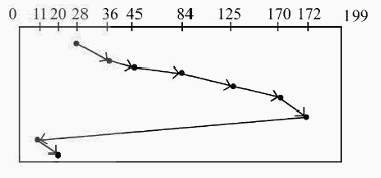
- SSTF
- SCAN
- C-SCAN
- C-LOOK
- Observability
- Controllability
- Repairability
- Understandability
- 500 bits
- 1000 bits
- 1500 bits
- 2000 bits
Considering the binary tree shown (A has children B and C; C has children D and E; E has right child F; F has children G and H), what will be the inorder traversal?
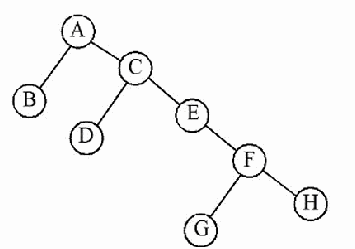
- BADCEGFH
- GHFEDCBA
- BACDEGFH
- GHFDEBCA
A. Algebraic Simplification
B. Use of machine idioms
C. Redundant-instruction elimination
D. Flow of control optimization
E. Improved target code
Choose the correct answer from the options given below:
- A, C, B, D, E
- B, C, D, A, E
- C, D, A, B, E
- D, B, A, C, E
A. Sender moves the window to the next set of frames.
B. Sender sends a window of frames.
C. Receiver acknowledges the received frames.
D. If acknowledgment is not received, sender retransmits the frame.
Choose the correct answer from the options given below:
- B, A, C, D
- B, C, D, A
- B, D, C, A
- B, C, A, D
- Queues
- Stacks
- Priority Queues
- Deques
A. An all-key relation is always in BCNF since it has no FDs.
B. A relation that is not in 4NF due to a nontrivial MVD must be decomposed to convert it into a set of relations in 4NF.
C. The decomposition removes the redundancy caused by the MVD.
D. 3NF is stronger than BCNF.
Choose the correct answer from the options given below:
- A only
- A, B only
- D only
- C only
A. INSERT
B. DELETE
C. UPDATE
D. SELECT
Choose the correct answer from the options given below:
- A, B, D only
- A, C, D only
- B, C, D only
- A, B, C only
- stack frame
- stack base
- stack limit
- stack record
δ(q0, a) = (q1, x, R)
δ(q1, a) = (q1, a, R)
δ(q1, y) = (q1, y, R)
δ(q1, b) = (q2, y, L)
δ(q2, y) = (q2, y, L)
δ(q2, a) = (q2, a, L)
δ(q2, x) = (q0, x, R)
δ(q0, y) = (q3, y, R)
δ(q3, y) = (q3, y, R)
δ(q3, □) = (qf, □, R)
- L = {aⁿbⁿ | n ≥ 0}
- L = {aⁿbⁿ | n ≥ 1}
- L = {aⁿbⁿ | n > 0}
- L = {aⁿbⁿ | n > 1}
Correct the order of instruction cycle:
A. Read the effective address
B. Fetch the information
C. Execute the instruction
D. Decode the instruction
- A, B, C, D
- B, D, A, C
- B, A, D, C
- A, B, D, C
Identify the correct statements from the following regarding spiral model.
A. Spiral model is an incremental process model.
B. Spiral model is a risk - driven process mode.
C. Spiral model is an acyclic balancing approach.
D. Spiral model involves a set of anchor point milestone.
Choose the correct answer from the options given below:
- A & B Only
- B & C Only
- A & D Only
- B & D Only x y
- y²xy²x⁴
- yxy²x³
- yx⁶y⁶x³
- x⁴y²x²y
Match the LIST-I with LIST-II
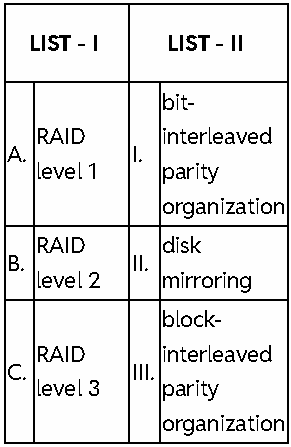
RAID ECC
D. IV. level 4 organization
- A-II, B-I, C-IV, D-III
- A-II, B-IV, C-I, D-III
- A-III, B-IV, C-I, D-II
- A-IV, B-III, C-II, D-I
Which of the following are correct for the neural network?
A. The training time depends upon the size of network.
B. Neural network can be simulated on the conventional computer.
C. Neural network mimic the same way as that of the humans brain.
D. A neural network include feedback.
- A and B only
- A, C and D only
- A, B and C only
- A and C only
Match the LIST-I with LIST-II
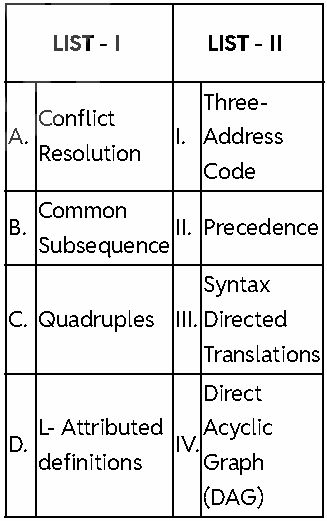
- A-III, B-II, C-IV, D-I
- A-II, B-IV, C-I, D-III
- A-II, B-III, C-I, D-IV
- A-IV,B-I, C-II, D-III
A. Ask questions about the intended interpretation.
B. Choose the task domain or world to represent.
C. Select atoms to represent propositions of interest.
D. Tell the system propositions that are true in the intended interpretation (axiomatizing the domain).
Choose the correct answer from the options given below:
- A, B, C, D
- B, C, D, A
- C, D, A, B
- D, A, B, C
- α ⊨ β
- α ⊆ β
- β ⊨ α
- β ⊆ α
Match the LIST-I with LIST-II
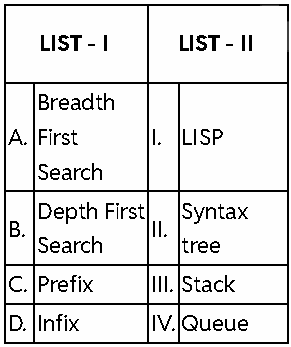
- A-III, B-IV, C-I, D-II
- A-III, B-IV, C-II, D-I
- A-IV, B-II, C-III, D-I
- A-IV, B-III, C-I, D-II
- 1024
- 2048
- 3072
- 4096
Collaborative document inspection technique used for?
- Requirement Validation Process
- Requirement Verification Process
- Integration Testing
- Blackbox Testing
A. Constant
B. Domain
C. Predicate
D. Temporal
E. Function
Choose the correct answer from the options given below:
- B, D only
- A, B, C only
- A, C, E only
- C, D only
int x = 10, y = 15;
x = ((x == y) ? (y + x) : (y - x));
What will be the value of x after executing these statements?
- 5
- 25
- 15
- 30
The major adverse side effects of scan conversion are ;-
A. Staircase appearance
B. Unequal brightness of slanted lines
C. Picket fence problem
D. Rasterization
E. Pre-filtering and Post-filtering
- A & B only
- A, B & C only
- B, C & D only
- C, D & E only
The primary function of firewall in network security is
- To monitor network traffic and detect anomalies.
- To create virtual private networks for secure communication.
- To filter incoming and outgoing network traffic based on security rules
- To encrypt data before Transmission.
Match List I (functions) with List II (uses). List I: A. fseek(), B. ftell(), C. feof(), D. rewind(). List II: I. Gives the current position in the file; II. Sets the position to the beginning of the file; III. Sets the position to a desired point in the file; IV. Used to test for an end-of-file condition.
- A-II, B-III, C-I, D-IV
- A-III, B-I, C-IV, D-II
- A-III, B-I, C-II, D-IV
- A-II, B-IV, C-III, D-I
- Dimension table
- Fact table
- Lookup table
- Primary table
A. add a single tuple to a relation
B. add multiple tuples to a relation
C. add values to specific attributes
D. insert a new table
Choose the correct answer from the options given below:
- A only
- A, B only
- A, B, C only
- B, C, D only
Match List I with List II. List I: A. Type-0 grammar, B. Type-1 grammar, C. Type-2 grammar, D. Type-3 grammar. List II: I. Linear grammar; II. GNF; III. x → y, |x| ≤ |y|, x, y ∈ (V ∪ T)*; IV. Recursively enumerable.
- A-I, B-II, C-III, D-IV
- A-II, B-I, C-III, D-IV
- A-III, B-II, C-IV, D-I
- A-IV, B-III, C-I, D-II
Which one of the following is not the part of requirement management?
- Features Traceability Table
- Dependency Traceability Table
- Interface Traceability Table
- Page Traceability Table
Arrange the following graphs in increasing order of number of edges (for n > 3): A. Kₙ (complete graph), B. Cₙ (cycle graph), C. Wₙ (wheel graph), D. Kₙ,ₙ (complete bipartite graph), E. Qₙ (n-cube graph).
- A, B, C, D, E
- B, C, A, D, E
- A, B, C, E, D
- E, D, C, A, B
- A′B + CD′
- (A′ + B)(C + D′)
- (A + B′)(C′ + D)
- AB′ + CD′
A. Save contents of processor registers
B. Turn the interrupt facility on
C. Service the device whose flag is set
D. Check which flag is set
E. Restore contents of processor registers
Choose the correct answer from the options given below:
- A, B, C, D, E
- D, B, C, A, E
- D, C, B, E, A
- A, D, C, E, B
Match the LIST-I with LIST-II
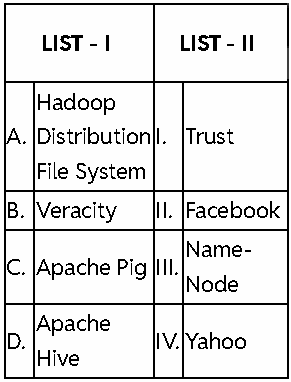
- A-IV, B-III, C-I, D-II
- A-III, B-I, C-II, D-IV
- A-III, B-I, C-IV, D-II
- A-II, B-III, C-I, D-IV
An LPP: Minimize z = 30x − 18y subject to 3x + 4y ≤ 60, 5x − 3y ≥ 20, x, y ≥ 0. In this feasible region, the solution(s) of the LPP is/are: A. (4, 0) B. (2, 0) C. (7, 5) D. (0, 15) E. (8, 5)
- A and C only
- B only
- E only
- D only
- Binary Search
- Merge Sort
- Quick Sort
- Heap Sort
Which of the following statement is not True?
- A data member of a class can be declared as static and is normally used to maintain values common to the entire class.
- A friend function can be invoked like a normal function without the help of any object.
- The scope resolution operator (::) can be overloaded like normal operators
- Multiple inheritance may lead to duplication of inherited members from a "Grandparent" base class. This may be avoided by making the common base class a virtual base class.
The degree of a relation in database is
- the number of tuples in the relation
- the number of attribute in the relation
- the number of values in domian
- the number of keys in a relation
A. S → ABC | AB, A → a, B → b, C → d
B. X → RT | TR, T → t, R → XT | r
C. P → qP | sQ, Q → r | s
D. M → MN | MP, N → nm | n, P → p
Choose the correct answer from the options given below:
- A & B only
- B only
- C only
- B & D only
A. Visit the left subtree
B. Visit the root node
C. Visit the right subtree
D. Start traversing by visiting the nodes in the rooted tree
E. Repeat the above three steps.
Choose the correct answer from the options given below:
- A, B, C, D, E
- E, A, B, C, D
- D, A, B, C, E
- D, A, E, B, C
Match the LIST-I with LIST-II
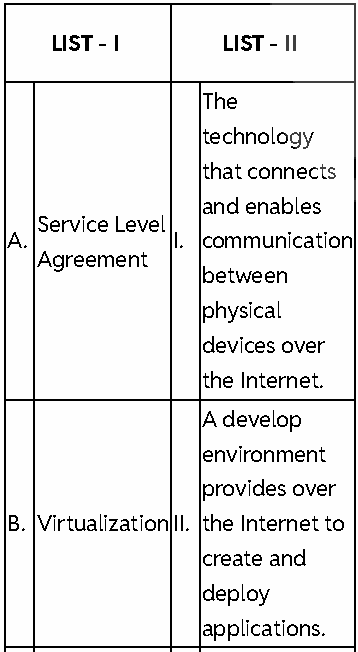
C. Internet of III. Contracts that Things specify performance standards and services availability. A method allowing multiple Platform as a
D. IV. operating service system to run on a single physical server.
- A-III, B-II, C-I, D-IV
- A-III, B-IV, C-I, D-II
- A-III, B-I, C-IV, D- I
- A-I, B-IV, C-III, D-II
Which of the following Graph is/are planer?
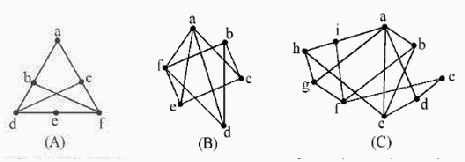
Choose the most appropriate answer from the options given below:
- A and C only
- B only
- A only
- A and B only
A. In connection-oriented service, the destination address is to be specified only during the setup.
B. Packet sequencing is not guaranteed in connection-oriented service.
C. Flooding is a method in which every incoming packet is sent out on every outgoing line except the one by which it arrived.
D. The presentation layer performs detection and recovery from errors in the transmitted data.
Choose the correct answer from the options given below:
- A, B & C only
- B, C & D only
- A & C only
- A, C & D only
Which of the following algorithms are based on the Breadth First Search (BFS) ?
A. Prim's algorithms
B. Kruskal algorithms
C. Dijkstra algorithms
D. Greedy algorithms
E. Dynamic Programming
- A & B only
- A, C & D only
- D & E only
- A & C only
Which of the following is the solution of the recurrence T(n) = T(2n/3) + 1?
- Θ(n²)
- Θ(log n)
- Θ(n log n)
- Θ(n^(3/2))
Which of the following is not a component of the classic Planning Definition?
- Init
- Domain
- Action
- Goal y
- Predictive Parser
- SLR Parser
- CLR Parser
- LALR Parser
- Machine Learning
- Deep Learning
- Artificial Intelligence
- Neural Network
- Device
- Timer
- Scheduler
- Power Failure
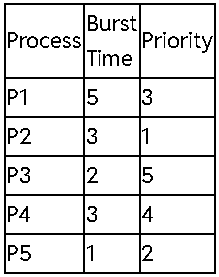
Given the following processes with their times and priority (lower number indicates higher priority)
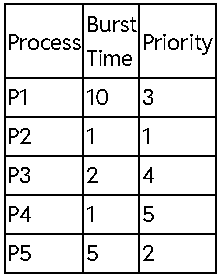
Which of the following is a value of average waiting time using priority scheduling algorithm?
- 9.2
- 6.8
- 7.6
- 8.2
Match List I with List II. List I: A. Project Join Normal Form, B. The lost update problem, C. Discretionary Access Control, D. Data Manipulation Language. List II: I. Concurrency, II. Fifth Normal Form, III. SQL, IV. Security.
- A-II, B-I, C-IV, D-III
- A-I, B-II, C-IV, D-III
- A-I, B-II, C-III, D-IV
- A-IV, B-II, C-III, D-I
Match List I (law) with List II (axiom). List I: A. Absorption law, B. Bounded law, C. Identity law, D. Distributive law. List II: I. a + 1 = 1; II. a + 0 = a; III. a·(b + c) = (a·b) + (a·c); IV. a + (a·b) = a.
- A-IV, B-I, C-II, D-III
- A-IV, B-III, C-I, D-II
- A-III, B-IV, C-II, D-I
- A-II, B-III, C-IV, D-I
- Fluorescence
- Phosphorescence
- Persistence
- Retracing
A. Red-Black Tree – guarantees worst case O(log n) time for search, insert & delete.
B. Trie – used for efficient prefix-based searches.
C. AVL Tree – self-balancing binary search tree with stricter balance criteria.
D. B-Tree – allows efficient search, insert, delete operations in disk-based systems.
Choose the correct answer from the options given below:
- A & B only
- C & D only
- B only
- A, B, C & D
Match List I with List II. List I: A. (100110011)₂, B. Complements, C. Parity bits, D. Variable-length instruction. List II: I. Error detection code; II. CISC; III. Negative number; IV. (133)₁₆.
- A-IV, B-I, C-III, D-II
- A-IV, B-III, C-I, D-II
- A-IV, B-II, C-III, D-I
- A-I, B-IV, C-II, D-III
Which of the following are not data manipulation instructions? A. Call B. Load C. And D. Increment E. Shift
- C & E only
- A & B only
- D & E only
- A & C only
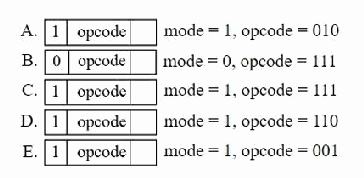
Which of the following do not represent memory-reference instructions? A. mode = 1, opcode = 010 B. mode = 0, opcode = 111 C. mode = 1, opcode = 111 D. mode = 1, opcode = 110 E. mode = 1, opcode = 001
- B & C only
- B & D only
- A & D only
- A & E only
Which one of the following is not related to the feed forward networks on the Backpropagation Algorithm
- Boolean function
- Continuous function
- Arbitrary function
- Greedy function
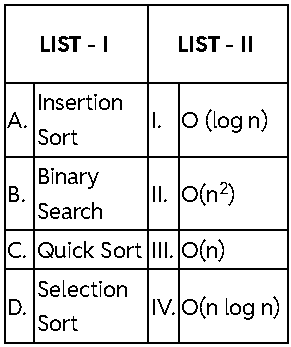
Match the LIST-I with LIST-II
- A-III, B-I, C-IV, D-II
- A-II, B-III, C-I, D-IV
- A-I, B-II, C-IV, D-III
- A-II, B-III, C-IV, D-I
A. Initial
B. Repeatable
C. Managed
D. Optimizing
E. Defined
Choose the correct answer from the options given below:
- A, B, C, D, E
- A, B, E, C, D
- A, E, C, D, B
- A, E, B, C, D
A. DHCP ACK
B. DHCP DISCOVER
C. DHCP OFFER
D. DHCP REQUEST
E. Client receives IP configuration
Choose the correct answer from the options given below:
- A, B, C, D, E
- B, C, D, A, E
- C, B, A, E, D
- D, A, E, C, B
Which of the following statements about sets are true? A. 0 ∈ ∅ B. ∅ ∈ {0} C. ∅ ∈ {∅} D. {∅} ∈ {∅} E. {∅} ⊂ {∅, {∅}}
- A, B, C, D and E
- A, B, C and E only
- A, C only
- C and E only
The characteristics of modern programming are :
A. Each module should do only one thing.
B. Communication between modules is allowed only by a calling module.
C. Communication can take place directly between modules that do not have calling - called relationship.
D. All modules are designed as single-entry, single exit systems using control structure.
- A, B & C only
- A, B & D only
- A, C & D only
- C & D only Directions (91-95) Read the following passage and answer the given questions. Q A machine is represented by states , input ∑ o^ q alphabet , transition function . Initial state 0 and final state F. The machine accepts all the ∑ = {a, b} strings over , which start and ended abb with any combination of all alphabet and works/lies as substring in all the strings to be accepted.
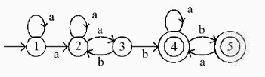
Directions (Q91–95): A machine is represented by states Q, input alphabet Σ = {a, b}, a transition function δ, initial state q0 and final states F. It accepts all strings over Σ that contain abb as a substring, with any combination of a and b before and after it.
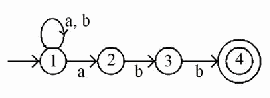
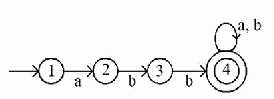
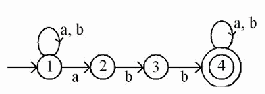
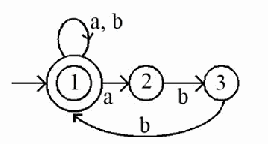
Directions (Q91–95): A machine is represented by states Q, input alphabet Σ, transition function δ, initial state q0 and final states F. The machine accepts all strings over Σ = {a, b} which start and end with any combination of the alphabet symbols, and in which abb occurs as a substring (i.e. the language of all strings over {a, b} containing abb).
- S → AabbB, A → aA | ε, B → bB | ε
- S → abbA, A → aA | ε | bA
- S → AabbA, A → aA | bA | ε
- S → Aabb, A → aA | bA | ε
Which of the following represented the minimum state DFA for the above specified passage?
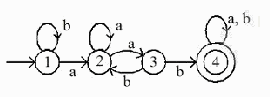
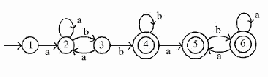
- All are NFA
For the above specified passage, which of the following is DFA for the language represented/accepeted by machine?
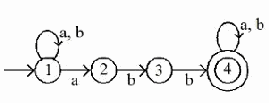
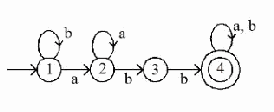
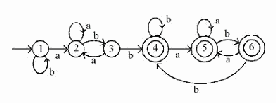
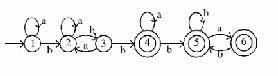
For the above specified passage, which of the following represents the regular expression?
- (a + b)* aab
- aba (a + b)*
- b (a + b)* b (a + b)* a (a + b)*
- (a + b)* abb (a + b)*
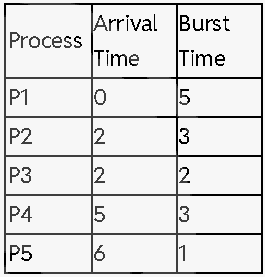
Directions (Q96–100): Processes with arrival time and CPU burst (ms): P1 (arrival 0, burst 5), P2 (2, 3), P3 (2, 2), P4 (5, 3), P5 (6, 1).
Calculate the average response time for these processes with nonpreemptive priority Scheduling algorithm? Priority of the process are as follows and consider that all the processes came at zero (0) time. (Note low numbers represent high priority).
- 5.6 ms
- 5.2 ms
- 4.7 ms
- 3.8 ms
Directions (Q96–100): Consider the following set of processes with arrival time and CPU burst time given in milliseconds (ms):
| Process | Arrival Time | Burst Time |
|---|---|---|
| P1 | 0 | 5 |
| P2 | 2 | 3 |
| P3 | 2 | 2 |
| P4 | 5 | 3 |
| P5 | 6 | 1 |
- 3.2 ms
- 2.834 ms
- 1.632 ms
- 6.721 ms
- 5.3 ms
- 6.4 ms
- 7.0 ms
- 8.2 ms
- 3.0 ms
- 2.1 ms
- 4.6 ms
- 3.2 ms
- Round Robin
- Priority
- Highest Response Ratio Next
- Least Completed Next
Answer key
- 1 – B
- 2 – C
- 3 – D
- 4 – C
- 5 – D
- 6 – A
- 7 – A
- 8 – D
- 9 – B
- 10 – B
- 11 – B
- 12 – A
- 13 – B
- 14 – C
- 15 – C
- 16 – B
- 17 – B
- 18 – D
- 19 – A
- 20 – C
- 21 – C
- 22 – D
- 23 – C
- 24 – A
- 25 – A
- 26 – D
- 27 – D
- 28 – C
- 29 – B
- 30 – A
- 31 – C
- 32 – D
- 33 – D
- 34 – C
- 35 – D
- 36 – A
- 37 – B
- 38 – B
- 39 – D
- 40 – B
- 41 – B
- 42 – B
- 43 – B
- 44 – B
- 45 – A
- 46 – D
- 47 – B
- 48 – A
- 49 – C
- 50 – A
- 51 – B
- 52 – C
- 53 – B
- 54 – B
- 55 – C
- 56 – D
- 57 – D
- 58 – B
- 59 – C
- 60 – D
- 61 – C
- 62 – A
- 63 – D
- 64 – C
- 65 – B
- 66 – B
- 67 – C
- 68 – B
- 69 – D
- 70 – C
- 71 – D
- 72 – B
- 73 – B
- 74 – D
- 75 – C
- 76 – C
- 77 – D
- 78 – A
- 79 – A
- 80 – A
- 81 – D
- 82 – B
- 83 – B
- 84 – A
- 85 – D
- 86 – A
- 87 – B
- 88 – B
- 89 – D
- 90 – B
- 91 – C
- 92 – C
- 93 – B
- 94 – C
- 95 – D
- 96 – A
- 97 – B
- 98 – C
- 99 – D
- 100 – C