
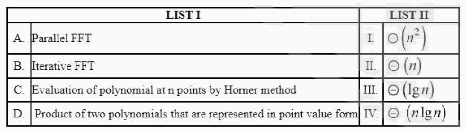
Match List I with List II. List I: A. Parallel FFT, B. Iterative FFT, C. Evaluation of a polynomial at n points by Horner's method, D. Product of two polynomials represented in point-value form. List II: I. Θ(n²), II. Θ(n), III. Θ(lg n), IV. Θ(n lg n).
Pick an option to check yourself, or open the answer below.
Show answer & explanation
Correct answer: C. A-III B-IV C-I D-II
Explanation
A parallel FFT circuit has depth Θ(lg n); the iterative FFT takes Θ(n lg n); Horner takes Θ(n) per point, so Θ(n²) for n points; multiplying in point-value form is pointwise, Θ(n).
More Data Structures and Algorithms questions
- Let f(n) and g(n) be asymptotically positive functions. Statement I: f(n) ≥ 1 and f(n) = O(g(n)) ⇒ g(n) = Ω(f(n)). Statement II: f(n) = O(g…
- A. If some NP-complete problem P is in 𝒫, then 𝒫 = 𝒩𝒫. B. TSP is in 𝒩𝒫. C. SAT is in 𝒩𝒫. D. The Hamiltonian circuit problem is not NP-compl…
- Suppose a circular queue of capacity n-1 elements is implemented with an array of n elements. Assume that the insertion and deletion operat…
- Given below are two statements: one is labelled as Assertion A and the other is labelled as Reason R. Assertion A: The AVL trees are more b…
- Consider a hash table of size seven with starting (6x + 3) mod 4 index zero and a hash function . Assuming the hash table is initially empt…
- Match List I with List II