
UGC NET Paper 2 Computer Science – June 2023 – Question Paper with Answer Key
Solved by The Binary Brothers: every question has the correct answer and an explanation. Open any question for its full solution, or practise it in the unit-wise mock tests.
Given below are two statements: one is labeled as Assertion A and the other is labeled as Reason R.
Assertion A: Validity checks the real need of system users
Reason R: Completeness checks system user- defined requirements. In light of the above statements, choose the correct answer from the options given below.
- Both A and R are true and R is the correct explanation of A
- Both A and R are true but R is NOT the correct explanation of A
- A is true but R is false
- A is false but R is true
A. The MAX-HEAPIFY procedure, which runs in O(lg n) time, is the key to maintaining the max-heap property.
B. The BUILD-MAX-HEAP procedure, which runs in O(lg n) time, produces a max-heap from an unordered input array.
C. The MAX-HEAP-INSERT procedure, which runs in O(lg n) time, implements the insertion operation.
D. The HEAP-INCREASE-KEY procedure runs in O(n lg n) time to set the key of a new node to its correct value.
Choose the correct answer from the options given below:
- A, B only
- A, C only
- B, D only
- A, B, C, D
- {1, 4}
- {2, 6}
- {3, 4, 5}
- {1}
- 1
- 2
- 3
- 4
Match List I with List II. List I: A. PERT, B. Optimistic time, C. CPM, D. Pessimistic time. List II: I. Used for non-repetitive jobs, II. Used for repetitive jobs, III. The shortest possible time to complete the activity if all goes well, IV. The longest time that an activity takes.

- A-III B-IV C-II D-I
- A-IV B-I C-II D-III
- A-I B-III C-II D-II
- A-I B-III C-II D-IV
- Budgeted cost of work performed − budget at completion
- Budgeted cost of work performed ÷ budget at completion
- Budgeted cost of work performed ÷ Actual cost of work performed
- Budgeted cost of work performed − Actual cost of work performed
- Software specification
- Software design
- Software evaluation
- Software validation
A TCP server application is programmed to listen on port P on host S . A TCP client is connected to the TCP server over the network, Consider that while TCP connection is active the server is crashed and rebooted. Assume that the client does not use TCP keepalive timer. Which of the following behaviour/s is/are possible?
Statement I: The TCP application server on S can listen on P after reboot.
Statement II: If client sends a packet after the server reboot, it will receive the RST segment. In the light of the above statements, choose the correct answer from the options given below.
- Both Statement I and Statement II are true
- Both Statement I and Statement II are false
- Statement I is true but Statement II is false
- Statement I is false but Statement II is true
Given below are two statements: one is labelled as Assertion A and the other is labelled as
Reason R.
Assertion A: I/O protection is ensured by a hardware trap
Reason R: I/O interrupt caused by the condition like I/O completion and device malfunction occuring within the I/O devices In the light of the above statements, choose the correct answer from the options given below.
- Both A and R are true and R is the correct explanation of A
- Both A and R are true but R is NOT the correct explanation of A
- A is true but R is false
- A is false but R is true
Match List I with List II. List I: A. Parallel FFT, B. Iterative FFT, C. Evaluation of a polynomial at n points by Horner's method, D. Product of two polynomials represented in point-value form. List II: I. Θ(n²), II. Θ(n), III. Θ(lg n), IV. Θ(n lg n).
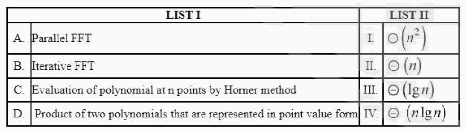
- A-III B-I C-II D-III
- A-II B-I C-III D-IV
- A-III B-IV C-I D-II
- A-II B-III C-IV D-I
Match List I with List II. List I: A. Bezier curves, B. B-splines, C. Sweep representations, D. Natural objects. List II: I. 3D objects that have translational/rotational symmetry, II. Fractal geometry, III. Bias and tension, IV. Painting, drawing, CAD.
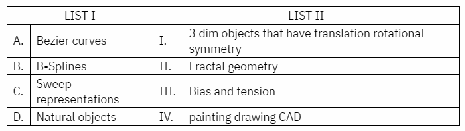
- A-IV B-I C-III D-II
- A-II B-III C-IV D-I
- A-IV B-III C-I D-II
- A-II B-IV C-I D-III
Let f(n) and g(n) be asymptotically positive functions. Statement I: f(n) ≥ 1 and f(n) = O(g(n)) ⇒ g(n) = Ω(f(n)). Statement II: f(n) = O(g(n)) ⇒ lg(f(n)) = O(lg(g(n))), where lg(g(n)) ≥ 1 and f(n) ≥ 1 for all sufficiently large n. Choose the most appropriate answer.
- Both Statement I and Statement II are correct
- Both Statement I and Statement II are incorrect
- Statement I is correct but Statement II is incorrect
- Statement I is incorrect but Statement II is correct
Consider the following statements:
S1: LRU page replacement algorithm suffers from the belady's anomaly
S2: Shortest remaining time first scheduling may cause starvations
S3: Stack is shared by all threads in a process
- S1 S2 and S3 are true
- S1, S3 false and S2 is true
- S1, S2 are false and S3 is true
- S1,S2 and S3 are false
- (F × N) + P
- (F + P) × N
- F × N × P
- F + P/N
Match List I with List II. List I: A. Scenario testing, B. Regression testing, C. Component testing, D. Beta testing. List II: I. To verify the I/O behaviour of a text object, II. User acceptance methodology, III. No new bugs after changes in the program, IV. The documentation of a use case.
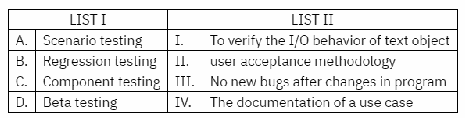
- A-IV B-III C-II D-I
- A-II B-I C-III D-IV
- A-IV B-III C-I D-II
- A-III B-I C-IV D-II P
A. If some NP-complete problem P is in 𝒫, then 𝒫 = 𝒩𝒫. B. TSP is in 𝒩𝒫. C. SAT is in 𝒩𝒫. D. The Hamiltonian circuit problem is not NP-complete. Which are correct?
- A, B and C only
- B, C and D only
- C, D and A only
- D, A and B only
- 5
- 4
- 3
- 2
Suppose a circular queue of capacity n-1 elements is implemented with an array of n elements. Assume that the insertion and deletion operations are carried out using REAR and FRONT as array index variable respectively. Initially, REAR = FRONT =0. The conditions to detect queue empty and queue full are
- EMPTY: REAR == FRONT FULL: ( REAR +1 ) mod n == FRONT
- EMPTY: ( FRONT +1) mod n==REAR FULL: (REAR+1) mod n ==FRONT
- EMPTY: ( REAR+1) mod n==FRONT FULL: REAR == FRONT
- EMPTY: REAR == FRONT FULL: ( FRONT +1 ) mod n == REAR
Statement I: At the interaction level, components provide an operator display interface and an interface with the communication system used.
Statement II: At the I/O management level, components handle operator authentication, report generator and query manager.
- Both Statement I and Statement II are correct
- Both Statement I and Statement II are incorrect
- Statement I is correct but Statement II is incorrect
- Statement I is incorrect but Statement II is correct
Given below are two statements: one is labelled as Assertion A and the other is labelled as
Reason R .
Assertion A: A process involves a library function to create a thread.
Reason R: The threads make system calls to convey their resource and I/O requirement to the Kernel. In the light of the above statements, choose the correct answer from the options given below.
- Both A and R are true and R is the correct explanation of A
- Both A and R are true but R is NOT the correct explanation of A
- A is true but R is false
- A is false but R is true
Given below are two statements: one is labelled as Assertion A and the other is labelled as
Reason R.
Assertion A: The AVL trees are more balanced as compared to Red Black trees, but they may cause more rotations during insertion and deletion
Reason R: A Red Black tree with n nodes has 2 log (n + 1) height that is greater than 2 and the AVL tree with n nodes has height less than – log (√5(n + 2)) − 2( Φ Φ where is golden ratio) In the light of the above statements, choose the correct answer from the options given below.
- Both A and R are correct and R is the correct explanation of A
- Both A and R are correct and R is NOT the correct explanation of A
- A is true but R is false
- A is false but R is true
Match List I with List II
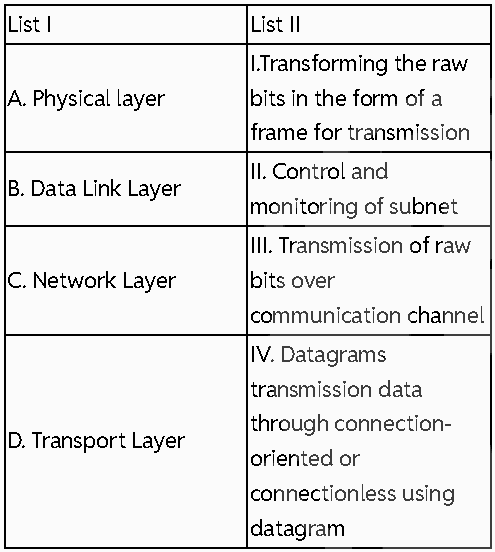
- A-III B-II C-I D-IV
- A-II B-III C-I D-IV
- A-III B-I C-II D-IV
- A-II B-IV C-I D-III R = {x, x ∈ N, x
Let R = {x ∈ N : x is a multiple of 3 and x ≤ 100} and S = {x ∈ N : x is a multiple of 5 and x < 100}. What is the number of elements in (R ∩ S) × (S ∩ R)?
- 36
- 33
- 20
- 6 R(A, B, C, D)
Let R(A, B, C, D) be a relational schema with dependencies A → B, B → C, C → D and D → B. The decomposition of R into (A, B), (B, C), (B, D):
- gives a lossless join, and is dependency preserving
- gives lossless join, but is not dependency preserving
- does not give a lossless join, but is dependency preserving
- does not give a lossless join and is not dependency preserving
Consider the following finite automata F1 that accepts a language L
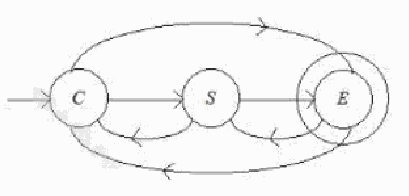
Let F2 be a finite automata which is obtained by reversal of F1. Then which of the following is correct?
- L(F1) ≠ L(F2)
- L(F1) = L(F2)
- L(F1) ≤ L(F2)
- L(F1) ≥ L(F2)
Given below are two statements: Which of the following statement/s is/are correct with respect to virtual memory
Statement I: Address translation is performed for every logical address used during the execution of a program
Statement II: A program can execute only when all of its components are loaded in the memory In the light of the above statements, choose the most appropriate answer from the options given below.
- Both Statement I and Statement II are correct
- Both Statement I and Statement II are incorrect
- Statement I is correct but Statement II is incorrect
- Statement I is incorrect but Statement II is correct
- mn(m + n − 2)
- ½ mn(m + n − 2)
- ½ mn(m + n − 1)
- mn(m + n − 1)
Given below are two statements:
Statement I: Fuzzifier is a part of a fuzzy system
Statement II: Inference engine is a part of fuzzy system In the light of the above statements, choose the most appropriate answer from the options given below.
- Both Statement I and Statement II are correct
- Both Statement I and Statement II are incorrect
- Statement I is correct but Statement II is incorrect
- Statement I is incorrect but Statement II is correct
A. A database design is in BCNF if each member of the set of relation schemas that constitutes the design is in BCNF.
B. A BCNF schema can have a transitive dependency.
C. It is always possible to obtain a 3NF design without sacrificing a lossless join.
D. There are multivalued dependencies in 4NF.
Choose the correct answer from the options given below:
- A, B and C only
- B, C and D only
- A, B and D only
- A, C and D only
- Presentation adequacy
- Inferential adequacy
- Inferential efficiency
- Acquisitional efficiency
#include <stdio.h>
int main() {
  int a, b, c;
  a = 0x10; b = 010;
  c = a + b;
  printf("%d", c);
  return 0;
}- 20
- 24
- Garbage
- Error
What is the 4+4 bit binary fixed-point equivalent of −(3.72)₁₀?
- 0011.1100
- 0011.1010
- 1100.0100
- 0011.1011
- Symmetric only
- Reflexive only
- Transitive only
- An equivalence relation
S → AB
A → CD
B → e
C → a
D → b
- 8
- 7
- 4
- 5
Let ⊕ denote XOR, and 1 and 0 the binary constants. F(P, Q) = ((1 ⊕ P) ⊕ (P ⊕ Q)) ⊕ ((P ⊕ Q) ⊕ (Q ⊕ 0)). Which of the following is equivalent to F?
- P ⊕ Q
- P + Q
- (P + Q)′
- (P ⊕ Q)′
Which of the following scenario may lead to an irrecoverable error in a database system?
- A transaction writes a data item after it is read by an uncommitted transaction
- A transaction reads a data item after it is read by an uncommitted transaction
- A transaction reads a data item after it is written by a committed transactions
- A transaction reads a data item after it is written by an uncommitted transaction.
- Requirement specification
- Structural specification
- Ethnography
- Natural language specification
Given below are two statements: one is labelled as Assertion A and the other is labelled as
Reason R . A virtual memory system uses first-in first-out page replacement policy and allocates a fixed number of frames to a process
Assertion A: Increasing number of page frames allocated to a process sometimes increases the page fault rate.
Reason R: Some programs do not exhibit locality of reference. In the light of the above statements, choose the correct answer from the options given below.
- Both A and R are true and R is the correct explanation of A
- Both A and R are true but R is NOT the correct explanation of A
- A is true but R is false
- A is false but R is true
Match List I with List II
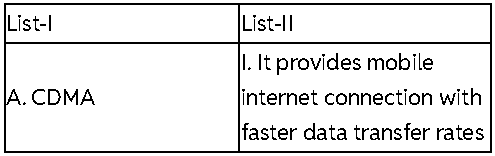
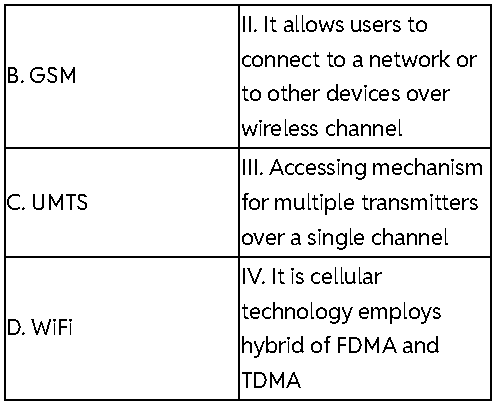
- A-III B-IV C-II D-I
- A-III B-IV C-I D-II
- A-II B-III C-IV D-I
- A-II B-I C-IV D-III
- Context free but not linear
- Not context free
- Context free and linear
- Linear
- Random resetting
- Scramble
- Inversion
- Difference
Consider three processes: P0 (arrival 0 ms, burst 7 ms), P1 (arrival 1 ms, burst 3 ms), P2 (arrival 2 ms, burst 7 ms). Pre-emptive shortest job first scheduling is used, and scheduling happens only at arrival or completion of a process. What is the average waiting time?
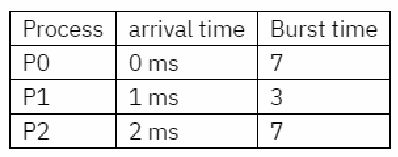
- 3 ms
- 3.67 ms
- 4.47 ms
- 4 ms
- Morphological analysis
- Semantic analysis
- Pragmatic analysis
- Meaning analysis
Consider a hash table of size seven with starting (6x + 3) mod 4 index zero and a hash function . Assuming the hash table is initially empty. Which of the following is the content of the table when 1, 3, 8, 10, 5 the sequence , is inserted into the table using closed hashing? Here "__ " denotes an empty location in the table.
- 1,3,8,10,5_,_
- 3,8,1,_,10_,5
- _3,8,1,_,10,5
- _1,3,8,10,5_ C + +
- &A[0][0][0] + w(b·c·s + c·r + t)
- &A[0][0][0] + w(b·c·r + c·s + t)
- &A[0][0][0] + w(a·b·r + c·s + t)
- &A[0][0][0] + w(a·b·s + c·r + t)
Match List I with List II. List I: A. RAID level 2, B. RAID level 4, C. RAID level 5, D. RAID level 3. List II: I. Bit-interleaved parity, II. Block-interleaved distributed parity, III. Error-correcting parity, IV. Block-interleaved parity.
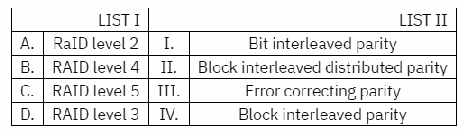
- A-IV B-III C-I D-II
- A-III B-IV C-II D-I
- A-III B-I C-II D-IV
- A-I B-III C-IV D-I
Match List I with List II. List I: A. Expert system, B. Fuzzy system, C. Operator in genetic algorithm, D. Supervised technique. List II: I. Decision tree, II. Scramble, III. Inference engine, IV. Mycin.
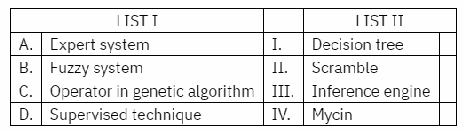
- A-IV B-I C-III D-II
- A-III B-IV C-II D-I
- A-IV B-III C-II D-I
- A-I B-II C-III D-IV
A. A context-free language is generated by an LR(0) grammar if and only if it is accepted by a deterministic pushdown automaton and has the prefix property.
B. If M1 is a single-tape TM simulating a multitape TM M, then the time taken by M1 to simulate n moves is O(n³).
C. A pushdown automaton behaves like a Turing machine when it has one auxiliary memory.
D. L = {aⁿbⁿcⁿ : n ≥ 1} is not context-free but is context-sensitive.
Choose the correct answer from the options given below:
- A, B and C only
- A, B only
- D only
- B, C only
- 8 megabits per second
- 4 megabits per second
- 6 megabits per second
- 2 megabits per second
How many integral solutions are there to x + y + z + w = 29, where x ≥ 1, y ≥ 2, z ≥ 3 and w ≥ 0?
- 2400
- 2600
- 2800
- 3000 R(A, B, C, D, F)
- CD
- EC
- AE
- AC
main() {
  struct s1 { char *z; int i; struct s1 *p; };
  static struct s1 a[] = {
    {"Nagpur", 1, a+1},
    {"Raipur", 2, a+2},
    {"Kanpur", 3, a}
  };
  struct s1 *ptr = a;
  printf("%s %s %s\n", a[0].z, ptr->z, a[2].p->z);
}- Nagpur Raipur Kanpur
- Nagpur Nagpur Nagpur
- Kanpur Kanpur Kanpur
- Error
- Atomicity
- Consistency
- Isolation
- Deadlock-freedom
Match List I with List II. List I: A. Critical region, B. Wait/signal, C. Working set, D. Deadlock. List II: I. Hoare's monitor, II. Mutual exclusion, III. Principle of locality, IV. Circular wait.
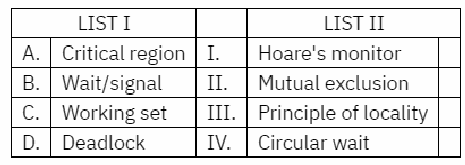
- A-IV B-I C-III D-II
- A-II B-I C-III D-IV
- A-I B-II C-III D-IV
- A-IV B-III C-I D-II
Consider two hosts P and Q that are connected through a router R. The maximum transfer unit (MTU) value of the link between P and R is 1500 bytes and between R and Q is 820 bytes. A TCP segment of size 1400 bytes is transferred from P to Q through R with IP identification value of 0 × 1234 . Assume that IP header size is 20 bytes. Further the pcaket is allowed to be fragmented that is Don't fragment (DF) flag in the IP Header is not set by P. Which of the following statement/s is/are true?
A. Two fragments are created at R and IP datagram size carrying the second fragment is 620 bytes
B. If the second fragment is lost, then R resends the fragment with IP identification value of 0 × 1234
C. If the second fragment lost, then P requires to resend the entire TCP segment.
D. TCP destination port can be determined by analyzing the second fragment only.
- A, B and C only
- A and C only
- C and D only
- B and D only
Given below are two statements: one is labelled as Assertion A and the other is labelled as
Reason R.
Assertion A: Dendral is an expert system
Reason R: The rationality of an agent is not related to its reaction to the environment. In the light of the above statements, choose the correct answer from the options given below.
- Both A and R are true and R is the correct explanation of A
- Both A and R are true but R is NOT the correct explanation of A
- A is true but R is false
- A is false but R is true
- e⁻¹⁵
- e⁻⁵
- 1 − e⁻⁵
- 1 − e⁻¹⁰
- 15
- 22
- 18
- 13
- Binary valued
- Real valued
- Permutation
- Combinations
Which phase of compiler checks the grammar of programming?
- Code optimization
- Semantic analysis
- Code generators
- Syntax analysis
Given the basic E R diagram and relational model, which of the the following is incorrect?
- An attribute of an entity can have more than one value
- An attribute of an entity can be composite
- In a row of relational table, an attribute can have more than one value
- In a row of a relational table, an attribute can have exactly one value or a NULL value
A processor chip is used for application in which 30 % of execution time is spent on floating point addition. For the new model of the processor, the design team has come up with redesign the floating point adder to make it twice as fast. What will be possible maximum speed up by this redesign?
- 2.0
- 1.06
- 1.18
- 2.5
Given below are two statements: Which of the following concurrency control protocol ensures both conflict serializability and freedom from deadlock?
Statement I: Two phase locking
Statement II: Timestamp ordering In the light of the above statements, choose the most appropriate answer from the options given below:
- Both Statement I and Statement II are correct
- Both Statement I and Statement II are incorrect
- Statement I is correct but Statement II is incorrect
- Statement I is incorrect but Statement II is correct
A. C-fuzzy means clustering is a supervised method of learning.
B. PCA is used for dimension reduction.
C. Apriori is not a supervised technique.
D. When a machine-learning model becomes so specially tuned to its exact input data that it fails to generalise to other similar data, it is called underfitting.
Choose the correct answer from the options given below:
- A and B
- B and C
- C and D
- D and A
Sutherland Hodgeman method is used on
- Smooth curves
- Line segment
- Convex polygons
- Concave polygons
A. The set of turning machine codes for TM's that accept all inputs that are palindromes (possible along with some other inputs) is decidable
B. The language of codes for TM's M that when started with blank tape, eventually write a 1 somewhere on the tape is undecidable
C. The language accepted by a TMM is LM is always recursive
D. Post's correspondence problem is undecidable
- A, B and C only
- B, C and D only
- A and C only
- B and D only G = R H = {−1, 1}
Let G = ℝ − {0} and H = {−1, 1} be groups under multiplication. Then the map φ : G → H defined by φ(x) = x/|x| is
- Not a homomorphism
- A one-one homomorphism, which is not onto
- An onto homomorphism, which is not one to one
- An homomorphism
Which of the following parser is most powerful parser?
- Operator precedence
- SLR
- Canonical LR
- LALR
What is x in the following program? # include < stdioh>
int main ()
{typedef (* (* arrfptr [3])()) [10];
arrfptr x ;
return 0;
}- x is a pointer
- x is a array of three pointer
- x is an array of three function pointer
- Error in x declaration
Find the sum of all four digit numbers formed using the digits 1,2,4 and 6 .
- 86,658
- 88,8858
- 91,958
- 93,358
A. Dynamic metrics are collected by measurements made of a program in execution.
B. Static metrics are collected by measurements made of representations of the system.
C. The assessment of software quality is an objective process.
D. An important part of quality assurance is the selection of standards that should apply to the software development process.
Choose the correct answer from the options given below:
- A, B, C only
- B, C, D only
- A, C, D only
- A, B, D only
The time between failures for a software system is: failure 1 – 6 hours, failure 2 – 4 hours, failure 3 – 8 hours, failure 4 – 5 hours, failure 5 – 6 hours. The reliability of the system for one hour of operation, assuming an exponential model, is
- e^(−9/29)
- e^(−7/29)
- e^(−5/29)
- e^(−3/29)
Which of the following statement is correct?
- Ackermann's function is primitive recursive.
- L = {aⁿbᵏcⁿ⁺ᵏ : n ≥ 0, k ≥ 0} is a regular language.
- L = {aⁿbʲ : n = j²} is not a context-free language.
- For every context-sensitive language L not including λ, there exists some linear bounded automaton M such that L ≠ L(M).
#include <stdio.h>
#include <stdlib.h>
#define MAXROW 3
#define MAXCOL 4
int main() {
  int **p, i, j;
  p = (int **) malloc(MAXROW * sizeof(int*));
  return 0;
}- memfree(int p);
- dealloc(p);
- malloc(p, 0);
- free(p);
Which is not a basic approach to the problem of conflict resolution in a production system?
- Assigning a preference based on the rule that matched
- Assigning a preference based the object that matched
- Assigning a preference based on the action that the matched rule would perform
- Assigning a preference based on the action that the matched object would perform
Match List I with List II. List I: A. A △ B, B. A − (B ∪ C), C. A − (B ∩ C), D. A ∩ (B − C). List II: I. (A − B) ∪ (A − C), II. (A − B) ∩ (A − C), III. (A − B) ∪ (B − A), IV. (A ∩ B) − (A ∩ C).
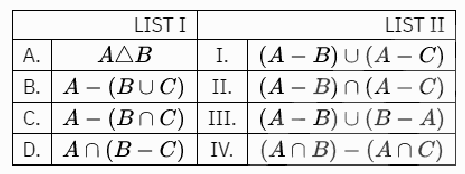
- A-III B-II C-I D-IV
- A-II B-III C-IV D-I
- A-IV B-III C-I D-II
- A-IV B-I C-III D-II
The clipping process in computer graphics is used for
- Adding graphics
- Copying
- Zooming
- Removing objects and lines
Consider a disk system with cylinders. The request to access the cylinders occurs in the following sequence: 4, 34, 10, 7, 19, 73, 2, 15, 6, 20 Assuming that the head is currently at cylinder 50 , what is the time taken to satisfy all requests if it takes 1 ms to move from one cylinder to adjacent one and shortest seek time first policy is used?
- 119 ms
- 120 ms
- 142 ms
- 146 ms
Consider the rectangle with vertices (0, 0), (0, 2), (3, 0), (3, 2) . There is scaling of 2 towards x -axis and 3 towards y -axis. The new cordinates of the rectangle are
- (0, 0), (6, 0), (0, 4), (6, 4)
- (0, 0), (6, 0), (0, 4), (3, 2)
- (0, 0), (6, 0), (0, 6), (6, 6)
- (0, 0), (4, 0), (0, 6), (4, 6)
Which of the following transforms in 2 dimension is used to resize a 2-dimensional object?
- Translation
- Rotation
- Scaling
- Shearing
- 25.25 μs and 51.2 μs
- 51.2 μs and 12.5 μs
- 10.24 μs and 50.12 μs
- 12.5 μs and 51.2 μs
Consider the following statements.
A. The identity is unique in any monoid.
B. A monoid is a group if there exists inverse of each element of monoid.
C. Semi group has closure, associative and identity properties.
D. Quasi group has closure property.
- A, B and D only
- B, C and D only
- A, B and C only
- A, C and D only
main() {
  static float a[] = {13.24, 1.5, 4.5, 5.4, 3.5};
  float *j, *k;
  j = a;
  k = a + 4;
  j = j * 2;
  k = k / 2;
  printf("%f %f", *j, *k);
}- 13.25, 4.5
- 1.5, 3.5
- 13.24, 1.5, 4.5, 5.4, 3.5
- Illegal use of pointer in main function
- {12n² + 6n | n is a natural number}
- {24n − 12 | n is a natural number}
- {60n + 30 | n is a natural number}
- {12n − 6 | n is a natural number}
Match List I with List II
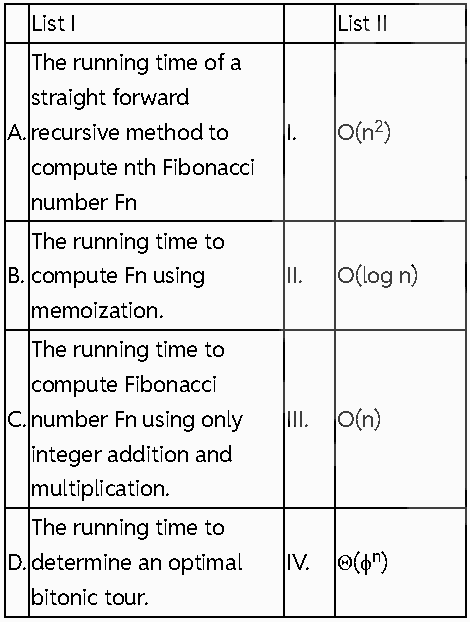
- A-I B-III C-IV D-II
- A-IV B-III C-II D-I
- A-I B-II C-IV D-III
- A-IV B-II C-III D-I
Given below are two statements:
Statement I: If f and g are two functions and f = O(g) g ≠ o(f) but , we say that the growth rate of g is smaller than that of f
Statement II: The class of all decision problems decided by a TM in exponential time, that is O(2k) k , being a constant. In the light of the above statements, choose the most appropriate answer from the options given below.
- Both Statement I and Statement II are correct
- Both Statement I and Statement II are incorrect
- Statement I is correct but Statement II is incorrect
- Statement I is incorrect but Statement II is correct 32M × 8
256 Mb DRAM is organized as a 16 K × 16 K memory externally and as a square array internally. Each row must be refreshed at least once every 50 mili second to forestall loss of data; refreshing one row takes 100 nanoseconds. What fraction of the total memory bandwidth is lost to refresh cycles?
- 6.6%
- 3.3%
- 9.9%
- 4.3%
Given below are two statements:
Statement I: subsystem models show logical grouping of objects into coherent subsystem
Statement II: State machine models show how objects change their states in response to events. In the light of the above statements, choose the most appropriate answer from the options given below.
- Both Statement I and Statement II are correct
- Both Statement I and Statement II are incorrect
- Statement I is correct but Statement II is incorrect
- Statement I is incorrect but Statement II is correct
Given below are two statements: one is labelled as Assertion A and the other is labelled as
Reason R.
Assertion A: It is possible to create doubly linked list using only one pointer with every node.
Reason R: By storing the XOR of the addresses of the previous and next nodes. In the light of the above statements, choose the most appropriate answer from the options given below.
- Both A and R are true and R is the correct explanation of A
- Both A and R are true but R is NOT the correct explanation of A
- A is true but R is false
- A is false but R is true
The compiler for high level language that runs on one machine and produces code for other machine is called-
- Cross compiler
- Multipass compiler
- Optimizing Compiler
- More than one of the above (E) None of the above Directions (91-95) Read the following passage and answer the given questions. Consider the following program fragment that deals with a table T with 17 rows and 1024 columns, computing an average for each column and printing it to screen ( i is row index and j is column index): for j= [ 0...1023] { temp =0; for i= [0...16] temp = temp + T[i][j]; print (temp/17.0); } T [i] [i] and temp are 32 bit floating point values and memory is word addressable. The temporary variable temp is kept in a processor register so access to temp does not involve a memory reference. The main memory is page and holds 16 pages of size 1024 words, the page replacement policy is "least recently used ". If T is stored in the virtual address space in row major format.
Directions (Q91–95): Consider the following program fragment that deals with a table T with 17 rows and 1024 columns, computing an average for each column and printing it (i is the row index and j is the column index):
for j = [0...1023] {
  temp = 0;
  for i = [0...16]
    temp = temp + T[i][j];
  print(temp / 17.0);
}
T[i][j] and temp are 32-bit floating-point values and memory is word addressable. temp is kept in a processor register, so accessing temp does not involve a memory reference. The main memory is paged and holds 16 pages of 1024 words each. The page replacement policy is least recently used (LRU). Unless stated otherwise, T is stored in the virtual address space in row-major format.
- 80%
- 95.6%
- 97.8%
- 99.9%
- 14
- 15
- 16
- 17
Directions (Q91–95): A program computes the average of each column of a table T with 17 rows and 1024 columns:
for j = 0 … 1023 {
temp = 0;
for i = 0 … 16
temp = temp + T[i][j];
print(temp / 17.0);
}
T[i][j] and temp are 32-bit floating-point values, memory is word addressable, and temp is kept in a register. Main memory is paged and holds 16 pages of 1024 words; page replacement is LRU. Unless stated otherwise, T is stored in row-major order.
What is fault ratio of row major to column major arrangements ?
- 1024: 1
- 1301: 1
- 1240: 1
- 9107: 8
What is the main memory hit ratio?
- 0
- 1
- 2
- 3 Directions (96-100) Read the following passage and answer the given questions. IP datagram has arrived with following partial information in the header (in hexadecimal ) 45000054000300002006....
Directions (Q96–100): An IP datagram has arrived with the following partial header information (in hexadecimal): 45000054 00030000 2006…
Directions (Q96–100): An IP datagram arrives with the following partial header (hexadecimal): 45 00 00 54 00 03 00 00 20 06 …
What is the protocol of the payload being carried by the packet?
- ICMP
- SCTP
- TCP protocol
- IGMP
Answer key
- 1 – B
- 2 – B
- 3 – A
- 4 – B
- 5 – D
- 6 – C
- 7 – D
- 8 – A
- 9 – D
- 10 – C
- 11 – C
- 12 – A
- 13 – B
- 14 – B
- 15 – C
- 16 – A
- 17 – A
- 18 – A
- 19 – A
- 20 – B
- 21 – C
- 22 – C
- 23 – A
- 24 – A
- 25 – B
- 26 – C
- 27 – B
- 28 – A
- 29 – D
- 30 – A
- 31 – B
- 32 – C
- 33 – D
- 34 – C
- 35 – D
- 36 – D
- 37 – C
- 38 – B
- 39 – B
- 40 – A
- 41 – D
- 42 – B
- 43 – D
- 44 – D
- 45 – B
- 46 – B
- 47 – C
- 48 – C
- 49 – B
- 50 – B
- 51 – B
- 52 – B
- 53 – D
- 54 – B
- 55 – B
- 56 – C
- 57 – A
- 58 – C
- 59 – D
- 60 – D
- 61 – C
- 62 – C
- 63 – D
- 64 – B
- 65 – C
- 66 – D
- 67 – C
- 68 – C
- 69 – C
- 70 – A
- 71 – D
- 72 – C
- 73 – C
- 74 – D
- 75 – D
- 76 – A
- 77 – D
- 78 – A
- 79 – C
- 80 – C
- 81 – B
- 82 – A
- 83 – D
- 84 – D
- 85 – B
- 86 – B
- 87 – B
- 88 – A
- 89 – A
- 90 – A
- 91 – D
- 92 – D
- 93 – B
- 94 – A
- 95 – A
- 96 – D
- 97 – C
- 98 – C
- 99 – B
- 100 – A