
Match List I with List II. List I: A. A △ B, B. A − (B ∪ C), C. A − (B ∩ C), D. A ∩ (B − C). List II: I. (A − B) ∪ (A − C), II. (A − B) ∩ (A − C), III. (A − B) ∪ (B − A), IV. (A ∩ B) − (A ∩ C).
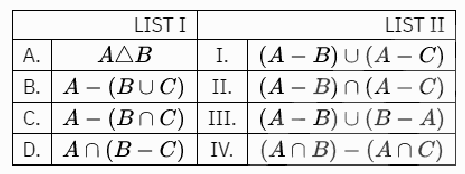
Pick an option to check yourself, or open the answer below.
Show answer & explanation
Correct answer: A. A-III B-II C-I D-IV
Explanation
Symmetric difference = (A − B) ∪ (B − A). By De Morgan, A − (B ∪ C) = (A − B) ∩ (A − C) and A − (B ∩ C) = (A − B) ∪ (A − C). Intersection distributes over difference: A ∩ (B − C) = (A ∩ B) − (A ∩ C).
More Discrete Structures and Optimization questions
- Consider the following statements. A. The identity is unique in any monoid. B. A monoid is a group if there exists inverse of each element…
- Seven people enter a lift. The lift stops only at three floors (which are unspecified). At each of the three floors, no one enters the lift…
- Consider: A. A group can have zero elements. B. A group cannot have any idempotent element except the identity. C. An isomorphism from a gr…
- The relation R = {(1, 3), (1, 1), (3, 1), (1, 2), (3, 3), (4, 4)} {1, 2, 3, 4} defined in is ____
- The negation of "Some students like hockey" is:
- A relation ' R ' is defined on ordered pairs of integers as (x, y) R(u, v) if x<u and y>v. Then R is