
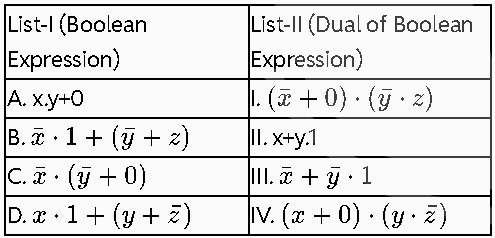
Match List - I with List - II.
Pick an option to check yourself, or open the answer below.
Show answer & explanation
Correct answer: C. A-II, B-I, C-III, D-IV
Explanation
The dual swaps + with · and 0 with 1. x·y + 0 → (x + y)·1; x̄·1 + (ȳ + z) → (x̄ + 0)·(ȳ·z); x̄·(ȳ + 0) → x̄ + ȳ·1; x·1 + (y + z̄) → (x + 0)·(y·z̄).
More Discrete Structures and Optimisation questions
- Arrange the following sets in increasing order of cardinality: A. A₁ = {{1, 2}, {3}} B. A₂ = {{1}, {2}, {3}, {4}} C. A₃ = {{1, 2, 3, 4, 5,…
- The chairs of an auditorium are to be labelled with a letter followed by a positive two digits integer where labelling is starting with A01…
- Z is set of integers, <Z,*> forms group if * in :
- Which of the following are tautologies? A. (p ∨ r) → p B. p → (p ∧ r) C. ~p → (p → r) D. (p ∧ r) → (p → r) E. ~(p → r) → p
- Which of the following is not the most common property in social network ?
- When we formulate the LPP from the above-given passage. Which of the following is an objective function for its dual problem?