
UGC NET Paper 2 Computer Science – June 2024 (Cancelled) – Question Paper with Answer Key
Solved by The Binary Brothers: every question has the correct answer and an explanation. Open any question for its full solution, or practise it in the unit-wise mock tests.
Which of the following is not an object Oriented Programming language ?
- Pearl
- Python
- Small talk
- SQL Plus
- Left recursion
- Left factoring
- Ambiguity
- Associativity and precedence
Let n be the least integer such that f(x) is O(xⁿ). Arrange the following functions in increasing order of n: A. f(x) = 3x³ + (log x)⁴ B. f(x) = (x⁵ + x² + 1)/(x³ + 1) C. f(x) = (x³ + x² + 1)/(x² + 1) D. f(x) = (x² + 5 log x)/(x² + 1)
- D, C, A, B
- D, C, B, A
- B, C, A, D
- B, A, C, D
Arrange the following so that they can be placed in perfect/appropriate order.
A. Planning
C. Modeling
B. Construction
E. Deployment
D. Communication
- A, B, C, D, E
- D, A, C, B, E
- A, D, B, C, E
- B, C, D, A, E
Match List I with List II. List I: A. A → aB | a (a ∈ T; A, B ∈ V), B. A → BC | a (a ∈ T; A, B, C ∈ V), C. LL(1) grammar, D. Halting problem. List II: I. Recursive descent parser, II. Turing machine, III. Chomsky Normal Form, IV. Finite automata.
- A-IV, B-III, C-I, D-II
- A-III, B-I, C-II, D-IV
- A-II, B-IV, C-III, D-I
- A-IV, B-III, C-II, D-I
What is a perceptron in ANN ?
- A double layer auto-associative neural network.
- A neural network that contains feedback.
- An auto-associative neural network.
- A single layer feed-forward neural network with pre-processing.
Arrange the following examples of Artificial Intelligence (AI) in the order of increasing complexity :
A. Spam email detection using rule-based systems.
B. Handwritten digit recognition using shallow neural networks.
C. Image classification using convolutional neural networks.
D. Autonomous driving using reinforcement learning algorithms.
- A, B, C, D
- B, A, C, D
- A, B, D, C
- B, C, A, D
Match List I (line coding scheme) with List II (average bandwidth, N = data rate). List I: A. NRZ-L, B. 2B1Q, C. 4D-PAM5, D. MLT-3. List II: I. B = N/4, II. B = N/8, III. B = N/3, IV. B = N/2.
- A-II, B-I, C-IV, D-III
- A-IV, B-II, C-I, D-III
- A-IV, B-I, C-II, D-III
- A-III, B-IV, C-II, D-I
The order of steps of Address Translation in Linux Virtual Memory Scheme will be :
A. register
B. offset
C. Page directory.
D. Page table
E. Page Middle directory
Choose the correct answer from the options given below :
- B, A, D, E, C
- A, C, E, D, B
- D, C, A, B, E
- C, A, D, E, B If f(n) = 5f(n/2) + 3 and f(1) = 7
If f(n) = 5f(n/2) + 3 and f(1) = 7, where n = 2ᴷ and K is a positive integer, then f(2ᴷ) =
- 5ᴷ(31/4) − 3/4
- 5ᴷ(29/4)
- 2ᴷ(31/4) − 3/4
- 2ᴷ(29/4)
The instruction LD ADR (X) which is equivalent to ← AC M[ADR+XR] is in :
- Direct Addressing Mode
- Indirect Addressing Mode
- Index Addressing Mode
- Immediate Addressing Mode
For the following Parents in figure (1) and (2) :
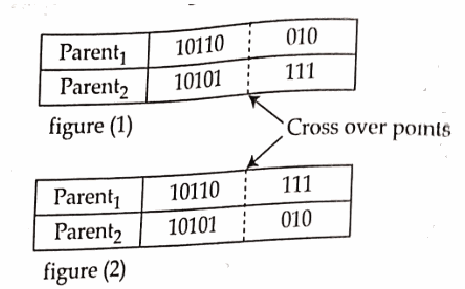
Which is correct?
- figure (2) is the two point crossover of figure (1)
- figure (2) is one point crossover of figure (1)
- figure (2) is N point crossover of figure (1)
- figure (2) is uniform crossover of figure (1)
A. Find a frame that is not currently being used
B. Change the page table
C. Use the freed frame
D. No frame is free
E. Free a frame
Choose the correct answer from the options given below:
- D, A, E, B, C
- E, B, A, C, D
- B, E, A, D, C
- D, E, B, A, C
Match List - I with List - II. f(n) = a f(n / b) + g(n) is a divide-and- conquer recurrence relation for the Listed-I algorithms, match their recurrence in Listed-II.
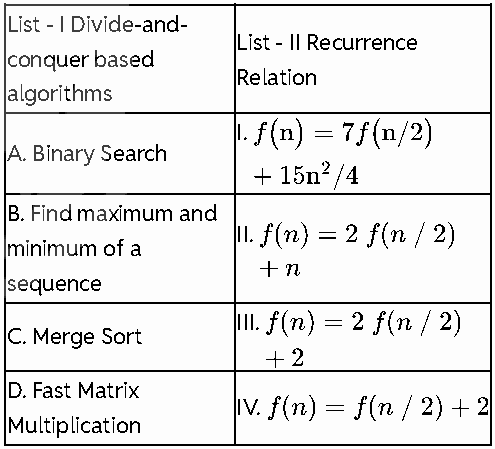
- A-I, B-II, C-III, D-IV
- A-II, B-III, C-IV, D-I
- A-III, B-IV, C-I, D-II
- A-IV, B-III, C-II, D-I
- Mutual exclusion
- Data coherence
- Starvation
- Deadlock
The height of a binary search tree for the words banana, peach, apple, pear, coconut, mango and papaya using alphabetical order is :
- 2
- 3
- 4
- 5
Match List-I with List-II :
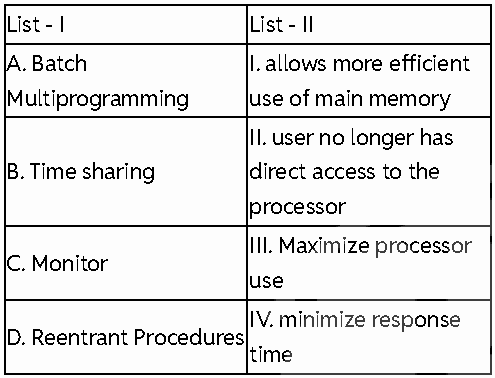
- A-III, B-II, C-IV, D-I
- A-III, B-IV, C-II, D-I
- A-I, B-III, C-IV, D-II
- A-II, B-I, C-IV, D-III
- Type conversion
- Tokenization
- Loop optimization
- Data flow analysis
For the regular languages and context-free languages which is not correct?
A. both are closed under union operation
B. both are closed under concatenation operation
C. both are closed under intersection operation
D. both are closed under complementation operation
E. both are closed under kleen star operation
Choose the most appropriate answer from the options given below :
- A and B Only
- B and C Only
- C and D Only
- D and E only
Match List-I with List-II :
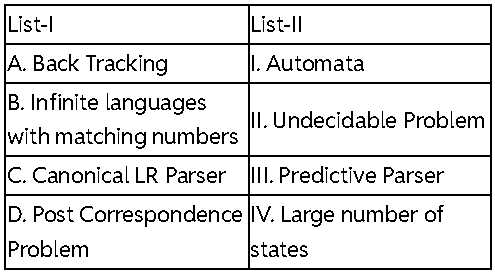
- A-I, B-II, C-III, D-IV
- A-II, B-III, C-I, D-III
- A-IV, B-III, C-II, D-I
- A-III, B-I, C-IV, D-Il
#include <stdio.h>
int main(void) {
  int x, *p;
  x = 30;
  p = x;
  printf("%d", *p);
  return 0;
}- 30
- value of x
- address of x
- Error
Which of the following are true if the universe of discourse consists of all integers? A. ∀n∃m (n² < m) B. ∃n∀m (n < m²) C. ∃n∃m (n² + m² = 5) D. ∃n∃m (n² + m² = 6) E. ∃n∃m (m + n = 4 ∧ n − m = 1)
- A, B, C Only
- B, C, E Only
- C, D, E Only
- B, D Only
Multiple Inheritance is permitted directly in.....
A. C++
B. Java
C. Python
D. VB.NET
E. BASIC
- A and B Only
- A and C Only
- B and D Only
- More than one of the above
The ratio of errors found before s/w delivery and to the total errors (before and after) is called :
- Accuracy
- Specificity
- Defect Removal efficiency
- Through put
Match List-I with List-II.
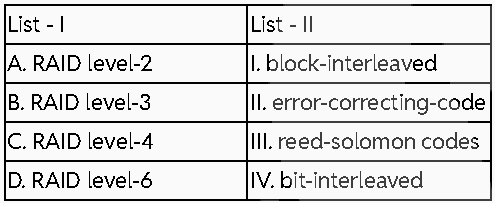
- A-I, B-III, C-IV, D-II
- A-II, B-IV, C-I, D-III
- A-IV, B-I, C-II, D-III
- A-II, B-III, C-IV, D-I
Which of the following sequences aₙ are solutions of the recurrence aₙ = 8aₙ₋₁ − 16aₙ₋₂? A. aₙ = 1 B. aₙ = 2ⁿ C. aₙ = 4ⁿ D. aₙ = n·4ⁿ E. aₙ = (−4)ⁿ
- A, B, C Only
- B, C, D Only
- C, D Only
- C, D, E Only
Match List-I with List-II :
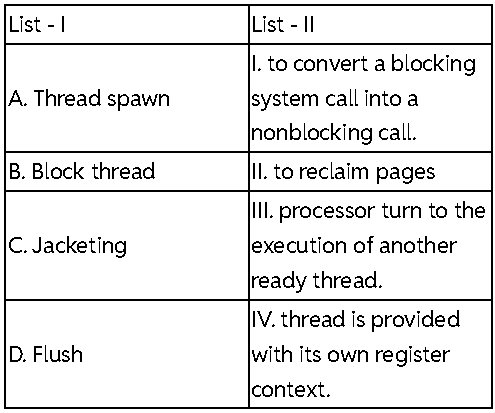
- A-I, B-III, C-IV, D-II
- A-IV, B-III, C-II, D-I
- A-IV, B-III, C-I, D-II
- A-II, B-I, C-IV, D-III
Which of the following is the Markup language?
A. HTML
B. XML
C. DHTML
D. LML
E. PML
- B, C, D Only
- A, C, D Orly
- A, C, D, E Only
- A, B, C Only
A. User-to-user
B. User-to-network
C. Network-to-network
D. Host-to-network
E. User-to-host
Choose the correct answer from the options given below:
- A and B Only
- B and C Only
- C and D Only
- D and E Only
- {(x1, 0.4), (x2, 0.3), (x3, 0.1)}
- {(x1, 0.3), (x2, 0.7), (x3, 0.4)}
- {(x1, 0.7), (x2, 0.3), (x3, 0.6)}
- {(x1, 0.21), (x2, 0.28), (x3, 0.12)}
ADD R1, A, B
ADD R2, C, D
MUL X, R1, R2
evaluate X = (A + B) * (C + D) using which of the following?
- 3-address instructions
- 2-address instructions
- 1-address instructions
- RISC instructions
A. More than one derivation
B. More than one leftmost derivation
C. More than one rightmost derivation
D. More than one parse tree
E. More than one syntax tree
Choose the correct answer from the options given below:
- A and D Only
- B and C Only
- D and E Only
- A and E Only
- Forward from source to hidden nodes
- Backward from sink to source
- Forward from source to sink
- Backward from sink to hidden nodes
- A′C′ + BC′
- B + AC′
- A + BC′
- A′ + BC′
A. Programming statement
B. Compilation
C. Memory allocation
D. Type of variable
E. Memory deallocation
Choose the correct answer from the options given below:
- A, B, C, D, E
- A, B, D, C, E
- B, A, D, C, E
- C, D, B, E, A
- 200 ns
- 190 ns
- 210 ns
- 120 ns
An IPv4 packet has arrived with the first few hexadecimal digits as shown below. How many hops can this packet travel before being dropped? The data belong to what upper-layer protocol? ( 5400001800100110040601...) 16
- 01 hops, TCP
- 02 hops, UDP
- 03 hops, ICMP
- 4 hops, TCP
Arrange the following simple graphs based on a number of spanning trees they have :
A. K [Complete Graph with 3 nodes] 3 B.K [Complete Graph with 4 nodes] 4 C.K (Complete bipartite graph of the 2 nodes 2,2 in each partition) D.C (Cycle graph of 5 nodes) 5
- A, B, C, D
- A, C, B, D
- A, C, D, B
- D, B, C, A
Match List I with List II. List I: A. Channelization protocol, B. Bit-oriented protocol, C. Random-access protocol, D. Controlled-access protocol. List II: I. ALOHA, II. TDMA, III. Reservation, IV. HDLC.
- A-I, B-III, C-IV, D-II
- A-II, B-IV, C-I, D-III
- A-IV, B-III, C-II, D-I
- A-III, B-IV, C-I, D-II
What is the total delay (latency) for a frame size of 10 million bits that is being set up on a link with 20 routers, each having a queuing time of 2 μ μs s and a processing time of 1 ? The length of link 5000 km. The speed of light inside the link is 2 * 108 m /s. The link has bandwidth of 6 Mbps.
- 0.624050 s
- 1.691726 s
- 2.425080 s
- 1.714030 s
How much time does an algorithm using 2⁵⁰ bit operations need if each bit operation takes 2⁻³⁸ seconds?
- 1 hour
- 10 minutes
- 30 minutes
- 1.5 hour
Match List - I with List - II.
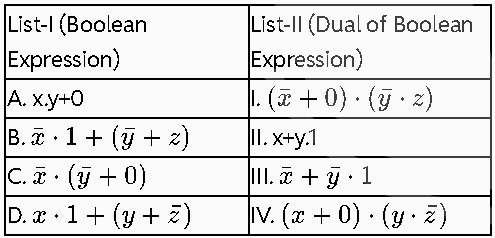
- A-III, B-IV, C-II, D-I
- A-III, B-IV, C-I, D-II
- A-II, B-I, C-III, D-IV
- A-II, B-I, C-IV, D-III
- 1/2
- 5/16
- 5/8
- 1/4
Services provided by point-to-point protocol (PPP):
A. frame format
B. establishment of the link
C. flow control
D. sequence numbering
E. authentication
- A, B, and E Only
- A, C and D Only
- D, E and B Only
- B, C and D Only
A. It ensures shorter waiting times.
B. It ensures freedom from deadlock.
C. A transaction can lock data items earlier.
D. It does not ensure a greater amount of concurrency.
Choose the correct answer from the options given below:
- A and B Only
- C and D Only
- B and C Only
- A and D Only
Arrange the following sets in increasing order of cardinality: A. A₁ = {{1, 2}, {3}} B. A₂ = {{1}, {2}, {3}, {4}} C. A₃ = {{1, 2, 3, 4, 5, 6}} D. A₄ = {{1, 2}, {2, 3, 4}, {5}} E. A₅ = {{1}, {2}, {3}, {4}, {5}}
- A, B, D, E, C
- A, B, E, D, C
- A, C, D, B, E
- C, A, D, B, E
Which of the following is not the goal of reverse Engineering?
- Cope with Complexity
- Recover lost information
- Detect side effect
- Data flow
The chairs of an auditorium are to be labelled with a letter followed by a positive two digits integer where labelling is starting with A01. How many maximum possible chairs could be labelled in this way?
- 2600
- 2574
- 2340
- 2366
A. Minimum-state DFA
B. Regular expression
C. NFA-ε
D. Problem statement
E. DFA
Choose the correct answer from the options given below:
- B, C, E, A, D
- D, B, C, E, A
- C, E, B, A, D
- A, D, C, B, E
A lower-triangular sparse matrix is one :
- in which all the non-zero elements lie only on the leading diagonal.
- in which all the non-zero elements lie above leading diagonal.
- in which all the non-zero elements lie below leading diagonal.
- which is not defined for sparse matrix.
stmt → if expr then stmt else stmt | if expr then stmt
suffers from:
- Ambiguity
- Left factoring
- Left recursion
- λ-moves
Which of the following is not correct about the virtual memory segmentation ?
- It is not necessary to load all of the segments of a process.
- It has no internal fragmentation.
- It has large virtual address space.
- It provides lower degree of multiprogramming.
Match List-I with List-II :
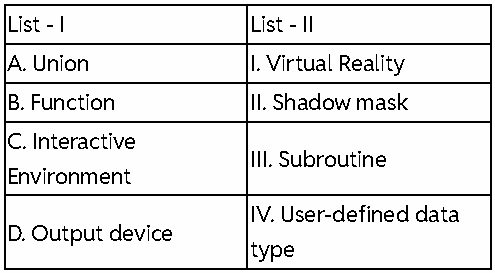
- A-IV, B-III, C-I, D-II
- A-II, B-IV, C-I, D-III
- A-IV, B-II, C-III, D-I
- A-I, B-III, C-IV, D-II
Z is set of integers, <Z,*> forms group if * in :
- *(a, b)=a+b+2
- *(a, b)=2a+b
- *(a, b)=(a+b) / 2
- *(a, b)=a2+b
Which of the following statements is/are false?
A. A user can assign privileges to any user on any relation.
B. A user can assign privileges to any user on its own relations only,
C. System error that leads to accessibility to the portion of database is an example of malicious attack.
D. Passwords itself need to be secured from unauthorized access.
- A and C Only
- A and B Only
- B and D Only
- B and C Only
- Real-time scheduling policy
- Responds to external interrupts
- Provides special non-sequential files
- Provides fixed or variable-sized partitions
A. Flag
B. FCS
C. Address
D. Information
Choose the correct answer from the options given below:
- A, C, D, B
- D, A, C, D
- C, B, A, D
- A, B, D, C
A. Time stamping
B. Index locking
C. Predicate locking
D. Execution indexing
Choose the correct answer from the options given below:
- A and B Only
- B and C Only
- A and D Only
- C and D Only
A. Flags
B. Options
C. Protocol
D. Identification
E. Service type
Choose the correct answer from the options given below:
- E, D, A, C, B
- D, A, B, C, E
- D, E, C, B, A
- E, C, D, A, B
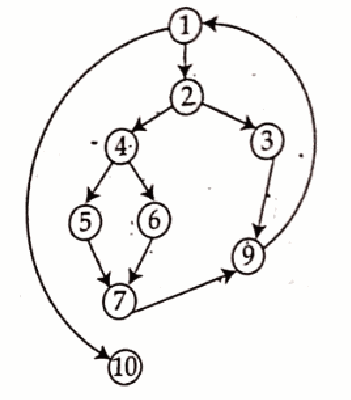
- Node-to-node, Host-to-host
- Process-to-process, Host-to-host
- Socket-to-socket, Host-to-node
- Host-to-host, Process-to-process
A. Solution fitting with data
B. Formulation mathematically
C. Solve mathematically
D. Repeat formulation if it fits poorly with the data
E. Interpret results
Choose the correct answer from the options given below:
- B, C, A, D, E
- B, A, D, C, E
- D, A, B, C, E
- E, D, C, A, B
In windows scheduling, which of the following option is correct ?
- 4 non-real-time priorities
- 8 non-real-time priorities
- 12 non-real-time priorities
- 16 non-real-time priorities
A. Isolated I/O
B. Memory-mapped I/O
C. Strobe control
D. Handshaking
E. Interrupt
Choose the most appropriate answer from the options given below:
- A, B Only
- C, D Only
- C, E Only
- B, E Only
A. Query optimizer
B. Runtime database processor
C. Scanning, parsing and validating
D. Query code generator
Choose the correct answer from the options given below:
- D, A, C, B
- C, A, D, B
- C, D, B, A
- D, C, B, A
Which of the following are tautologies? A. (p ∨ r) → p B. p → (p ∧ r) C. ~p → (p → r) D. (p ∧ r) → (p → r) E. ~(p → r) → p
- A, B Only
- A, B, C Only
- B, C, D Only
- C, D, E Only
A. DRAM
B. SRAM
C. CPU registers
D. Magnetic tapes
E. Hard disk
Choose the correct answer from the options given below:
- A, B, C, D, E
- C, B, A, D, E
- C, D, B, A, E
- B, C, D, A, E
δ(q0, a, z0) = (q0, aaaz0)
δ(q0, a, a) = (q0, aaaa)
δ(q0, b, a) = (q1, λ)
δ(q1, b, a) = (q1, λ)
δ(q1, ε, z0) = (qf, z0), where qf is the final state.
- {aⁿbⁿ | n > 0}
- {aⁿb²ⁿ | n > 0}
- {aⁿb³ⁿ | n > 0}
- {aⁿb⁴ⁿ | n > 0}
A. Turn the interrupt facility on
B. Service the device whose flag is set
C. Save the contents of processor registers
D. Check which flag is set
E. Restore the contents of processor registers
Choose the correct answer from the options given below:
- A, D, C, B, E
- D, A, B, C, E
- C, D, B, E, A
- B, D, A, C, E
Match List-I with List-II :
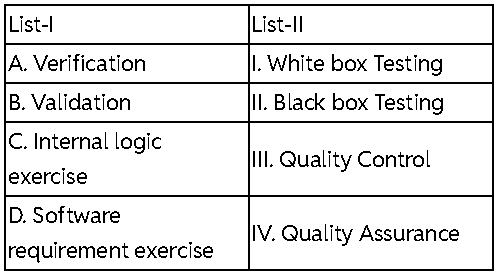
Chowe the correct answer from the options given below :
- A-IV, B-III, C-I, D-II
- A-I, B-II, C-III, D-IV
- A-IV, B-III, C-II, D-I
- A-III, B-IV, C-I, D-II
The parameter Actual count is used in Genetic Algorithm (GA) for :
- Crossover
- Mutation
- Selecting population
- Encoding the Genetic Algorithm
For the given two machines which of the following is correct?
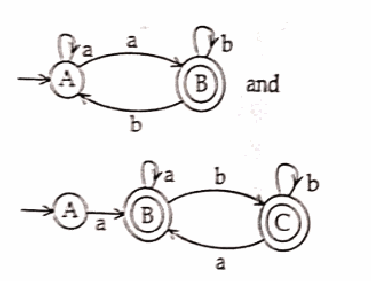
- both Machines are DFAs
- both are non-equivalent Machines
- both are equivalent Machines
- cannot be determined
- 4
- 7
- 8
- 12
A. Conceptual dependency
B. Predicate logic
C. Slot-and-filler
D. Non-monotonic systems
Choose the correct answer from the options given below:
- A and B Only
- B and C Only
- B and D Only
- C and D Only
In Genetic Algorithm's cross over operation, mask in used in ?
- Three parent crossover
- Two parent crossover
- Uniform crossover
- N point cronsover
Match the List-I and List-II
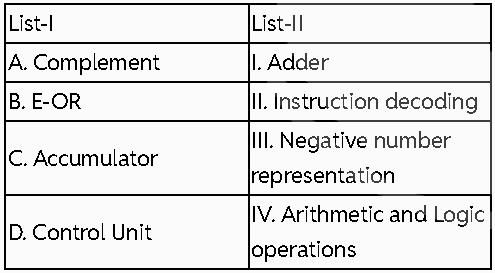
- A-I, B-II, C-III, D-IV
- A-III, B-II, C-I, D-IV
- A-III, B-I, C-IV, D-II
- A-IV, B-II, C-III, D-I
Arrange the following prefix expressions by value in increasing order: A. + − * 2 / 8 4 3 2 B. ↑ − * 3 3 * 4 2 5 C. + − ↑ 3 2 ↑ 2 3 / 6 − 4 2 D. * + 3 + 3 ↑ 3 + 1 1 3
- A, B, C, D
- B, A, C, D
- D, C, B, A
- C, D, A, B
Which of the following is not the most common property in social network ?
- Degree distribution follows scale free.
- Average shortest path lengths are shorten in connected network.
- Most of them are directed network.
- Follows small world property.
For line drawing, which of the following algorithms are used ?
A. DDA algorithm
B. Bresenham algorithm
C. Mid point algorithm
D. Curve algorithm
- B and C Only
- C and D Only
- A and B Only
- D and A Only
According to the Nyquist theorem to produce the original analog signal, one necessary condition is :
- Sampling rate must be at least 2 times the highest frequency contained in the signal
- Sampling rate must be at least 2 times the lowest frequency contained in the signal 1
- Sampling rate must be at least times the 2 highest frequency contained in the signal 1
- Sampling rate must be at least times the 2 lowest frequency contained in the signal
- {(x1, 0.3), (x2, 0.7), (x3, 0.4)}
- {(x1, 0.5), (x2, 0.2), (x3, 0.5)}
- {(x1, 0.5), (x2, 0.7), (x3, 0.5)}
- {(x1, 0.3), (x2, 0.2), (x3, 0.4)}
The least values of a signed and unsigned data type variables requiring 8 bits, would be...
- 0,128
- -128,127
- 0,0
- -128,0
Which of the following are true for a complete binary tree?
A. It has always odd number of vertices.
B. With i internal vertices, it has i+1 leaves.
C. With l leaves, it has 2l-1 vertices.
D. With 2 n-1 vertices, it has n leaves.
- A, B, C Only
- B, C Only
- A, D Only
- A, B, C, D
For making a memory of size 2048 x 8 bytes, by using the chips of size 128 x 4 bytes, the number of chips required is :
- 8
- 16
- 32
- 64
Which of the following are sequential circuits?
A. Flip flop
B. Multiplexer
C. Counter
D. Decoder
E. Adder
- B, D Only
- A, C Only
- C, E Only
- D, A Only
A. Path testing
B. Loop testing
C. Regression testing
D. Non-functional testing
Choose the correct answer from the options given below:
- A and B Only
- B and C Only
- C and D Only
- A and D Only
Techniques for performing I/O :
A. Programmed I/O
B. Interrupt-driven I/O
C. Rotational I/O
D. Direct memory access
E. Channelized I/O
- A and C Only
- A, B, and D Only
- A, D and E Only
- B and E Only
A. Execution of code
B. No execution of code
C. Preventive technique
D. A corrective technique
Choose the correct answer from the options given below:
- A, B Only
- B, C Only
- C, D Only
- D, A Only
Which of the following genetic algorithm operations is computationally most expensive?
- Convergence testing
- Initial population creation
- Selection of sub-population for mating
- Reproduction to produce next generation Directions (91-95) Read the following passage and answer the given questions. Answer the following 5 questions based on the passage, (141-145) A firm can produce two types of cloth say A and B. Three kinds of wool are required for it, say red wool, green wool, and blue wool. One unit length of type A cloth needs 2 yards of red and 3 yards of green wool. One unit length of type B cloth needs 3 yards of red wool, 2 yards of green wool and 2 yards of blue wool. The firm has only a stock of 8 yards of red wool, 10 yards of green wool, and 15 yards of blue wool. It is assumed that the income obtained from one unit length of type A and type B clothes are ₹ 30 and ₹ 50, respectively.
Directions (Q91–95): A firm produces two types of cloth, A and B, using red, green and blue wool. One unit length of type A needs 2 yards of red and 3 yards of green wool. One unit length of type B needs 3 yards of red, 2 yards of green and 2 yards of blue wool. The firm has 8 yards of red, 10 yards of green and 15 yards of blue wool. Income is ₹30 per unit length of type A and ₹50 per unit length of type B.
When we formulate the LPP from the above-given passage. Which of the following is an objective function for its dual problem?
- Min P = 5u + 8v + 15w
- Min P = 8u + 10v + 15w
- Min P = 15u + 5v + 8w
- Max P = 10u + 8v + 15w
Directions (Q91–95): A firm can produce two types of cloth, A and B. Three kinds of wool are required: red, green and blue. One unit length of type A cloth needs 2 yards of red and 3 yards of green wool. One unit length of type B cloth needs 3 yards of red wool, 2 yards of green wool and 2 yards of blue wool. The firm has a stock of only 8 yards of red wool, 10 yards of green wool and 15 yards of blue wool. The income from one unit length of type A and type B cloth is ₹30 and ₹50 respectively. Let x and y be the unit lengths of type A and type B cloth produced.
- 2x + 3y
- 3x + 2y + 2z
- 30x + 50y
- 3x + 2y
How many unit length used for cloth A when income is maximized ?
- 0.8 unit
- 2.4 unit
- 2.8 unit
- 3.0 unit
If x unit length of type A cloths and y unit length of type B cloths, then contrains formulate for the LPP, is :
- y ≤ 7.5, 2x + 3y ≤ 8, 3y + 2x ≤ 10
- y ≤ 7.5, 2x + 3y ≤ 8, 3x + 2y ≤ 10
- 2x + 3y ≤ 8, 3x + 2y + 2z < 15
- 2x + 3y ≤ 10, 3x + 2y ≤ 10, 2y ≤ 15
On the basis of available material, maximum total income is :
- ₹ 133.3
- ₹ 124
- ₹ 100
- ₹ 153.3 Directions (96-100) Read the following passage and answer the given questions. A company is implementing a new database system to manage its customer information. The database contains labels for customers, orders, products and sales representatives. Each customer can place multiple orders and each order can contain multiple products. Each order is associated with a specific sales representative who manages the accountable products. The database is designed to improve efficiency in tracking sales and customer interactions.
Directions (Q96–100): A company is implementing a new database system to manage its customer information. The database contains tables for customers, orders, products and sales representatives. Each customer can place multiple orders and each order can contain multiple products. Each order is associated with a specific sales representative who manages the account. The database is designed to improve efficiency in tracking sales and customer interactions.
SELECT COUNT(*) AS total_orders FROM orders WHERE customer_id = [Customer_ID];SELECT COUNT(order_id) AS total_orders FROM orders WHERE customer_id = [Customer_ID];SELECT COUNT(DISTINCT order_id) AS total_orders FROM orders WHERE customer_id = [Customer_ID];SELECT SUM(order_id) AS total_orders FROM orders WHERE customer_id = [Customer_ID];
- Each customer can place only one order.
- Each sales representative can manage multiple customer accounts.
- Each order can be associated with only one product.
- The database does not include a table for products.
Directions (Q96–100): A company is implementing a new database to manage customer information. It holds tables for customers, orders, products and sales representatives. Each customer can place multiple orders and each order can contain multiple products. Each order is associated with a specific sales representative who manages the account. The design aims to improve tracking of sales and customer interactions.
Which of the following tables is likely to have a foreign key referencing another table in the database system implemented by the company ?
- Customers
- Orders
- Products
- Sales representatives
SELECT COUNT(DISTINCT customer_id) AS total_customers FROM orders;SELECT COUNT(*) AS total_customers FROM customers;SELECT COUNT(DISTINCT order_id) AS total_customers FROM orders;SELECT COUNT(DISTINCT customer_id) AS total_customers FROM customers;
Which of the following best describes the relationship between the "orders" table and the "Customers" table in the company's database system?
- One-to-One
- One-to-Many
- Many-to-One
- Many-to-Many
Answer key
- 1 – D
- 2 – D
- 3 – B
- 4 – B
- 5 – A
- 6 – D
- 7 – A
- 8 – C
- 9 – B
- 10 – A
- 11 – C
- 12 – B
- 13 – A
- 14 – D
- 15 – B
- 16 – C
- 17 – B
- 18 – A
- 19 – C
- 20 – D
- 21 – D
- 22 – A
- 23 – B
- 24 – C
- 25 – B
- 26 – C
- 27 – C
- 28 – D
- 29 – B
- 30 – C
- 31 – A
- 32 – C
- 33 – B
- 34 – D
- 35 – B
- 36 – A
- 37 – D
- 38 – C
- 39 – B
- 40 – B
- 41 – A
- 42 – C
- 43 – C
- 44 – A
- 45 – A
- 46 – D
- 47 – B
- 48 – D
- 49 – B
- 50 – B
- 51 – C
- 52 – A
- 53 – D
- 54 – A
- 55 – A
- 56 – A
- 57 – C
- 58 – A
- 59 – B
- 60 – A
- 61 – B
- 62 – D
- 63 – A
- 64 – D
- 65 – A
- 66 – B
- 67 – D
- 68 – B
- 69 – C
- 70 – C
- 71 – A
- 72 – C
- 73 – C
- 74 – D
- 75 – B
- 76 – C
- 77 – C
- 78 – B
- 79 – B
- 80 – C
- 81 – A
- 82 – D
- 83 – D
- 84 – D
- 85 – C
- 86 – B
- 87 – A
- 88 – B
- 89 – B
- 90 – D
- 91 – B
- 92 – C
- 93 – C
- 94 – B
- 95 – A
- 96 – B
- 97 – B
- 98 – B
- 99 – A
- 100 – C