
Match List I with List II and choose the correct answer from the code given below.
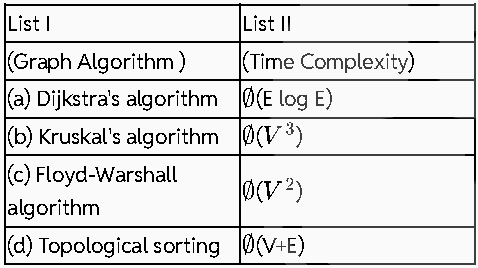
Where V and E are the number of vertices and edges in the graph respectively.
Pick an option to check yourself, or open the answer below.
Show answer & explanation
Correct answer: B. (a)-(iii), (b)-(i), (c)-(ii), (d)-(iv)
Explanation
Dijkstra with an array is O(V²); Kruskal is O(E log E); Floyd–Warshall is O(V³); topological sort is O(V + E).
More Data Structures and Algorithms questions
- A K-colouring of an undirected graph G = (V, E) is a function c : V → {0, 1, …, K − 1} such that c(u) ≠ c(v) for every edge (u, v) ∈ E. For…
- Consider a singly linked list. What is the worst case time complexity of the best-known algorithm to delete the node a, pointer to this nod…
- The second smallest of n elements can be found with ____________ comparisons in the worst case.
- Consider the pseudo-code fragment, where m is a non-negative integer that has been initialized: p = 0; k = 0; while (k < m) p = p + 2^k; k…
- The solution of the recurrence relation T(m) = T(3 m/4) + 1 is :
- Consider the array A=<4, 1, 3, 2, 16, 9, 10, 14, 8, 7>. After building heap from the array A, the depth of the heap and the right child of…