
Match List I with List II and choose the correct answer from the code given below.
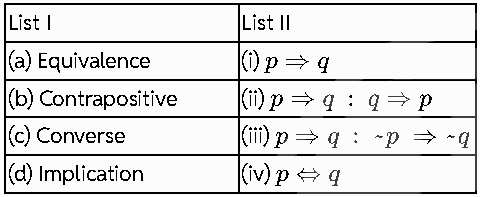
Pick an option to check yourself, or open the answer below.
Show answer & explanation
Correct answer: D. (a)-(iv), (b)-(iii), (c)-(ii), (d)-(i)
Explanation
Equivalence is p ⇔ q (iv); contrapositive is ¬q ⇒ ¬p, listed as p ⇒ q : ¬q ⇒ ¬p (iii); converse is q ⇒ p (ii); implication is p ⇒ q (i).
More Discrete Structures and Optimisation questions
- A box contains six red balls and four green balls. Four balls are selected at random from the box. What is the probability that two of the…
- A survey has been conducted on methods of commuter travel. Each respondent was asked to check Bus, Train or Automobile as a major method of…
- Which of the following statements are true? (i) Every logic network is equivalent to one using just NAND gates or just NOR gates. (ii) Bool…
- The relations ≤ and < on a Boolean algebra are defined as: x ≤ y if and only if x ∨ y = y; x < y means x ≤ y but x ≠ y; x ≥ y means y ≤ x;…
- In PERT/CPM, the merge event represents ___ of two or more events.
- Use the dual simplex method to solve: Maximize z = −2x₁ − 3x₂ subject to x₁ + x₂ ≥ 2, 2x₁ + x₂ ≤ 10, x₁ + x₂ ≤ 8, x₁, x₂ ≥ 0.