
UGC NET Paper 2 Computer Science – September 2022 – Question Paper with Answer Key
Solved by The Binary Brothers: every question has the correct answer and an explanation. Open any question for its full solution, or practice it in the unit-wise mock tests.
- CF(R1) = 0.8, CF(R2) = 0.3
- CF(R1) = 0.40, CF(R2) = 0.15
- CF(R1) = 0.15, CF(R2) = 0.35
- CF(R1) = 0.8, CF(R2) = 0.35
- 0.237
- 0.723
- 0.18
- 0.452
Consider a memory system with addresses spaced at a distance m, bank cycle time T and n banks. The average data access time per word in synchronous organization is
- t = m·T/n for m << n; T for m >> n
- t = T/n for m << n; T for m >> n
- t = m·T for m << n; T for m >> n
- t = m·T for m << n; m/T for m >> n
For a multiprocessor system, an interconnection network such as a crossbar switch is an example of
- Non-blocking network
- Blocking network
- Network that varies from connection to connection
- Recurrent network
- 1010101
- 1111001
- 1011101
- 1110000
- 12
- 13
- 14
- 15
A2 = D4 + D5 + D6 + D7
A1 = D2 + D3 + D6 + D7
A0 = D1 + D3 + D5 + D0
where + is logical OR. This circuit is a(n)
- 3 × 8 multiplexer
- Decimal to BCD converter
- Octal to binary encoder
- Priority encoder
- 27
- 2048
- 4K
- 16
- 2K, 4K
- 1024K, 2K
- 4K, 2048K
- 2048K, 4K
Consider the primal problem: maximize z = 5x1 + 12x2 + 4x3 subject to x1 + 2x2 + x3 = 10, 2x1 − x2 + 3x3 = 8, x1, x2, x3 ≥ 0. Its dual is: minimize w = 10y1 + 8y2 subject to y1 + 2y2 ≥ 5, 2y1 − y2 ≥ 12, y1 + 3y2 ≥ 4. Which of the following is correct?
- y1 ≥ 0, y2 unrestricted
- y1 ≥ 0, y2 ≥ 0
- y1 unrestricted, y2 ≥ 0
- y1 unrestricted, y2 restricted
- P′ ∨ Q
- P ∨ Q′
- P ∨ Q
- P′ ∨ Q′
The reduced grammar equivalent to S → AB | CA, B → BC | AB, A → a, C → aB | b is
- S → CA, A → a, C → b
- S → CA | B, B → BC | B, A → a, C → aB | b
- S → CA | B, B → BC, A → a, C → aB | b
- S → AB | AC, B → BC | BA, A → a, C → aB | b
Consider the grammar G: S → AbB, A → aAb | λ, B → bB | λ. Which language does G generate?
- {aⁿbᵐ : n ≥ 0, m > n}
- {aⁿbᵐ : n ≥ 0, m ≥ 0}
- {aⁿbᵐ : n ≥ m}
- {aⁿbᵐ : n ≥ m, m > 0}
- aaaa*(λ + b + bb + bbb)
- aaaaa*(b + bb + bbb)
- aaaaa*(λ + b + bb + bbb)
- aaaa*(b + bb + bbb)
Consider L = {ab, aa, baa}. Which string is NOT in L*?
- baaaabaaaaa
- abaabaaabaa
- aaaabaaaa
- baaaaabaa
Consider the NPDA ({q0, q1, qf}, {a, b}, {1, z}, δ, q0, z, {qf}) with δ(q0, λ, z) = {(qf, z)}, δ(q0, a, z) = {(q1, 11z)}, δ(q1, a, 1) = {(q1, 111)}, δ(q1, b, 1) = {(q1, λ)}, δ(q1, λ, z) = {(qf, z)}. Which language does it accept?
- {a²ⁿbⁿ : n ≥ 0}
- {aⁿb²ⁿ : n ≥ 0}
- {a²ⁿbⁿ : n > 0}
- {aⁿb²ⁿ : n > 0}
The hidden surface removal problem with a minimal 3D pipeline can be solved with
- Painter's algorithm
- Window clipping algorithm
- Brute force rasterization algorithm
- Flood fill algorithm
Using RSA with p = 13, q = 5 and e = 7, the value of d and the cipher value of '6' with key (e, n) are
- 7, 4
- 7, 1
- 7, 46
- 55, 1
- num > 65 || num < 65
- !(num == 65)
- num − 65
- !(num − 65)
- find the address of a variable in memory
- reference a value directly
- simulate call by reference
- manipulate dynamic data structures
- root
- header
- schema
- namespace
- Threading
- Cascading termination
- Zombie termination
- Process killing
What is called journalling in the Linux operating system?
- Process scheduling
- File saving as transaction
- A type of thread
- An editor
The transformation [x̄ ȳ z̄ w̄]ᵀ = [a1 b1 c1 d1; a2 b2 c2 d2; a3 b3 c3 d3; e f g h] · [x y z 1]ᵀ is called
- Scaling
- Shear
- Homography
- Steganography
- Rapid Application Development
- Relative application development
- Rapid application design
- Recent application development
- Verifiable
- Traceable
- Modifiable
- Complete
- Unit testing
- Beta testing
- Stress testing
- Mutation testing
- White-box testing
- Black-box testing
- Acceptance testing
- System testing
- Software Engineering Process
- User Engineering Process
- Requirement Elicitation Process
- Requirement Engineering Process
- People Metrics
- Project Metrics
- Process Metrics
- Product Metrics
Directions (Q31–35): Consider the relational schema of Sailors S, Reserves R and Boats B.
Table 1: Sailors
| Sid | Sname | Rating | Age |
|---|---|---|---|
| 22 | Dustin | 7 | 45.0 |
| 29 | Brutus | 1 | 33.0 |
| 31 | Lubber | 8 | 55.5 |
| 32 | Andy | 8 | 25.5 |
| 58 | Rusty | 10 | 35.5 |
| 64 | Horatio | 7 | 35.5 |
| 71 | Zorba | 10 | 16.0 |
| 74 | Horatio | 9 | 35.0 |
| 85 | Art | 3 | 25.5 |
| 95 | Bob | 3 | 63.5 |
Table 2: Reserves
| Sid | Bid | Day |
|---|---|---|
| 22 | 101 | 10/10/98 |
| 22 | 102 | 10/10/98 |
| 22 | 103 | 10/8/98 |
| 22 | 104 | 10/7/98 |
| 31 | 102 | 11/10/98 |
| 31 | 103 | 11/6/98 |
| 31 | 104 | 11/12/98 |
| 64 | 101 | 9/5/98 |
| 64 | 102 | 9/8/98 |
| 74 | 103 | 9/8/98 |
Table 3: Boats
| Bid | Bname | Color |
|---|---|---|
| 101 | Interlake | blue |
| 102 | Interlake | red |
| 103 | Clipper | green |
| 104 | Marine | red |
- πsid(σage>20 Sailors) − πsid((σcolor='red' Boats) ⋈ Reserves ⋈ Sailors)
- πsid(σcolor='red' ∧ age=20(Boats ⋈ Sailors ⋈ Reserves))
- πsid(σage<20 Sailors) − πsid((σcolor='red' Boats) ⋈ Reserves ⋈ Sailors)
- πsid(σage>20 Sailors) ∧ πsid((σcolor='red' Boats) ⋈ Reserves ⋈ Sailors)
Q1: πsname((σcolor='red' Boats) ⋈ Reserves ⋈ Sailors)
Q2: πsname(πsid((πbid σcolor='red' Boats) ⋈ Reserves) ⋈ Sailors)
Q3: πsname((σcolor='red' Reserves) ⋈ Boats ⋈ Sailors)
- Both Q1 and Q2
- Both Q2 and Q3
- Only Q1
- Only Q2
Q1: πsname((σbid=103 Boats) ⋈ Sailors)
Q2: πsname(σbid=103(Reserves ⋈ Sailors))
Q3: πsname((σbid=103 Reserves) ⋈ Sailors)
- Both Q1 and Q3
- Both Q2 and Q3
- Only Q3
- Only Q2
Directions (Q31–35): Sailors S(sid, sname, rating, age): (22, Dustin, 7, 45), (29, Brutus, 1, 33), (31, Lubber, 8, 55.5), (32, Andy, 8, 25.5), (58, Rusty, 10, 35), (64, Horatio, 7, 35), (71, Zorba, 10, 16), (74, Horatio, 9, 35), (85, Art, 3, 25.5), (95, Bob, 3, 63.5). Reserves R(sid, bid, day): (22, 101), (22, 102), (22, 103), (22, 104), (31, 102), (31, 103), (31, 104), (64, 101), (64, 102), (74, 103). Boats B(bid, bname, color): (101, Interlake, blue), (102, Interlake, red), (103, Clipper, green), (104, Marine, red).
Which relational algebra query computes the names of sailors who have reserved all boats?
- ρ(Tempsids, π_bid Reserves / π_bid Boats); π_sname(Tempsids ⋈ Sailors)
- ρ(Tempsids, π_sid,bid Reserves / π_bid Boats); π_sname(Tempsids ⋈ Sailors)
- ρ(Tempsids, π_sid Sailors / π_bid Boats); π_sname(Tempsids ⋈ Sailors)
- ρ(Tempsids, π_sid Reserves / π_bid Boats); π_sname(Tempsids ⋈ Boats)
Which relational algebra query computes the names of sailors who have reserved a red and a green boat?
- ρ(Tempred, π_sid((σ_color='red' Boats) ⋈ Reserves)); ρ(Tempgreen, π_sid((σ_color='green' Boats) ⋈ Reserves)); π_sname((Tempred ∩ Tempgreen) ⋈ Sailors)
- ρ(Tempboats2, (σ_color='red' Boats) ∩ (σ_color='green' Boats)); π_sname(Tempboats2 ⋈ Reserves)
- π_sname((σ_color='red' Boats) ∩ (σ_color='green' Boats) ⋈ Sailors ⋈ Reserves)
- ρ(Tempboats2, σ_color='red' ∧ color='green' Boats); π_sname(Tempboats2 ⋈ Sailors)
Directions (Q36–40): A 3000 km long trunk operates at 1.536 Mbps and is used to transmit 64-byte frames using a sliding window protocol. The propagation delay is 6 μs/km.
- Tt = 333.33 μs, Tp = 18000 μs
- Tt = 300 μs, Tp = 15360 μs
- Tt = 33.33 μs, Tp = 1800 μs
- Tt = 1800 μs, Tp = 33.33 μs
- 6 bits
- 7 bits
- 5 bits
- 4 bits
- 0.587
- 0.875
- 0.578
- 0.50
Directions (Q36–40): A 3000 km long trunk operates at 1.536 Mbps and transmits 64-byte frames using a sliding window protocol. The propagation speed is 6 μs/km.
Which metrics are derived by normalizing quality and/or productivity measures by the size of the software produced?
- Function-oriented metrics
- Function-point metrics
- Line of code metrics
- Size-oriented metrics
The model in which the requirements are implemented by category is
- Evolutionary development model
- Waterfall model
- Prototyping model
- Iterative enhancement model
- Quality
- Complexity
- Reliability
- All of these
Modules X and Y operate on the same input and output data. The cohesion is
- Logical cohesion
- Sequential cohesion
- Procedural cohesion
- Communicational cohesion
- Cipher Block Chaining mode
- Cipher Feedback mode
- Electronic Codebook mode
- Output Feedback mode
- Transmission Control Protocol (TCP)
- User Datagram Protocol (UDP)
- Routing Protocol (RP)
- Datagram Control Protocol (DCP)
- 32 kbps
- 48 kbps
- 64 kbps
- 70 kbps
A classless address is given as 167.199.170.82/27. The number of addresses in the network is
- 64 addresses
- 32 addresses
- 28 addresses
- 30 addresses
- Network layer
- Transport layer
- Data link layer
- Physical layer
A 4-stage pipeline has stage delays of 150, 120, 160 and 140 ns. The registers between stages have a delay of 5 ns. Assuming a constant clocking rate, the total time required to process 1000 data items on this pipeline is
- 160.5 ms
- 165.5 ms
- 120.5 ms
- 590.5 ms
- Unicast address
- Multicast address
- Broadcast address
- Unicast and broadcast address
- f(n) = O(g(n)) and g(n) = O(h(n)) ⇒ f(n) = ω(h(n))
- f(n) = Ω(g(n)) and g(n) = Ω(h(n)) ⇒ f(n) = O(h(n))
- f(n) = o(g(n)) and g(n) = o(h(n)) ⇒ f(n) = o(h(n))
- f(n) = ω(g(n)) and g(n) = ω(h(n)) ⇒ f(n) = Ω(h(n))
The solution of the recurrence T(n) = 3T(n/4) + n log n is
- Θ(n² log n)
- Θ(n log n)
- Θ((n log n)²)
- Θ(log log n)
- ⌈n / 2h+1⌉
- ⌈n / 2h−1⌉
- ⌈n / 2h⌉
- ⌈(n − 1) / 2h−1⌉
Consider a B-tree of height h and minimum degree t ≥ 2 containing n keys, n ≥ 1. Which is correct?
- h ≥ log_t((n + 1)/2)
- h ≤ log_t((n + 1)/2)
- h ≥ log_t((n − 1)/2)
- h ≤ log_t((n − 1)/2)
- Dynamic programming
- Backtracking
- Divide and conquer
- Greedy approach
- 8
- 7
- 10
- 4
Preorder → ABCEIFJDGHKL
Inorder → EICFJBGDKHLA
Which of the following is the correct postorder traversal?
- EIFJCKGLHDBA
- FCGKLHDBUAE
- FCGKLHDBAEIJ
- IEJFCGKLHDBA
How many rotations are required during the construction of an AVL tree if the elements 35, 50, 40, 25, 30, 60, 78, 20, 28 are added in this sequence?
- 2 left rotations, 2 right rotations
- 2 left rotations, 3 right rotations
- 3 left rotations, 2 right rotations
- 3 left rotations, 1 right rotation
Match List I with List II. List I: (A) Stack overflow, (B) Timer, (C) Invalid opcode, (D) Supervisor call. List II: (I) Software interrupt, (II) Internal interrupt, (III) External interrupt, (IV) Machine check interrupt.
- (A)-(I), (B)-(II), (C)-(III), (D)-(IV)
- (A)-(II), (B)-(III), (C)-(I), (D)-(IV)
- (A)-(I), (B)-(II), (C)-(IV), (D)-(III)
- (A)-(II), (B)-(III), (C)-(IV), (D)-(I)
Let R(ABCDEFGH) be a relation schema and F = {A → B, ABCD → E, EF → G, EF → H, ACDF → EG}. The minimal cover of this set of dependencies is
- A → B, ACD → E, EF → G and EF → H
- A → B, ACD → E, EF → G, EF → H and ACDF → G
- A → B, ACD → E, EF → G, EF → H and ACDF → E
- A → B, ABCD → E, EF → H and EF → G
A trigger is
- A statement that enables the DBMS to start
- A statement executed by the user when debugging an application program
- A condition the system tests for the validity of the database user
- A statement that is executed automatically by the system as a side effect of a modification to the database
- 6
- 8
- 10
- 12
- 1.875 sec
- 2.6251 sec
- 2.0062 sec
- 2.6150 sec
Consider two PCP instances over {0, 1}, each with lists A and B of three strings. X: A = (1, 10111, 10), B = (111, 10, 0). Y: A = (10, 011, 101), B = (101, 11, 011). Which is true?
- Only PCP in X has a solution
- Only PCP in Y has a solution
- PCP in both X and Y has a solution
- PCP in neither X nor Y has a solution
(A) Finiteness
(B) Context-freedom
(C) Emptiness
Which of the following is true?
- Only (A) and (B) are not decidable
- Only (B) and (C) are not decidable
- Only (C) and (A) are not decidable
- All of (A), (B) and (C) are not decidable
Match List I with List II. List I: (A) Activation record, (B) Location counter, (C) Reference count, (D) Address relocation. List II: (I) Linker/loader, (II) Garbage collection, (III) Subroutine call, (IV) Assembler.
- (A)-(III), (B)-(IV), (C)-(II), (D)-(I)
- (A)-(IV), (B)-(III), (C)-(I), (D)-(II)
- (A)-(IV), (B)-(III), (C)-(II), (D)-(I)
- (A)-(II), (B)-(III), (C)-(I), (D)-(IV)
Consider the following related to Fourth Generation Techniques (4GT): (A) It controls efforts. (B) It controls resources. (C) It controls cost of development. Choose the correct answer:
- (A) and (B) only
- (B) and (C) only
- (C) and (A) only
- All (A), (B) and (C)
Consider the grammar S → SbS | a. The string abababa has (A) two parse trees (B) two leftmost derivations (C) two rightmost derivations. Which is correct?
- All (A), (B) and (C) are true
- Only (B) is true
- Only (C) is true
- Only (A) is true
(A) Root (0) level
(B) 6 level
(C) 8 level
(D) Depends on utility value in a breadth-first order
Choose the correct answer from the options given below:
- (B) and (C) only
- (A) and (B) only
- (A), (B) and (C) only
- (A) and (D) only
Considering α, β, γ as logical variables, which represent correct equivalences? (A) (α ∧ (β ∨ γ)) ≡ ((α ∧ β) ∨ (α ∧ γ)) (B) (α ∨ β) ≡ ¬α ∨ β (C) (α ⇒ β) ≡ (¬β ⇒ ¬α) (D) ¬(α ∨ β) ≡ (¬α ⇒ ¬β)
- (A) and (D) only
- (B) and (C) only
- (A) and (C) only
- (B) and (D) only
Let ({a, b}, *) be a semigroup where a * a = b. Which hold? (A) a * b = b * a (B) b * b = b
- (A) only true
- (B) only true
- Both (A) and (B) true
- Neither (A) nor (B) true
For the graph shown, the following depth-first search sequences are given: (A) abcghf (B) abfchg (C) abfhgc (D) afghbc. Which of the following is correct?
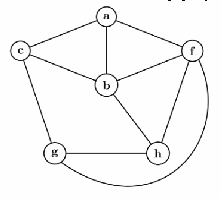
- (A), (B) and (D) only
- (A), (B), (C) and (D)
- (B), (C) and (D) only
- (A), (C) and (D) only
Let ε = 0.0005 and R_ε be the relation {(x, y) ∈ ℝ² : |x − y| < ε}, interpreted as 'approximately equal'. R_ε is (A) reflexive (B) symmetric (C) transitive.
- (A) and (B) only true
- (B) and (C) only true
- (A) and (C) only true
- (A), (B) and (C) true
In reference to big data, consider the following databases: (A) Memcached (B) CouchDB (C) InfiniteGraph.
- (A) and (B) only
- (B) and (C) only
- (C) and (A) only
- (A), (B) and (C)
Match List I with List II. List I: A. BCNF, B. 3NF, C. 2NF, D. 4NF. List II: I. Removes multivalued dependency, II. Not always dependency preserving, III. Removes transitive dependency, IV. Removes partial functional dependency.
- (A)-(III), (B)-(II), (C)-(IV), (D)-(I)
- (A)-(II), (B)-(IV), (C)-(I), (D)-(III)
- (A)-(II), (B)-(III), (C)-(IV), (D)-(I)
- (A)-(II), (B)-(I), (C)-(IV), (D)-(III)
Match List I with List II. List I: A. Localization, B. Packaging or binding of a collection of items, C. Mechanism that lets a designer focus on the essential details of a component, D. Information hiding. List II: I. Encapsulation, II. Abstraction, III. Characteristic of software indicating how concentrated information is in the program, IV. Suppressing the operational details of a component.
- (A)-(I), (B)-(II), (C)-(III), (D)-(IV)
- (A)-(II), (B)-(I), (C)-(III), (D)-(IV)
- (A)-(III), (B)-(I), (C)-(II), (D)-(IV)
- (A)-(III), (B)-(I), (C)-(IV), (D)-(II)
Match List I with List II. List I: (A) Type 0, (B) Type 1, (C) Type 2, (D) Type 3. List II: (I) Finite automata, (II) Turing machine, (III) Linear bounded automata, (IV) Pushdown automata.
- (A)-(III), (B)-(IV), (C)-(II), (D)-(I)
- (A)-(II), (B)-(III), (C)-(IV), (D)-(I)
- (A)-(III), (B)-(IV), (C)-(I), (D)-(II)
- (A)-(II), (B)-(III), (C)-(II), (D)-(IV)
Match List I with List II. List I: (A) Ontological engineering, (B) Taxonomy hierarchy, (C) Inheritance, (D) Probability models. List II: (I) Organizing subclass relations, (II) Organizing knowledge into categories and sub-categories, (III) Attaches a number to each possibility, (IV) Representing concepts, events, time and physical concepts of different domains.
- (A)-(II), (B)-(I), (C)-(IV), (D)-(III)
- (A)-(I), (B)-(II), (C)-(III), (D)-(IV)
- (A)-(IV), (B)-(III), (C)-(I), (D)-(II)
- (A)-(IV), (B)-(II), (C)-(I), (D)-(III)
Match List I with List II. List I: (A) Least frequently used, (B) Critical section, (C) Loosely coupled multiprocessor system, (D) Distributed operating system. List II: (I) Memory is distributed among processors, (II) Page-replacement policy in cache memory, (III) Program section that, once begun, must complete before another processor accesses the same shared resource, (IV) OS routines are distributed among available processors.
- (A)-(III), (B)-(II), (C)-(IV), (D)-(I)
- (A)-(I), (B)-(II), (C)-(III), (D)-(IV)
- (A)-(II), (B)-(III), (C)-(I), (D)-(IV)
- (A)-(II), (B)-(I), (C)-(III), (D)-(IV)
Match List I with List II. List I: (A) Firmware, (B) Batch file, (C) Packing, (D) Banker's algorithm. List II: (I) Number of logical records into physical blocks, (II) ASCII format, (III) Resource allocation, (IV) ROM.
- (A)-(II), (B)-(I), (C)-(IV), (D)-(III)
- (A)-(II), (B)-(I), (C)-(III), (D)-(IV)
- (A)-(IV), (B)-(II), (C)-(I), (D)-(III)
- (A)-(IV), (B)-(I), (C)-(II), (D)-(III)
Match List I with List II. List I: (A) DES, (B) AES, (C) 3DES, (D) RSA. List II: (I) Key size 256, (II) Key size 1024, (III) Key size 56, (IV) Key size 168.
- (A)-(I), (B)-(II), (C)-(IV), (D)-(III)
- (A)-(III), (B)-(I), (C)-(IV), (D)-(II)
- (A)-(III), (B)-(IV), (C)-(II), (D)-(I)
- (A)-(IV), (B)-(II), (C)-(III), (D)-(I)
Match List I with List II. List I: (A) BIND, (B) LISTEN, (C) ACCEPT, (D) SOCKET. List II: (I) Block the caller until a connection attempt arrives, (II) Give a local address to a socket, (III) Show willingness to accept connections, (IV) Create a new end point.
- (A)-(I), (B)-(III), (C)-(II), (D)-(IV)
- (A)-(II), (B)-(III), (C)-(I), (D)-(IV)
- (A)-(III), (B)-(II), (C)-(I), (D)-(IV)
- (A)-(I), (B)-(II), (C)-(III), (D)-(IV)
Match List I with List II. List I: (A) Physical layer, (B) Data link layer, (C) Network layer, (D) Presentation layer. List II: (I) Routing of signals, dividing outgoing messages into packets, acting as network controller, (II) Making and breaking connections, defining voltages and data rates, converting bits into electrical signals, (III) Synchronization, error detection and correction, assembling outgoing messages into frames, (IV) Works as a translating layer.
- (A)-(IV), (B)-(III), (C)-(II), (D)-(I)
- (A)-(II), (B)-(III), (C)-(IV), (D)-(I)
- (A)-(IV), (B)-(III), (C)-(I), (D)-(II)
- (A)-(II), (B)-(III), (C)-(I), (D)-(IV)
Match each algorithm with its running time. (A) Breadth-first search, (B) Rabin–Karp algorithm, (C) Depth-first search, (D) Heap sort (worst case), (E) Quick sort (worst case). Times: (I) Θ(V + E), (II) O(V + E), (III) Θ((n − m + 1)m), (IV) O(n²), (V) O(n log n).
- (A)-(III), (B)-(II), (C)-(I), (D)-(IV), (E)-(V)
- (A)-(II), (B)-(III), (C)-(I), (D)-(V), (E)-(IV)
- (A)-(II), (B)-(III), (C)-(I), (D)-(V), (E)-(IV)
- (A)-(III), (B)-(I), (C)-(II), (D)-(IV), (E)-(V)
Match List I with List II. List I: (A) Stack algorithm, (B) Elevator algorithm, (C) Priority scheduling algorithm, (D) Havender's algorithm. List II: (I) Deadlock, (II) Disk scheduling, (III) Page replacement, (IV) CPU scheduling.
- (A)-(III), (B)-(II), (C)-(IV), (D)-(I)
- (A)-(II), (B)-(III), (C)-(IV), (D)-(I)
- (A)-(III), (B)-(II), (C)-(I), (D)-(IV)
- (A)-(II), (B)-(III), (C)-(I), (D)-(IV)
Statement I: Vertex cover has a polynomial-time 2-approximation algorithm. Statement II: TSP-tour is a polynomial-time 3-approximation algorithm for the travelling salesman problem with the triangle inequality. Which is correct?
- Statement I true and Statement II false
- Statement I and Statement II true
- Statement I false and Statement II true
- Statement I and Statement II false
Statement I: Conservative 2PL is a deadlock-free protocol. Statement II: Thomas's write rule enforces conflict serializability. Statement III: Timestamp ordering ensures serializability based on the order of transaction timestamps. Which is correct?
- Statements I and II true, Statement III false
- Statements I and III true, Statement II false
- Statements I and II false, Statement III true
- Statements I, II and III true
Statement I: Composite attributes cannot be divided into smaller subparts. Statement II: Complex attributes are formed by nesting composite and multivalued attributes in an arbitrary way. Statement III: A derived attribute is one whose values are computed from other attributes. Which is correct?
- Statements I, II and III are true
- Statement I true and Statements II, III false
- Statements I, II true and Statement III false
- Statement I false and Statements II, III true
Statement I: Working from the general to the specific.
Statement II: Postponing the minor decisions.
Statement III: A systematic approach.
Statement IV: Intermediate coding of the problem.
Which of the following is true?
- Statement I only
- Statements I and II only
- Statements I, II and III only
- Statements I, II and IV only
Statement I: The LALR parser is more powerful than the canonical LR parser. Statement II: The SLR parser is more powerful than LALR. Which is correct?
- Statement I true and Statement II false
- Statement I false and Statement II true
- Both Statements I and II false
- Both Statements I and II true
Statement I: CFLs are closed under homomorphism. Statement II: CFLs are closed under complement. Which is correct?
- Statement I is true and Statement II is false
- Statement II is true and Statement I is false
- Both Statement I and Statement II are true
- Neither Statement I nor Statement II is true
X: a ∨ (b ∧ (a ∨ c)) = (a ∨ b) ∧ (a ∨ c)
Y: a ∧ (b ∨ (a ∧ c)) = (a ∧ b) ∨ (a ∧ c)
The identity a ∨ (b ∧ c) = (a ∨ b) ∧ c is satisfied if
- X is true
- Y is true
- Both X and Y are true
- It does not depend on X and Y
- Completeness
- Consistency
- Clarity
- Reliability
Assertion (A): p̄. Reason (R): (r → q̄, r ∨ s, s → q̄, p → q). Choose the correct answer.
- Both (A) and (R) are true and (R) is the correct explanation of (A)
- Both (A) and (R) are true but (R) is NOT the correct explanation of (A)
- (A) is true but (R) is false
- (A) is false but (R) is true
Of the following, which is NOT a logical error?
- Using '=' instead of '==' to check whether two values are equal
- Divide by zero
- Failing to initialize counter and total variables before the body of a loop
- Using commas instead of the two required semicolons in a for loop header
Assertion (A): A load-and-go assembler avoids the overhead of writing the object program out and reading it back in. Reason (R): This can be done with either a one-pass or a two-pass assembler.
- Both (A) and (R) are true and (R) is the correct explanation of (A)
- Both (A) and (R) are true but (R) is NOT the correct explanation of (A)
- (A) is true but (R) is false
- (A) is false but (R) is true
Which statement is false?
- All function calls in C pass arguments using call by value
- Call by reference enables a called function to modify a variable in the calling function
- Call by value is always more efficient than call by reference
- Programmers use pointers and indirection to simulate call by reference
Statement I: "Grandparent is a parent of one's parent". Statement II: Its first-order predicate logic representation is ∀g, c grandparent(g, c) ⇔ ∃p parent(g, p) ∧ parent(p, c).
- Both Statement I and Statement II are correct
- Both Statement I and Statement II are incorrect
- Statement I is correct but Statement II is incorrect
- Statement I is incorrect but Statement II is correct
Statement I: Consider the 20-bit 'Branch' microinstruction format: F1 (3 bits), F2 (3), F3 (3), CD (2), BR (2), AD (7), where F1–F3 are micro-operation fields, CD is the branch condition, BR the branch field and AD the address field. Statement II: An instruction in this format can perform a branch in 4 conditions.
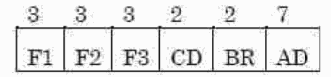
- Both Statement I and Statement II are correct
- Both Statement I and Statement II are incorrect
- Statement I is correct but Statement II is incorrect
- Statement I is incorrect but Statement II is correct
Answer key
- 1 – B
- 2 – A
- 3 – A
- 4 – A
- 5 – A
- 6 – D
- 7 – C
- 8 – D
- 9 – D
- 10 – A
- 11 – C
- 12 – A
- 13 – A
- 14 – C
- 15 – A
- 16 – B
- 17 – A
- 18 – C
- 19 – D
- 20 – B
- 21 – D
- 22 – B
- 23 – B
- 24 – C
- 25 – A
- 26 – A
- 27 – D
- 28 – C
- 29 – D
- 30 – D
- 31 – A
- 32 – A
- 33 – B
- 34 – B
- 35 – A
- 36 – A
- 37 – B
- 38 – B
- 39 – A
- 40 – C
- 41 – D
- 42 – A
- 43 – D
- 44 – D
- 45 – B
- 46 – B
- 47 – C
- 48 – B
- 49 – B
- 50 – B
- 51 – A
- 52 – C
- 53 – B
- 54 – A
- 55 – B
- 56 – C
- 57 – B
- 58 – D
- 59 – C
- 60 – D
- 61 – A
- 62 – D
- 63 – C
- 64 – A
- 65 – A
- 66 – D
- 67 – C
- 68 – D
- 69 – A
- 70 – A
- 71 – C
- 72 – C
- 73 – D
- 74 – D
- 75 – D
- 76 – C
- 77 – C
- 78 – B
- 79 – D
- 80 – C
- 81 – D
- 82 – B
- 83 – B
- 84 – D
- 85 – C
- 86 – A
- 87 – A
- 88 – B
- 89 – D
- 90 – C
- 91 – C
- 92 – A
- 93 – C
- 94 – D
- 95 – B
- 96 – D
- 97 – C
- 98 – C
- 99 – A
- 100 – A