
UGC NET Paper 2 Computer Science – December 2023 – Question Paper with Answer Key
Solved by The Binary Brothers: every question has the correct answer and an explanation. Open any question for its full solution, or practice it in the unit-wise mock tests.
- 10/5
- 3/5
- 2/5
- 1/5
- abcba
- abba
- abbbba
- adba
Which of the following is TRUE?
- The cost of searching an AVL tree is Θ(log n) but that of a binary search tree is O(n)
- The cost of searching an AVL tree is Θ(log n) but that of a complete binary tree is Θ(n log n)
- The cost of searching a binary search tree is O(log n) but that of an AVL tree is Θ(n)
- The cost of searching an AVL tree is Θ(n log n) but that of a binary search tree is O(n)
- 8
- 14
- 10
- 5
- Encoder
- Decoder
- Flip-Flop
- Register
- BCD
- Excess-3
- Gray
- Excess-3 Gray
- Circular shift
- Logical shift
- Arithmetic shift right
- Arithmetic shift left
- Micro program
- Micro operation
- Routine
- Subroutine
- P(−20,−12), Q(−20,−4) and R(10,4)
- P(−30,−12), Q(−22,−4) and R(10,4)
- P(−25,−10), Q(22,−4) and R(10,4)
- P(30,−12), Q(−22,4) and R(10,4)
Which of the following statements is TRUE?
- Virtual functions do not implement polymorphism
- Virtual functions do not permit calling of derived class functions using a base class pointer
- We can never build an object from a class containing a pure virtual function
- Pure virtual function can never have a body
#include<stdio.h>
int main() {
  int i = 3;
  while (i--) {
    int i = 10;
    i--;
    printf("%d", i);
  }
  printf("%d", i);
}- 990
- 9990
- 999-1
- 99-1
The Hue of a color is related to its:
- Luminance
- Saturation
- Incandescence
- Wavelength
- Normalization
- DML
- DDL
- Primary key
- Virtual address
- Memory address
- Logical address
- Physical address
- MIMD
- DMA
- Asynchronous bus
- Synchronous bus
#include <stdio.h>
#define SQR(x) (x*x)
int main() {
  int a, b = 3;
  a = SQR(b+2);
  printf("%d", a);
  return 0;
}- 25
- 11
- Garbage value
- 24
- 259 cylinders
- 169 cylinders
- 154 cylinders
- 264 cylinders
- 1075000 and 5375 KB
- 215000 and 40960 bytes
- 10750 and 10240 bytes
- 43000 and 1024 bytes
- /etc/password
- /root/password
- /etc/passwd
- /root/passwd
- Public key
- Digital signature
- Cipher text
- Data Encryption Standard
Let L= {ab, aa, baa}. Which of the following strings are not in L*?
- abaabaaabaa
- aaaabaaaa
- baaaaabaaaab
- baaaaabaa
Let A={a, b} and L=A*. Let X={anbn, n>0}. The languages L U X and X are respectively :
- Not regular, Regular
- Regular, Regular
- Regular, Not regular
- Not Regular, Not Regular
Which of the following symbol table implementations is best suited if access time is to be minimum?
- Linear list
- Search tree
- Hash Table
- Self organisation list →
- n, E + n and E + n × n
- n, E + n and E + E × n
- n, n + n and n + n × n
- n, E + n and E × n
- Linked list
- Array
- Binary tree
- Stack
- Linear probing
- Quadratic probing
- Chaining
- Double hashing
- h(n) is O(f(n))
- h(n) is O(g(n))
- g(n) is not O(f(n))
- f(n) is O(g(n))
2-3-4 trees are B - trees of order 4. They are isometric of trees.
- AVL
- AA
- 2-3
- Red-Black
- Access time
- Latency time
- Response time
- Reading time
- make parsing and semantic analysis simpler
- improve error recovery and error reporting
- increase the chances of reusing the machine-independent code optimizer in other compilers
- improve the register allocation
The sum of minimum and maximum number of final states for a Deterministic Finite Automata (DFA) having ' P ' state is equal to :
- P
- P-1
- P+1
- P+2
- Set of defect cases
- Set of boundary cases
- Set of test cases
- Set of nest cases
- 100 Kbps
- 200 Kbps
- 400 Kbps
- 1000 Kbps
Which of the following is not a field in TCP header?
- Sequence Number
- Checksum
- Fragmentation offset
- Window size
- 0x8C
- 0x6F
- 0xFF
- 0x7E
- Use case Diagram
- Sequence Diagram
- Context Diagram
- Prototype Diagram
What is the generic structure of a Multi-Agent System (MAS)?
- Single-agent with multiple objectives
- Multiagents with single objectives
- Multiagents with diverse objectives and communication abilities
- Multiagent with two objectives ∈
A point of a fuzzy set A is a point x X at which μA(x) = 0. 5
- Core
- Support α − cut
- Crossover
- 2.25
- 6.0
- 0.0
- 6.25
In a feed-forward neural network with the following specifications : The input layer has 4 neurons, hidden layer has 3 neurons, and output layer has 2 neurons using the sigmoid activation function for given input values [0.5,0.8,0.2,0.6] as well as the initial weights for the connections. W1: [0.1,0.3,0.5,0.2] W2: [0.2,0.4,0.6,0.2] W3: [0.3,0.5,0.7,0.2] Input layer to hidden layer weights W4 : [0.4,0.1,0.3] W5 : [0.5,0.2,0.4] Hidden layer to output layer weights What is the output of the output layer when the given input values are passed through neural network? Round the answer to two decimal places:
- [0.62,0.68]
- [0.72,0.78]
- [0.82,0.88]
- [0.92,0.98]
If the universe of discourse is all real numbers, which of the following are true? (A) ∃x∀y (x + y = y) (B) ∀x∀y (((x ≥ 0) ∧ (y < 0)) → (x − y > 0)) (C) ∃x∃y (((x ≤ 0) ∧ (y ≤ 0)) ∧ (x − y > 0)) (D) ∀x∀y (((x ≠ 0) ∧ (y ≠ 0)) ↔ (xy ≠ 0))
- (A) and (B) Only
- (A), (C) and (D) Only
- (A), (B) and (D) Only
- (A), (B), (C) and (D) Only
If the universe of discourse is the set of integers, which of the following are TRUE? (A) ∀n∃m (n² < m) (B) ∃n∀m (n < m²) (C) ∃n∀m (nm = m) (D) ∃n∃m (n² + m² = 6) (E) ∃n∃m (n + m = 4 ∧ n − m = 1)
- (A), (B) and (C) Only
- (B) and (C) Only
- (C), (D) and (E) Only
- (C) and (E) Only
Let N² = N × N, where N is the set of natural numbers, and let R be the relation on N² with ⟨x, y⟩ R ⟨u, v⟩ ⇔ xv = yu. Which of the following are TRUE? (A) Reflexive (B) Symmetric (C) Transitive (D) Asymmetric
- (A) and (B) Only
- (B) and (C) Only
- (A), (C) and (D) Only
- (A), (B) and (C) Only
The interface(s) that provide(s) I/0 transfer of data directly to and from the memory unit peripheral is/are termed as:
(A) DMA (Direct Memory Access)
(B) IOP (Input-Output Processor)
(C) Serial Interface
(D) Parallel Interface
- (A) Only
- (B) Only
- (A) and (B) Only
- (C) and (D) Only
Which of the following(s) are main memory?
(A) Virtual memory
(B) Cache memory
(C) RAM
(D) SSD
- (A) and (C) Only
- (B) and (C) Only
- (C) and (D) Only
- (A), (B) and (C) Only
Which of the following are tautology? → → → →
(A) (P (P Q)) (P Q) → → → ∨
(B) ((P Q) Q) (P Q) ∨¬ → → ∨¬ →
(C) ((P P) Q) ((P P) R) → ∧¬ → → ∧¬
(D) (Q (P P)) (R (P P))
- (A) Only
- (B) Only
- (A) and(B) Only
- (C) and (D) Only
Consider the three points P1(1,2,0), P2(3,6,20) and P3(2,4,6) and a view point C(0,0,-10). Choose the correct options.
(A) P1 obscure P2, if viewed from C.
(B) P2 obscure P1, if viewed from C.
(C) P3 does not obscure P1 if viewed from C.
(D) P2 does not obscure P3 if viewed from C.
- (A), (B) and (C) Only
- (A), (C) and (D) Only
- (B), (C) and (D) Only
- (A), (B) and (D) Only
(A) Constructors are invoked automatically when objects are created.
(B) Constructors do not have return types, not even void, and therefore cannot return values.
(C) Constructors cannot be inherited, though a derived class can call the base class constructors.
(D) Constructors can be declared as virtual.
Choose the correct answer from the options given below:
- (A), (B) and (D) Only
- (A), (B) and (C) Only
- (B), (C) and (D) Only
- (A), (C) and (D) Only
(A) Granularity is the size of data items in a database.
(B) Two operations in a schedule are said to be in conflict if they belong to the same transaction.
(C) Two schedules are said to be conflict equivalent if the order of any two conflicting operations is the same in both schedules.
(D) Write operations that are performed without performing the write operation are known as blind writes.
Choose the correct answer from the options given below:
- (A) and (B) Only
- (A), (B) and (C) Only
- (A), (B) and (D) Only
- (B) and (C) Only
(A) The first record in each block of the data file is known as the actor record.
(B) A dense index has index entries for every search-key value in the data file.
(C) Searching is harder in a B+ tree than in a B-tree as all external nodes are linked to each other.
(D) In extendible hashing, the size of the directory is 2^(d−1), where d is the global depth.
Choose the correct answer from the options given below:
- (A), (B) and (C) Only
- (A), (C) and (D) Only
- (A), (B) and (D) Only
- (A), (B), (C) and (D) Only
(A) LOAD and STORE instructions are used to access remote memory.
(B) There is a single address space visible to all CPUs.
(C) Access to local memory is slower than access to remote memory.
(D) When the access time to remote memory is hidden, the system is called NC-NUMA.
(E) In CC-NUMA, coherent caches are present.
Choose the correct answer from the options given below:
- (A) and (C) Only
- (B) and (D) Only
- (A) and (E) Only
- (C) and (D) Only
Indexed/grouped allocation is useful as :
(A) It supports both sequential and direct access.
(B) Entire block is available for data.
(C) It does not require lots of space for keeping pointers.
(D) No external fragmentation.
- (A) Only
- (B) and (C) Only
- (B) Only
- (A), (B) and (D) Only
(A) A process always checks the state of the currently executing process to enter the critical section.
(B) Spin locks use busy waiting.
(C) Periodically testing a variable until some value appears is known as busy waiting.
(D) A critical region is the part of the program where shared memory is accessed.
(E) The printer daemon continuously checks to see if there are any files to be printed.
Choose the correct answer from the options given below:
- (A) and (B) Only
- (B) and (C) Only
- (B) and (D) Only
- (B) and (E) Only
Three address codes can be represented in special structures known as :
(A) Quadruples
(B) Triples
(C) Patterns
(D) Indirect Triples
- (A) and (B) Only
- (A), (B) and (D) Only
- (B) and (C) Only
- (B), (C) and (D) Only
Which of the statement is/are CORRECT ?
(A) Moore and Mealy machines are finite state machines with output capabilities.
(B) Any given Moore machine has an equivalent Mealy machine.
(C) Any given Mealy machine has an equivalent Moore machine.
(D) Moore machine is not a finite state machine.
- (A) and (B) Only
- (A), (B) and (C) Only
- (B) and (D) Only
- (A), (B) and (D) Only
Let P(x) be the statement "x = x²". If the universe of discourse is the integers, which of the following are true? (A) P(0) (B) P(1) (C) P(2) (D) ∃x P(x) (E) ∀x P(x)
- (A), (B) and (E) Only
- (A), (B) and (C) Only
- (A), (B) and (D) Only
- (B), (C) and (D) Only
Which of the following statements are true if the universe of discourse is the set of integers? (A) ∀n (n² ≥ 0) (B) ∃n (n² = 2) (C) ∀n (n² ≥ n) (D) ∃n (n² < 0)
- (A) and (B) Only
- (B) and (C) Only
- (C) and (D) Only
- (A) and (C) Only
Which of the following graphs are trees? (see figure)
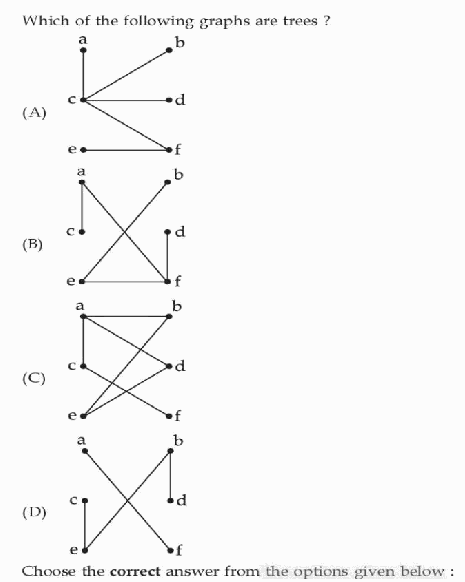
- (A) and (B) only
- (A), (B) and (D) only
- (A) and (D) only
- (A), (B), (C) and (D) only
Which of the following are examples of CSMA channel sensing methods?
(A) 1-persistent
(B) 2-persistent
(C) p-persistent
(D) o-persistent
- (A), (B) and (D) Only
- (A), (C) and (D) Only
- (B), (C) and (D) Only
- (A), (B) and (C) Only
(A) Are requirements easily understandable and defined?
(B) Do we change requirements quite often?
(C) Can we define requirements early in the cycle?
(D) Requirements are indicating a complex to be built
- (C) Only
- (B) Only
- (B) and (D) Only
- (A) and (C) Only
The work done by UDP is/are :
(A) Congestion control
(B) Flow control
(C) Retransmission
(D) Segment transmission
- (A) and (D) Only
- (C) Only
- (D) Only
- (B) and (C) Only
(A) OSPF is based on the distance-vector routing protocol.
(B) Both link-state and distance-vector routing are based on the least-cost goal.
(C) BGP4 is based on the path-vector algorithm.
(D) Three-node instability can be avoided using split horizon combined with poison reverse.
(E) RIP is based on the link-state algorithm.
Choose the correct answer from the options given below:
- (A), (D) and (E) Only
- (A) and (B) Only
- (B) and (C) Only
- (B), (C) and (E) Only
(A) NRZ is a bipolar scheme in which a positive voltage defines bit 0.
(B) NRZ-L and NRZ-I both have an average signal rate of N/2.
(C) The ideas of RZ and NRZ-L are combined in the Manchester scheme.
(D) NRZ-L and NRZ-I both have DC component problems.
(E) The minimum bandwidth of Manchester and differential Manchester is 3 times that of NRZ.
Choose the correct answer from the options given below:
- (A), (B) and (C) Only
- (A), (C), (D) and (E) Only
- (B), (C) and (D) Only
- (A), (B), (C) and (E) Only
Which of the following are commonly used parsing techniques in NLP (Natural Language Processing) for syntactic analysis?
(A) Top-down parsing
(B) Bottom Up parsing
(C) Dependency parsing
(D) Statistical machine translation
(E) Earley parsing
- (A), (C), (D), (E) Only
- (B), (C), (D), (E) Only
- (A), (B), (C), (E) Only
- (A) and (B) Only
(A) Alpha-beta pruning can eliminate subtrees with certainty when the value of a node exceeds the alpha/beta bounds.
(B) The primary purpose of alpha-beta pruning is to save computation time by searching fewer nodes in the same tree.
(C) Alpha-beta pruning guarantees the optimal solution in all cases by exploring the entire game tree.
(D) Alpha and beta bounds are initialised to negative and positive infinity respectively at the root node.
Choose the correct answer from the options given below:
- (A), (C), (D) Only
- (B), (C), (D) Only
- (A), (B), (D) Only
- (C), (B) Only
Match List I with List II. List I: (A) ∅ ∩ {∅} = (B) {∅} ∩ {∅} = (C) {∅, {∅}} − ∅ = (D) ∅ ∪ {{∅}} =. List II: (I) ∅ (II) {∅} (III) {{∅}} (IV) {∅, {∅}}
- (A)-(I), (B)-(II), (C)-(III), (D)-(IV)
- (A)-(II), (B)-(I), (C)-(III), (D)-(IV)
- (A)-(II), (B)-(I), (C)-(IV), (D)-(III)
- (A)-(I), (B)-(II), (C)-(IV), (D)-(III)
Match List - I with List - II.
List - I List - II
(a) SZA (I) Increment M and skip it zero
(b) SKI (II) Skip if AC is negative
(c) SNA (III) Skip if input flag is on
(d) ISZ (IV) Skip if AC is Zero
- (a)-(II), (b)-(IV), (c)-(I), (d)-(III)
- (a)-(IV), (b)-(III), (c)-(II), (d)-(I)
- (a)-(IV), (b)-(II), (c)-(I), (d)-(III)
- (a)-(III), (b)-(IV), (c)-(II), (d)-(I)
Match List - I with List - II.
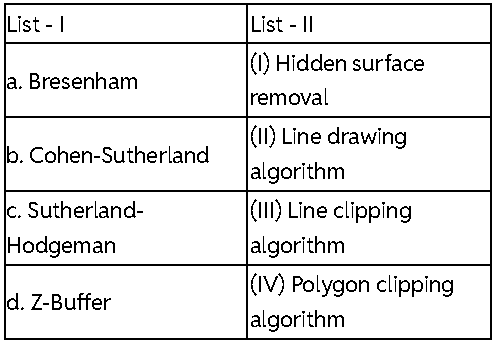
- (a)-(III), (b)-(II), (c)-(IV), (d)-(I)
- (a)-(II), (b)-(III), (c)-(I), (d)-(IV)
- (a)-(II), (b)-(III), (c)-(IV), (d)-(I)
- (a)-(II), (b)-(IV), (c)-(III), (d)-(I)
Match List - I with List - II.
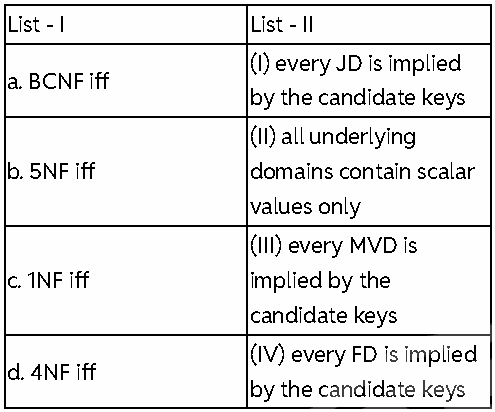
- (a)-(III), (b)-(II), (c)-(I), (d)-(IV)
- (a)-(IV), (b)-(I), (c)-(II), (d)-(III)
- (a)-(II), (b)-(III), (c)-(IV), (d)-(I)
- (a)-(IV), (b)-(I), (c)-(III), (d)-(II)
Match List - I with List - II.
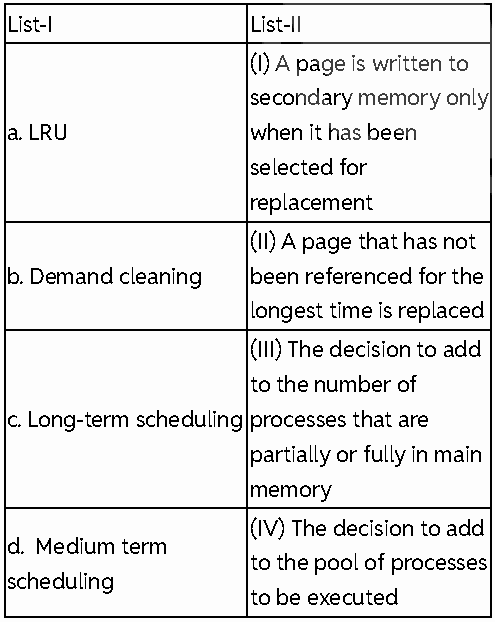
- (a)-(I), (b)-(III), (c)-(IV), (d)--(II)
- (a)-(II), (b)--(I), (c)-(IV), (d)-(III)
- (a)-(III), (b)-(II), (c)--(I), (d)-(IV)
- (a)-(IV), (b)-(II), (c)-(III), (d)-(I)
Match List - I with List - II according to input to the compiler phase that process it :
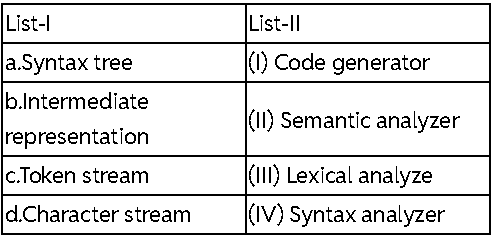
- (a)-(IV), (b)-(III), (c)-(I), (d)-(II)
- (a)-(II), (b)-(I), (c)-(IV), (d)-(III)
- (a)-(II), (b)-(IV), (c)-(I), (d)-(III)
- (a)-(IV), (b)-(I), (c)-(II), (d)-(III)
Match List - I with List - II.
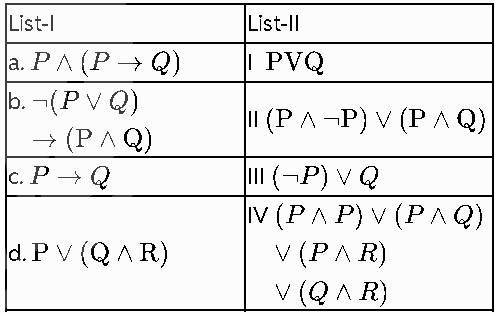
- (a)-(I), (b)-(II), (c)-(III), (d)-(IV)
- (a)-(II), (b)-(I), (c)-(III), (d)-(IV)
- (a)-(III), (b)-(I), (c)-(II), (d)-(IV)
- (a)-(IV), (b)-(III), (c)-(II), (d)-(I)
Match List - I with List - II.
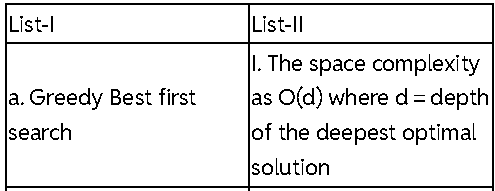
b. A* II. Incomplete even if the search space is finite
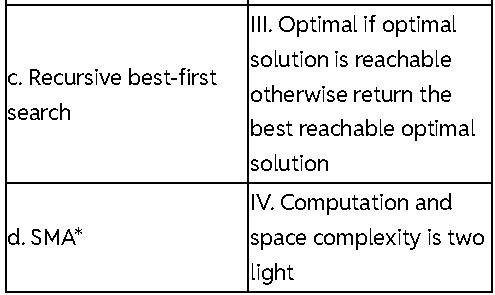
- (a)-(II), (b)-(IV), (c)-(I), (d)-(III)
- (a)-(II), (b)-(III), (c)-(I), (d)-(IV)
- (a)-(III), (b)-(II), (c)-(IV), (d)-(I)
- (a)-(III), (b)-(IV), (c)-(II), (d)-(I)
Match List - I with List - II.
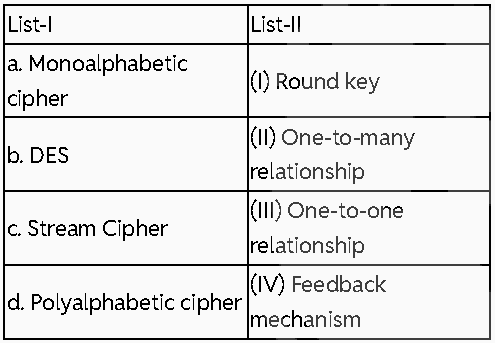
- (a)-(III), (b)-(I), (c)-(IV), (d)-(II)
- (a)-(III), (b)-(IV), (c)-(II), (d)-(I)
- (a)-(I), (b)-(III), (c)-(IV), (d)-(II)
- (a)-(II), (b)-(I), (c)-(IV), (d)-(III)
Match List - I with List - II.
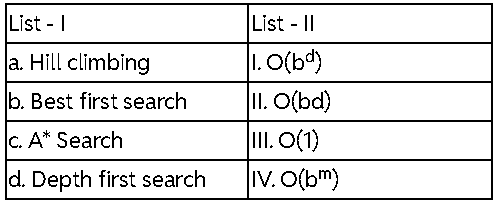
- (a)-(III), (b)-(I), (c)-(IV), (d)-(II)
- (a)-(II), (b)-(I), (c)-(IV), (d)-(III)
- (a)-(II), (b)-(IV), (c)-(I), (d)-(III)
- (a)-(I), (b)-(III), (c)-(II), (d)-(I)
Arrange the following in ascending order: (a) remainder of 49¹⁶ divided by 17 (b) remainder of 24⁴⁶ divided by 9 (c) remainder of 155¹⁷ divided by 17 (d) last digit of 7⁴⁵
- (a), (b), (c), (d)
- (a), (b), (d), (c)
- (a), (c), (b), (d)
- (d), (c), (b), (a)
In most general case, the computer needs to process each instruction with the following sequence of steps:
(A) Calculate the effective address
(B) Execute the instruction
(C) Fetch the instruction from memory
(D) Fetch the operand from memory
(E) Decode the instruction
- (C),(E),(D),(A),(B)
- (C),(E),(A),(D),(B)
- (A),(B),(C),(E),(D)
- (A),(B),(C),(D),(E)
int arr[] = {0,1,2,3,4};
int i = 1, *ptr;
ptr = arr + 2;
Arrange the following printf statements in increasing order of their output:(a) printf("%d", ptr[i]);
(b) printf("%d", ptr[i+1]);
(c) printf("%d", ptr[-i]);
(d) printf("%d", ptr[-i+1]);
- (c), (a), (b), (d)
- (c), (d), (a), (b)
- (d), (a), (b), (c)
- (a), (b), (d), (c)
(a) Draw interaction diagrams
(b) Draw state chart and object diagrams
(c) Draw use case and activity diagrams
(d) Draw component and deployment diagrams
(e) Draw class diagram
Choose the correct answer from the options given below:
- (e) → (b) → (a) → (c) → (d)
- (b) → (a) → (e) → (d) → (c)
- (e) → (c) → (b) → (d) → (a)
- (c) → (a) → (e) → (b) → (d)
(A) user mode programs
(B) bottom half interrupt handlers
(C) kernel system service routines
(D) top half interrupt handlers
- (A), (B), (D), (C)
- (A), (C), (B), (D)
- (A), (C), (D), (B)
- (D), (A), (C), (B)
Arrange the following phases of a compiler as per their order of execution (start to end)
(a) Target code generation
(b) Syntax Analysis
(c) Code optimization
(d) Semantic Analysis
(e) Lexical Analysis
- (b), (e), (d), (a), (c)
- (e), (d), (b), (a), (c)
- (e), (b), (d), (c), (a)
- (b),(d),(e),(a),(c)
(a) Customer evaluation
(b) Quick design
(c) Requirements
(d) Implement (build prototype)
(e) Design (refine)
Choose the correct answer from the options given below:
- (c) → (a) → (d) → (b) → (e)
- (b) → (c) → (a) → (d) → (e)
- (c) → (b) → (d) → (a) → (e)
- (e) → (b) → (c) → (d) → (a)
Arrange the following encoding strategies used in Genetic Algorithms (GAs) in the correct sequence starting from the initial step and ending with the final representation of solutions :
(a) Binary Encoding
(b) Real valued Encoding
(c) Permutation Encoding
(d) Gray coding
- (d),(b),(a),(c)
- (b),(d),(a),(c)
- (c),(d),(a),(b)
- (b),(c),(a),(d)
(a) DHCP client sends a DHCPREQUEST message
(b) DHCP server acknowledges the renewal with a DHCPACK message
(c) DHCP client checks the local lease timer and initiates renewal
(d) DHCP server updates its lease database
Choose the correct answer from the options given below:
- (a), (b), (c), (d)
- (c), (d), (b), (a)
- (c), (b), (a), (d)
- (c), (a), (b), (d)
Arrange the following steps in the correct sequence for applying an unsupervised learning technique such as K-means clustering to a data set:
(a) Randomly initialize cluster centroids
(b) Assign each data point to nearest cluster centroid
(c)Update the cluster centroids based on the mean of data points assigned to each cluster
(d) Specify the number of clusters (K) to partition the data into
(e) Repeat steps B and C until convergence criteria are met
- (d),(a),(b),(c),(e)
- (a),(b),(c),(d),(e)
- (c),(b),(a),(d),(e)
- (d),(c),(a),(b),(e)
Given below are two statements :
Statement (I): If H is a nonempty finite subset of ∈ ∀ ∈ a group G and ab H a,b H then H is also a group
Statement (II): There is no homomorphism existing from (Z,+) to (Q,+); where Z is a set of integers and Q is a set of rational numbers. In the light of the above statements, choose the most appropriate answer from the options given below:
- Both Statement I and Statement II are correct
- Both Statement I and Statement II are incorrect
- Statement I is correct but Statement II is incorrect
- Statement I is incorrect but Statement II is correct
Statement (II): A friend function can access private data through the member functions of the base class.
In the light of the above statements, choose the most appropriate answer from the options given below:
- Both Statement I and Statement II are correct
- Both Statement I and Statement II are incorrect
- Statement I is correct but Statement II is incorrect
- Statement I is incorrect but Statement II is correct
Statement (II): It is not possible to alter the behaviour of a thread by altering its context when the thread is suspended.
In the light of the above statements, choose the most appropriate answer from the options given below:
- Both Statement I and Statement II are correct
- Both Statement I and Statement II are incorrect
- Statement I is correct but Statement II is incorrect
- Statement I is incorrect but Statement II is correct
Given below are two statements :
Statement (I) : In Reuse Oriented Model, Modification of the old system parts appropriate to the new requirements.
Statement (II) : In Reuse Oriented Model, Integration of the modified parts are not possible into the new systems. In the light of the above statements, choose the most appropriate answer from the options given below :
- Both Statement I and Statement II are correct
- Both Statement I and Statement II are incorrect
- Statement I is correct but Statement II is incorrect
- Statement I is incorrect but Statement II is correct
Given below are two statements:
Statement (I) : In datagram networks - routers hold state information about connections
Statement (II) : In a virtual circuit network- each virtual circuit requires router table space per connection In the light of the above statements, choose the most appropriate answer from the options given below :
- Both Statement I and Statement II are correct
- Both Statement I and Statement II are incorrect
- Statement I is correct but Statement II is incorrect
- Statement I is incorrect but Statement II is correct Directions (91-95) Read the following passage and answer the given questions. Food X contains 6 units of Vitamin D per gram and 7 units of Vitamin E per gram and cost is Rs 12 per gram. Food Y contains 8 units of vitamin D per gram and 12 units of Vitamin E per gram and cost is Rs 20 per gram. The daily minimum requirements of vitamin D and E are 100 units and 120 units respectively. Suppose x is the quantity (in gram) of food X, y is quantity (in gram) of food Y. Answering the following question based on the above paragraph given.
Directions (Q91–95): Food X contains 6 units of vitamin D and 7 units of vitamin E per gram and costs ₹12 per gram. Food Y contains 8 units of vitamin D and 12 units of vitamin E per gram and costs ₹20 per gram. The daily minimum requirements of vitamins D and E are 100 units and 120 units. Let x and y be the grams of food X and Y.
The cost function of total food is:
- Z=6 x+7 y
- Z=8 x+12 y
- Z=12 x+20 y
- Z=20 x+12 y
Which of the following constraints when formulating the LPP?
- 6 x+7 y<= 100,8 x+12 y <= 120, x, y >= 0
- 6 x+8 y <=100,7 x+12 y <=120, x, y>= 0
- 6 x+7 y >= 100,8 x+12 y >=120, x, y >= 0
- 6 x+8 y >= 100,7 x+12 y >=120, x, y >= 0
Which of the following are quantities (in grams) of food X and Y respectively when the cost of food is minimum:
- 0 and 12½
- 15 and 5/4
- 120/7 and 0
- 0 and 10
The dual of the formulated LPP is :
- Max Z=100 u+120 v s.t. 6 u+7 v <=12 8 u+12 v <= 20 u, v >= 0
- Max Z=12 u+20 v s.t. 6 u+7 v <=100 8 u+12 v <= 120 u, v >= 0
- Max Z=100 u+120 v 6 u+7 u <=12 8 u+7 v <= 20 u, v are unrestricted
- Max Z=100 u+120 u s.t. 6 u+7 v >= 12 8 u+12 v >=20 u, v >= 0
The minimum cost of food is:
- 205
- 250
- 330
- 200 Directions (96-100) Read the following passage and answer the given questions. Consider the following relations X(S, S i, C) and Y(S, P, D). X S Si C J 1 M B 2 N R 3 H T 4 G Y S P D J S1 CA B P1 AB R D1 DC A H1 MD
Directions (Q96–100): Relations X(S, Si, C) with tuples (J, 1, M), (B, 2, N), (R, 3, H), (T, 4, G), and Y(S, P, D) with tuples (J, S1, CA), (B, P1, AB), (R, D1, DC), (A, H1, MD).
Find the number of tuples obtained by applying the right outer join X ⟖ (X.S = Y.S) Y.
- 1
- 3
- 4
- 6
The result of the operation X ⟖ (X.S = Y.S) Y (right outer join) will be:
- Columns S, Si, C, P, D: (J,1,M,S1,CA), (B,2,N,P1,AB), (R,3,H,D1,DC), (T,4,G,NULL,NULL)
- Columns S, Si, C, P, D: (J,1,M,S1,CA), (B,2,N,P1,AB), (R,3,H,D1,DC), (A,NULL,NULL,H1,MD)
- Columns S, Si, C, P, D: (J,1,M,S1,CA), (B,2,N,P1,AB), (R,3,H,D1,DC), (T,4,G,NULL,MD)
- None of these
Which of the following join is used to get all the tuples of relation X and Y with Null values of corresponding missing values?
- Left outer join
- Right outer join
- Natural join
- Full outer join
Number of tuples by applying right outer join on relation X and Y is/are :
- 16
- 5
- 3
- 4
Directions (Q96–100): Consider the relations X(S, Si, C) and Y(S, P, D):
| X | ||
|---|---|---|
| S | Si | C |
| J | 1 | M |
| B | 2 | N |
| R | 3 | H |
| T | 4 | G |
| Y | ||
|---|---|---|
| S | P | D |
| J | S1 | CA |
| B | P1 | AB |
| R | D1 | DC |
| A | H1 | MD |
- 16
- 12
- 04
- 32
Answer key
- 1 – B
- 2 – D
- 3 – A
- 4 – B
- 5 – C
- 6 – C
- 7 – C
- 8 – D
- 9 – B
- 10 – C
- 11 – C
- 12 – D
- 13 – C
- 14 – D
- 15 – D
- 16 – B
- 17 – B
- 18 – A
- 19 – C
- 20 – B
- 21 – C
- 22 – C
- 23 – C
- 24 – D
- 25 – B
- 26 – C
- 27 – D
- 28 – D
- 29 – A
- 30 – C
- 31 – C
- 32 – C
- 33 – C
- 34 – C
- 35 – D
- 36 – C
- 37 – C
- 38 – C
- 39 – D
- 40 – A
- 41 – D
- 42 – A
- 43 – D
- 44 – C
- 45 – B
- 46 – C
- 47 – B
- 48 – B
- 49 – B
- 50 – B
- 51 – D
- 52 – D
- 53 – C
- 54 – B
- 55 – B
- 56 – C
- 57 – D
- 58 – A
- 59 – B
- 60 – C
- 61 – C
- 62 – A
- 63 – C
- 64 – C
- 65 – C
- 66 – D
- 67 – B
- 68 – C
- 69 – B
- 70 – B
- 71 – B
- 72 – B
- 73 – A
- 74 – A
- 75 – A
- 76 – C
- 77 – B
- 78 – B
- 79 – D
- 80 – B
- 81 – C
- 82 – C
- 83 – C
- 84 – D
- 85 – A
- 86 – C
- 87 – A
- 88 – B
- 89 – C
- 90 – D
- 91 – C
- 92 – D
- 93 – B
- 94 – A
- 95 – A
- 96 – C
- 97 – B
- 98 – D
- 99 – D
- 100 – A