
UGC NET Paper 2 Computer Science – November 2021 – Question Paper with Answer Key
Solved by The Binary Brothers: every question has the correct answer and an explanation. Open any question for its full solution, or practice it in the unit-wise mock tests.
Which of the statements given below is/are correct? It is always important and useful to include an 'alt' attribute on 'img' tag in HTML because
A. users who cannot see the image due to vision impairment can have a textual description of the image (which can be spoken aloud by a screen reader).
B. If the image fails to load (slow connection, broken path, etc.) then alt text is displayed instead.
C. SEO (Search Engine Optimization) benefits.
Choose the correct answer from the options given below:
- A only
- B and C only
- C only
- A, B, and C f()
What does the following C function f() return?
int f(unsigned int N) {
  unsigned int counter = 0;
  while (N > 0) {
    counter += N & 1;
    N = N >> 1;
  }
  return counter == 1;
}- 1 if N is odd, otherwise 0
- 1 if N is a power of 2 , otherwise 0
- 1 if the binary representation of N is all 1 s 's, otherwise 0
- 1 if the binary representation of N has any 1 's, otherwise 0 F()
Consider the following recursive Java function:
public static String F(int N) {
  if (N <= 0) return "-";
  return F(N - 3) + N + F(N - 2) + N;
}
The value of F(5) is:
- -2-25-3-135
- -2-25-1-3-135
- -1-145-2-245
- -2-25-3-1-135
Match List I (programming terms) with List II (meaning). List I: A. JNDI, B. RMI, C. JDK, D. JRE. List II: I. Runtime support for running Java programs, II. The API in support of naming and directory services, III. The methods provided by the Java development kit and runtime support for calling remote methods, IV. The compiler and class libraries to develop Java applications.
- A-II, B-III, C-IV, D-I
- A-II, B-IV, C-III, D-I
- A-I, B-III, C-IV, D-II
- A-III, B-II, C-IV, D-I
Match List I (programming paradigms) with List II (characteristics). List I: A. Imperative, B. Object-oriented, C. Logic, D. Functional. List II: I. Declarative, clausal representation, theorem proving, II. Side-effect-free, declarative, expression evaluation, III. Imperative, abstract data type, IV. Command-based, procedural.
- A ‐ IV, B ‐ III, C ‐ I, D ‐ II
- A ‐ III, B ‐ IV, C ‐ I, D ‐ II
- A ‐ IV, B ‐ III, C ‐ II, D ‐ I
- A ‐ II, B ‐ III, C ‐ I, D ‐ IV
Suppose you have eight black-and-white images taken with a 1-megapixel camera and one 8-colour image taken with an 8-megapixel camera. How much hard disk space in total do you need to store these images?
- 1 GB
- 4 MB
- 3 MB
- 3 GB
Which of the statements given below are correct? The midpoint (or Bresenham) algorithm for rasterizing lines is optimized relative to DDA algorithm in that
A. it avoids round‐off operations.
B. it is incremental.
C. it uses only integer arithmetic.
D. all straight lines can be displayed as straight (exact).
- A and B only
- A and C only
- A, B, C, and D
- A, B, and C only M
What is the transformation matrix that transforms the square with vertices (1, 1), (−1, 1), (−1, −1), (1, −1) into the parallelogram with corresponding vertices (2, 1), (0, 1), (−2, −1), (0, −1)?
- M = [1 1 0; 0 1 0; 0 0 1]
- M = [1 0 0; 1 1 0; 0 0 1]
- M = [1 1 1; 0 1 0; 0 0 1]
- M = [1 1 0; 1 1 0; 0 0 1]
A Bezier curve P(t) is defined by four control points P0 = (−2, 0), P1 = (−2, 4), P2 = (2, 4), P3 = (2, 0). Which statements are correct? A. P(t) has degree 3. B. P(1/2) = (0, 3). C. The curve may extend outside the convex hull of its control points.
- A and B only
- A and C only
- B and C only
- A, B, and C
Given below are two statements
Statement I: The maximum number of sides that a triangle might have when clipped to a rectangular viewport is 6.
Statement II: In 3D graphics, the perspective transformation is nonlinear in z. In light of the above statements, choose the correct answer from the options given below
- Both Statement I and Statement II are true.
- Both Statement I and Statement II are false
- Statement I is true but Statement II is false
- Statement I is false but Statement II is true
In software testing, beta testing is the testing performed by _______________.
- potential customers at the developer's location
- potential customers at their own locations
- product developers at the customer's location
- product developers at their own locations
The V components in MVC are responsible for:
- User interface.
- Security of the system.
- Business logic and domain objects.
- Translating between user interface actions/events and operations on the domain objects.
In software engineering, what kind of notation do formal methods predominantly use?
- textual
- diagrammatic
- mathematical
- computer code
If every requirement stated in the Software Requirement Specification (SRS) has only one interpretation, then SRS is said to be
- correct
- consistent
- unambiguous
- verifiable 99. 99%
A system has uptime and has a mean‐ 1 day time‐between‐failure of . How fast does the system has to repair itself in order to reach this availability goal?
- ~9 Seconds
- ~10 Seconds
- ~11 Seconds
- ~12 Seconds
In the context of Software Configuration Management (SCM), what kind of files should be committed to your source control repository?
A. Code files
B. Documentation files
C. Output files
D. Automatically generated files that are required for your system to be used
- A and B only
- B and C only
- C and D only
- D and A only
Match List I (software process model) with List II (description). List I: A. Waterfall model, B. Evolutionary model, C. Component-based software engineering, D. Spiral development. List II: I. Software can be developed incrementally, II. Requirement compromises are inevitable, III. Explicit recognition of risk, IV. Inflexible partitioning of the project into stages.
- A ‐ IV, B ‐ I, C ‐ III, D ‐ II
- A ‐ I, B ‐ IV, C ‐ II, D ‐ III
- A ‐ II, B ‐ III, C ‐ I, D ‐ IV
- A ‐ IV, B ‐ I, C ‐ II, D ‐ III
Identify the correct order of the following five levels of Capability Maturity Model (from lower to higher) to measure the maturity of an organisation's software process.
A. Defined
B. Optimizing
C. Initial
D. Managed
E. Repeatable
- C, A, E, D, B
- C, E, A, B, D
- C, B, D, E, A
- C, E, A, D, B
Given below are two statements
Statement I: Cleanroom software process model incorporates the statistical quality certification of code increments as they accumulate into a system.
Statement II: Cleanroom software engineering follows the classic analysis, design, code, test, and debug cycle to software development and focussing on defect removal rather than defect prevention. In light of the above statements, choose the correct answer from the options given below
- Both Statement I and Statement II are true
- Both Statement I and Statement II are false
- Statement I is true but Statement II is false
- Statement I is false but Statement II is true
Given below are two statements, one is labelled as Assertion A and the other is labelled as
Reason R
Assertion A : Software developers donot do exhaustive software testing in practice.
Reason R : Even for small inputs, exhaustive testing is too computationally intensive (e.g., takes too long) to run all the tests. In light of the above statements, choose the correct answer from the options given below
- Both A and R are true and R is the correct explanation of A
- Both A and R are true but R is NOT the correct explanation of A
- A is true but R is false
- A is false but R is true
Which of the following are logically equivalent? A. ¬p → (q → r) and q → (p ∨ r) B. (p → q) → r and p → (q → r) C. (p → q) → (r → s) and (p → r) → (q → s)
- A only
- A and B only
- B and C only
- A and C only
Statement I: ⌊2x⌋ = ⌊x⌋ + ⌊x + 1/2⌋ for every real x. Statement II: ⌈x + y⌉ = ⌈x⌉ + ⌈y⌉ for all real x and y.
- Both Statement I and Statement II are true
- Both Statement I and Statement II are false
- Statement I is true but Statement II is false
- Statement I is false but Statement II is true 5
How many ways are there to assign 5 different jobs to 4 different employees if every employee is assigned at least 1 job?
- 1024
- 625
- 240
- 20
A warehouse has 50 aisles, 85 horizontal locations in each aisle, and 5 shelves. Storage bins are specified by aisle, location and shelf. What is the least number of products so that at least two must be stored in the same bin?
- 251
- 426
- 4251
- 21251
A person climbing stairs can take one or two stairs at a time. How many ways can the person climb a flight of eight stairs?
- 21
- 24
- 31
- 34
Which of the following Graphs is(are) planar?
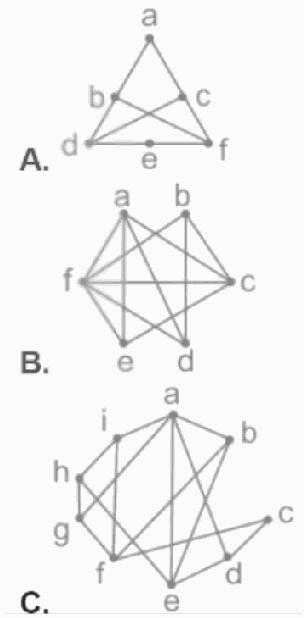
- A and B only
- B and C only
- A only
- B only
Match List I (identity) with List II (name). List I: A. x + x = x, B. x + 0 = x, C. x + 1 = 1, D. x + xy = x. List II: I. Identity law, II. Absorption law, III. Idempotent law, IV. Domination law.
- A ‐ III, B ‐I , C ‐ II, D ‐ IV
- A ‐ I, B ‐III , C ‐ IV, D ‐ II
- A ‐ III, B ‐I , C ‐ IV, D ‐ II
- A ‐ III, B ‐IV , C ‐ I, D ‐ II (X, *)
Let (X, *) be a semigroup in which, for every a, b in X, a ≠ b implies a * b ≠ b * a. Which equalities hold? A. a * a = a for every a. B. a * b * a = a for all a, b. C. a * b * c = a * c for all a, b, c.
- A and B only
- A and C only
- B and C only
- A, B and C
Maximize Z = 6x + 5y subject to 2x − 3y ≤ 5, x + 3y ≤ 11, 4x + y ≤ 15, x, y ≥ 0. The optimal value is
- 15
- 25
- 31.72
- 41.44
Which of the following languages are not regular? A. L = {(01)ⁿ0ᵏ | n > k, k ≥ 0} B. L = {cⁿbᵏaⁿ⁺ᵏ | n ≥ 0, k ≥ 0} C. L = {0ⁿ1ᵏ | n ≠ k}
- A and B only
- A and C only
- B and C only
- A, B and C
Any string of terminals generated by the CFG S → XY, X → 0X | 1X | 0, Y → Y0 | Y1 | 0 (S is the start symbol)
- has at least one 1
- should end with 0
- has no consecutive 0's or 1's
- has at least two 0's
Let L1 = {0ⁿ1ⁿ0ᵐ | n ≥ 1, m ≥ 1}, L2 = {0ⁿ1ᵐ0ᵐ | n ≥ 1, m ≥ 1}, L3 = {0ⁿ1ⁿ0ⁿ | n ≥ 1}. Which are correct? A. L3 = L1 ∩ L2. B. L1 and L2 are context free but L3 is not. C. L1 and L2 are not context free but L3 is. D. L1 is a subset of L3.
- A and B only
- A and C only
- A and D only
- A only
Given below are two statements
Statement I: The family of context free languages is closed under homomorphism
Statement II: The family of context free languages is closed under reversal In light of the above statements, choose the correct answer from the options given below
- Both Statement I and Statement II are true
- Both Statement I and Statement II are false
- Statement I is true but Statement II is false
- Statement I is false but Statement II is true
What is the minimum number of states required to the finite automaton equivalent to the transition diagram given below?
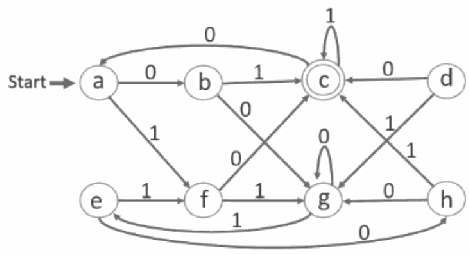
- 3
- 4
- 5
- 6
Find the regular expression for the language accepted by the automata given below.
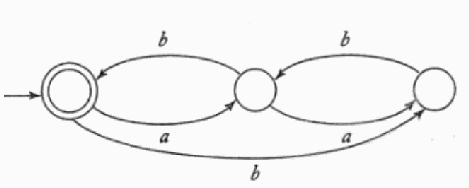
- (aa*(a + b)ab)*
- (a + b)ab(ab + bb + aa* (a + b) ab)*
- a* ab(ab + bb + aa* (a + b ) ab)*
- a*(a + b) ab(ab + bb + aa * (a + b) ab)*
What language is accepted by the PDA M = ({q0, q1, q2}, {a, b}, {a, b, z}, δ, q0, z, {q2}) where in q0 every input symbol is pushed, δ(q0, λ, a) = {(q1, a)}, δ(q0, λ, b) = {(q1, b)}, in q1 a matches a and b matches b (pop), and δ(q1, λ, z) = {(q2, z)}?
- L = {w | nₐ(w) = n_b(w), w ∈ {a, b}⁺}
- L = {w | nₐ(w) ≤ n_b(w), w ∈ {a, b}⁺}
- L = {w | n_b(w) ≤ nₐ(w), w ∈ {a, b}⁺}
- L = {wwᴿ | w ∈ {a, b}⁺}
Match List I (production rules) with List II (grammar). List I: A. S → XY, X → 0, Y → 1. B. S → aS | bSS | c. C. S → AB, A → 0A | 1A | 0, B → 0A. D. S → aAbc, Ab → bA, Ac → Bbcc, bB → Bb, aB → aa | aaA. List II: I. Greibach normal form, II. Context-sensitive grammar, III. Chomsky normal form, IV. S-grammar.
- A ‐ III, B ‐I , C ‐ IV, D ‐ II
- A ‐ III, B ‐II , C ‐ I, D ‐ IV
- A ‐ III, B ‐IV, C ‐ I, D ‐ II
- A ‐ IV, B ‐III , C ‐ I, D ‐ II
Which of the following concepts can be used to identify loops?
A. Depth first ordering
B. Dominators
C. Reducible graphs
- A and B only
- A and C only
- B and C only
- A, B and C
Given below are two statements
Statement I: LL(1) and LR are examples of Bottom‐up parsers.
Statement II: Recursive descent parser and SLR are examples of Top‐down parsers In light of the above statements, choose the correct answer from the options given below
- Both Statement I and Statement II are true
- Both Statement I and Statement II are false
- Statement I is true but Statement II is false
- Statement I is false but Statement II is true
The postfix form of the expression (A + B) * (C * D - E ) * F /G is _______
- A B + C D * E – F G / * *
- A B + C D * E – F * * G /
- A B + C D * E – * F * G /
- A B + C D E * – * F * G /
A double‐ended queue (dequeue) supports adding and removing items from both the ends of the queue. The operations supported by dequeue are AddFront(adding item to front of the queue), AddRear(adding item to the rear of the queue), RemoveFront(removing item from the front of the queue), and RemoveRear(removing item from the rear of the queue). You are given only stacks to implement this data structure. You can implement only push and pop operations. What’s the time complexity of performing AddFront() and AddRear() n assuming m is the size of the stack and is the number of elements?
- O(m) and O(n)
- O(1) and O(n)
- O(n) and O(1)
- O(n) and O(m)
Two balanced binary trees are given with m and n elements, respectively. They can be merged into a balanced binary search tree in ____ time.
- O(m*n)
- O(m + n)
- O(m*log n)
- O(m*log(m + n))
A data structure is required for storing a set of integers such that each of the following O(log n) operations can be done in time, where n is the number of elements in the set. Deletion of the smallest element Insertion of an element if it is not already present in the set Which of the following data structures can be used for this purpose?
- A heap can be used but not a balanced binary search tree.
- A balanced binary search tree can be used but not a heap.
- Both balanced binary search tree and heap can be used.
- Neither balanced binary search tree nor heap can be used.
Consider the following graph.
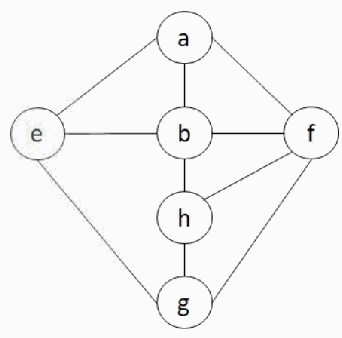
Among the following sequences
I. a b e g h f
II. a b f e h g
III. a b f h g e
IV. a f g h b e Which are depth first traversals of the above graph?
- I, II, and IV only
- I and IV only
- II, III, and IV only
- I, III, and IV only
Given below are two statements
Statement I: In an undirected graph, number of odd degree vertices is even.
Statement II: In an undirected graph, sum of degrees of all vertices is even. In light of the above statements, choose the correct answer from the options given below.
- Both Statement I and Statement II are true.
- Both Statement I and Statement II are false.
- Statement I is true but Statement II is false.
- Statement I is false but Statement II is true.
Which of the given options provides the increasing order of asymptotic complexity of f1, f2, f3 f4 functions and ? f1(n) = 2n A. f2(n) = n3/2 B. f3(n) = n log n C. f4(n) = nlog n D.
- C, B, D, A
- C, B, A, D
- B, C, A, D
- B, C, D, A B+
The order of a leaf node in a B+ tree is the maximum number of (value, data record pointer) pairs it can hold. Given a block size of 1K bytes, a 7-byte data record pointer, a 9-byte value field and a 6-byte block pointer, what is the order of the leaf node?
- 63
- 64
- 67
- 68
A hash function h(key) = key mod 7 with linear probing is used to insert the keys 44, 45, 79, 55, 91, 18, 63 into a table indexed 0 to 6. What will be the location of key 18?
- 3
- 4
- 5
- 6
Match each graph algorithm with its time complexity (n vertices, m edges). List I: A. Bellman-Ford, B. Kruskal's algorithm, C. Floyd-Warshall, D. Topological sorting. List II: I. O(m log n), II. O(n³), III. O(n·m), IV. O(n + m).
- A ‐ III, B ‐ I, C ‐ II, D ‐ IV
- A ‐ II, B ‐ IV, C ‐ III, D ‐ I
- A ‐ III, B ‐ IV, C ‐ I, D ‐ II
- A ‐ II, B ‐ I, C ‐ III, D ‐ IV
Which agent deals with the happy and unhappy state?
- Utility‐based agent
- Model‐based agent
- Goal‐based Agent
- Learning Agent
Given below are two statements
Statement I: Breadth‐First Search is optimal when all the step costs are equal whereas uniform‐cost search is optimal with any step‐cost.
Statement II: When all the step costs are same uniform‐cost search expends more nodes at depth d than the Breadth‐First Search. In light of the above statements, choose the correct answer from the options given below
- Both Statement I and Statement II are true
- Both Statement I and Statement II are false
- Statement I is true but Statement II is false
- Statement I is false but Statement II is true
Consider the game tree shown (root A is MAX; B and C are MIN; D, E, F, G are MAX with leaves D: 3, 5; E: 6, 9; F: 1, 2; G: 0, −1). Calculate the value at the root using alpha-beta pruning.
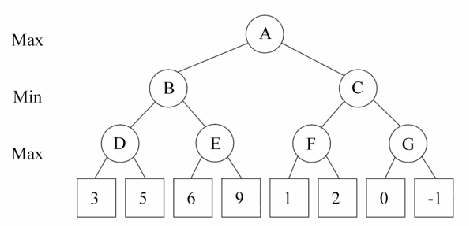
- 3
- 5
- 6
- 9
Which among the following statement(s) is(are) FALSE?
A. Greedy best‐first search is not optimal but is often efficient. A*
B. is complete and optimal provided h(n) is admissible or consistent.
C. Recursive best‐first search is efficient in terms of time complexity but poor in terms of space complexity. h(n) = 0
D. is an admissible heuristic for the 8‐ puzzle.
- A only
- A and D only
- C only
- C and D only
Consider the sentence: There is a country that borders both India and Pakistan. Which expression is correct, where Country(x) means x is a country and Border(x, y) means x and y share a border?
- ∃c Country(c) ∧ Border(c, India) ∧ Border(c, Pakistan)
- ∃c Country(c) ⇒ [Border(c, India) ∧ Border(c, Pakistan)]
- [∃c Country(c)] ⇒ [Border(c, India) ∧ Border(c, Pakistan)]
- ∃c Border(Country(c), India ∧ Pakistan)
Directions (Q56–60): A domain has three Boolean variables Toothache, Cavity and Catch, with full joint distribution: cavity ∧ toothache: catch 0.108, ¬catch 0.012; cavity ∧ ¬toothache: catch 0.072, ¬catch 0.008; ¬cavity ∧ toothache: catch 0.016, ¬catch 0.064; ¬cavity ∧ ¬toothache: catch 0.144, ¬catch 0.576.
The marginal probability of cavity P(cavity) is __________.
- 0.200
- 0.216
- 0.120
- 0.080
The probability of a cavity, given evidence of a toothache, P(cavity | toothache) is __________.
- 0.400
- 0.600
- 0.280
- 0.216
The probability of a toothache, given evidence of a cavity, P(toothache | cavity) is __________.
- 0.400
- 0.600
- 0.280
- 0.216
The probability for Cavity, given that either Toothache or Catch is true, P(Cavity | toothache ∨ catch) is _______.
- 0.6000
- 0.5384
- 0.8000
- 0.4615
Which of the DBMS component ensures that concurrent execution of multiple operations on the database results into a consistent database state?
- Logs
- Buffer manager
- File manager
- Transaction processing system
Consider following two statements:
Statement I: Relational database schema represents the logical design of the database.
Statement II: Current snapshot of a relation only provides the degree of the relation. In the context to the above statements, choose the correct option from the options given below:
- Statement I is TRUE but Statement II is FALSE
- Statement I is FALSE but Statement II is TRUE
- Both Statement I and Statement II are FALSE
- Both Statement I and Statement II are TRUE
Given a fixed‐length record file that is ordered B on the key field. The file needs disk blocks to R store number of records. Find the average access time needed to access any record of the given file using binary search.
- B/2
- B + R
- B
- log₂ B
Given the following STUDENT‐COURSE scheme: STUDENT (Rollno, Name, courseno) COURSE (courseno, coursename, capacity), where Rollno is the primary key of relation STUDENT and courseno is the primary key of relation COURSE. Attribute coursename of COURSE takes unique values only. Which of the following query(ies) will find total number of students enrolled in each course, along with its coursename. *
A. SELECT coursename, count( ) 'total' from STUDENT natural join COURSE group by
coursename;
*
B. SELECT C.coursename, count( ) 'total' from STUDENT S, COURSE C where
S.courseno=C.courseno group by coursename;
*
C. SELECT coursename, count( ) 'total' from COURSE C where courseno in (SELECT courseno
from STUDENT);- A and B only
- C only
- A only
- B only
Given STUDENT(Rollno, Name, Courseno) and COURSE(Courseno, Coursename, Capacity) with 5 and 3 records, R = STUDENT × COURSE is computed. Match List I with List II. List I: A. Degree of table R, B. Cardinality of table R, C. Foreign key of relation STUDENT, D. Foreign key of relation COURSE. List II: I. 15, II. NIL, III. 6, IV. Courseno.
- A ‐III , B ‐I , C ‐IV , D ‐ II
- A ‐I , B ‐III , C ‐IV , D ‐ II
- A ‐I , B ‐III , C ‐IV , D ‐ II
- A ‐I , B ‐III, C ‐II , D ‐ IV
A B tree indexes a database file with search key 10 bytes, block 1024 bytes, record pointer 9 bytes and block pointer 8 bytes. If K is the order of the internal node and L the order of the leaf node, (K, L) =
- (57, 53)
- (50, 52)
- (60, 64)
- (34, 31)
Given R(x, y, z, w) with F = {x → y, z → w}, where all attributes are atomic: A. R is in First Normal Form. B. R is in Second Normal Form. C. The primary key of R is xz.
- C only
- B and C only
- A and C only
- B only
A company is consuming parts in the manufacturing of other products. Each of the part is either manufactured within the company or purchased from the external suppliers or both. For each part, partnumber, partname is maintained. Attribute batchnumber is maintained if the consumed part is manufactured in the company. If part is purchased from external supplier, then supplier name is maintained. Which of the following constraints need to be considered when modelling class/subclass concepts in ERD for the given problem.
- Total specialization and overlapping constraints
- Disjoint constraint only
- Partial participation
- Partial participation and disjoint constraints
A transaction may be in one of the following states during its execution life cycle in concurrent execution environment.
A. FAILED
B. TERMINATED
C. PARTIALLY COMMITTED
D. COMMITTED
E. ACTIVE Given a transaction in active state during its execution, find its next transitioned state from the options given below:
- A only
- Either A or C only
- C only
- D only
Which of the following is used to create a database schema?
- DML
- DDL
- HTML
- XML p
- p + q/100
- (p + q)/100
- p + q
- p/100 + q
In a file allocation system, the following allocation schemes are used:
A. Contiguous
B. Indexed
C. Linked allocation Which of the allocation scheme(s) given above will not suffer from external fragmentation?
Choose the correct answer from the options given below:
- A only
- B and C only
- A and B only
- C only
Given below are three statements related to
interrupt handling mechanismA. Interrupt handler routine is not stored at a fixed address in the memory.
B. CPU hardware has a dedicated wire called the
interrupt request line used for handling
interrupts
C. Interrupt vector contains the memory
addresses for speciaized interrupt handlers. In the context of above statements, choose the correct answer from the options given below:
- A is TRUE only
- Both B and C are TRUE only
- Both A and B are TRUE only
- Both A, C are TRUE only
Match List I (system calls) with List II (description). List I: A. fork(), B. exec(), C. kill(), D. exit(). List II: I. Sends a signal from one process to a particular process, II. Indicates termination of the current process, III. Loads the specified program in memory, IV. Creates a child process.
- A ‐ II , B ‐ III , C ‐ IV , D ‐ I
- A ‐ IV , B ‐ III , C ‐ I , D ‐ II
- A ‐ IV , B ‐ I , C ‐ II , D ‐ III
- A ‐ IV , B ‐ III , C ‐ II, D ‐ I
Consider processes P1 (arrival 0, burst 8), P2 (1, 4), P3 (2, 9), times in ms. What is the average waiting time with preemptive shortest job first scheduling?
- 5.5
- 2.66
- 4.66
- 6
Directions (Q76–80): A machine has 16 GB main memory and a 32-bit virtual address space with 4 KB pages. Frame size equals page size.
Find number of pages required for the given virtual address space
- 2¹⁰
- 2²⁰
- 2³⁰
- 2¹²
What is the minimum number of bits needed for the physical address?
- 28
- 34
- 24
- 12
What is the size of page table for handling the given virtual address space, given that 2 bytes each page table entry is of size ?
- 2 MB
- 2 KB
- 32 MB
- 12 KB
If a process of size 34 KB is to be executed on this machine, what will be the size of internal fragmentation for this process?
- 4 KB
- Zero
- 1 KB
- 2 KB
Match List I with List II. List I: A. Odd function, B. Universal gate, C. 2421 code, D. Buffer. List II: I. NAND gate, II. XOR gate, III. Amplification, IV. Self-complementing.
- A ‐ I, B ‐ II, C ‐ III, D ‐ IV
- A ‐ II, B ‐ I, C ‐ IV, D ‐ III
- A ‐ I, B ‐ III, C ‐ II, D ‐ IV
- A ‐ IV, B ‐ II, C ‐ III, D ‐ I (D. C)
A digital computer has a common bus system for 8 registers 16 bits each. How many multiplexers are required to implement common bus? What size of multiplexers is required?
- 16, 8 × 1
- 8, 16 × 1
- 8, 8 × 1
- 16, 16 × 1
Which of the following is not an example of pseudo‐instruction?
- ORG
- DEC
- END
- HLT
The reverse Polish notation of the infix expression [A * {B + C * (D + E)}] / {F * (G + H)} is
- ABCDE + * + * FGH + * /
- ABCDE * + + * FGH + * /
- ABCDE + * + * FGH * + /
- ABCDE + * * + FGH + * /
Arrange the following in the increasing order of complexity.
A. I/O Module
B. I/O processor
C. I/O Channel
D. DMA
- D, C, B, A
- C, D, A, B
- A, B, C, D
- A, D, C, B
The characteristics of the combinational circuits are:
A. Output at any time is function of inputs at that time
B. Contains memory elements
C. Do not have feedback paths
D. Clock is used to trigger the circuits to obtain outputs
- A and B only
- B and C only
- A and C only
- B and D only
The cache coherence problem can be solved
A. by having multiport memory
B. allow only nonshared data to be stored in cache
C. using a snoopy cache controller
D. using memory interleaving
- A and C only
- B and C only
- D and C only
- B and D only
Given below are two statements
Statement I: CISC computers have a large of number of addressing modes.
Statement II: In RISC machines memory access is limited to load and store instructions. In light of the above statements, choose the correct answer from the options given below
- Both Statement I and Statement II are true
- Both Statement I and Statement II are false
- Statement I is true but Statement II is false
- Statement I is false but Statement II is true
Which of the following statements is true?
- Control memory is part of the hardwired control unit.
- Program control instructions are used to alter the sequential flow of the program.
- The register indirect addressing mode for accessing memory operand is similar to displacement addressing mode.
- CPU utilization is not affected by the introduction of Interrupts.
Match List I with List II. List I: A. Data link layer, B. Network layer, C. Transport layer, D. Session layer. List II: I. True end-to-end layer, II. Token management, III. Produce billing information, IV. Piggybacking.
- A ‐ IV, B ‐ III, C ‐ I, D ‐ II
- A ‐ IV, B ‐ II, C ‐ I, D ‐ III
- A ‐ II, B ‐ III, C ‐ I, D ‐ IV
- A ‐ IV, B ‐ I, C ‐ III, D ‐ II
Given below are two statements
Statement I: Telnet, Ftp, Http are application layer protocol
Statement II: The Iridium project was planned to launch 66 low orbit satellites. In light of the above statements, choose the correct answer from the options given below
- Both Statement I and Statement II are true
- Both Statement I and Statement II are false
- Statement I is true but Statement II is false
- Statement I is false but Statement II is true
Which of the following statement is False?
- Packet switching leads to better utilization of bandwidth resources than circuit switching.
- Packet switching results in less variation in the delay than circuit switching.
- Packet switching sender and receiver can use any bit rate, format or framing method unlike circuit switching.
- Packet switching can lead to reordering unlike circuit switching.
In Ethernet when Manchester coding is used, the bit rate is__________
- Half the baud rate
- twice the baud rate
- Thrice the baud rate
- Same as the baud rate
The address of class B host is to be split into 6 bit subnets with ‐ subnet number. What is the maximum number of the subnets and the maximum number of hosts in each subnet?
- 62 subnets and 262142 hosts
- 64 subnets and 1024 hosts
- 64 subnets and 262142 hosts
- 62 subnets and 1022 hosts
In electronic mail, which of the following protocols allows the transfer of multimedia?
- IMAP
- SMTP
- POP3
- MIME
A message is encrypted using public key cryptography to send a message from sender to receiver. Which one of the following statements is True?
- Sender encrypts using receiver’s public key
- Sender encrypts using his own public key
- Receiver decrypts using sender’s public key
- Receiver decrypts using his own public key
Which of the following statements are true?
A. Frequency division multiplexing technique can be handled by digital circuits.
B. Time division multiplexing technique can be handled by analog circuits
C. Wavelength division multiplexing technique is used with optical fiber for combining two signals.
D. Frequency division multiplexing technique can be applied when the bandwidth of a link is greater than the bandwidth of the signals to be transmitted.
- B and D only
- C and D only
- A and D only
- B and D only
Which statements are true? A. X.25 is a connection-oriented network. B. X.25 doesn't support switched virtual circuits. C. Frame relay provides acknowledgements. D. Frame relay provides detection of transmission errors.
- A and D only
- B and D only
- C and D only
- B and C only G(x)
Let G(x) be the generator polynomial used for CRC checking. The condition G(x) must satisfy to catch all errors consisting of an odd number of inverted bits is
- (x + 1) is a factor of G(x)
- (x − 1) is a factor of G(x)
- (x² + 1) is a factor of G(x)
- (1 − x²) is a factor of G(x)
Answer key
- 1 – D
- 2 – B
- 3 – D
- 4 – A
- 5 – A
- 6 – B
- 7 – D
- 8 – A
- 9 – A
- 10 – D
- 11 – B
- 12 – A
- 13 – C
- 14 – C
- 15 – A
- 16 – A
- 17 – D
- 18 – D
- 19 – C
- 20 – A
- 21 – A
- 22 – C
- 23 – C
- 24 – D
- 25 – D
- 26 – C
- 27 – C
- 28 – C
- 29 – D
- 30 – C
- 31 – D
- 32 – D
- 33 – A
- 34 – A
- 35 – C
- 36 – B
- 37 – D
- 38 – C
- 39 – D
- 40 – B
- 41 – C
- 42 – B
- 43 – B
- 44 – B
- 45 – D
- 46 – A
- 47 – A
- 48 – A
- 49 – C
- 50 – A
- 51 – A
- 52 – A
- 53 – B
- 54 – C
- 55 – A
- 56 – A
- 57 – B
- 58 – B
- 59 – C
- 60 – D
- 61 – D
- 62 – A
- 63 – D
- 64 – A
- 65 – A
- 66 – A
- 67 – C
- 68 – A
- 69 – B
- 70 – B
- 71 – A
- 72 – B
- 73 – B
- 74 – B
- 75 – C
- 76 – A
- 77 – B
- 78 – B
- 79 – A
- 80 – D
- 81 – B
- 82 – A
- 83 – A
- 84 – D
- 85 – A
- 86 – D
- 87 – C
- 88 – B
- 89 – A
- 90 – B
- 91 – A
- 92 – A
- 93 – B
- 94 – A
- 95 – D
- 96 – D
- 97 – A
- 98 – B
- 99 – A
- 100 – A