
UGC NET Paper 2 Computer Science – December 2022 (Shift 2) – Question Paper with Answer Key
Solved by The Binary Brothers: every question has the correct answer and an explanation. Open any question for its full solution, or practise it in the unit-wise mock tests.
The negation of "Some students like hockey" is:
- Some students dislike hockey Q
- Every student dislike hockey
- Every student like hockey
- All students like hockey
A relation ' R ' is defined on ordered pairs of integers as (x, y) R(u, v) if x<u and y>v. Then R is
- Neither a partial order nor an equivalence Q relation
- A partial order but not a total order
- A total order
- An equivalence relation Q
- 1
- 2
- 3
- 4
if ((x > 25) && (y > 100))
    return 'false';
else if ((x <= 25) && (y <= 100))
    return 'true';
else if ((x > 25) && (y <= 100))
    return 'false';
else
    return 'true';
Simplify it by filling in the blank with a single Boolean expression without changing the behaviour of the code:if ( ________ )
return 'true';
else
return 'false';- x > 25
- x <= 25
- y > 100
- y <= 100
- Cache Memory
- Register Memory
- Main Memory
- Secondary Memory
The memory size for n address lines and m data lines is given by
- 2^m × n
- m × n²
- 2ⁿ × m
- n × m²
Simplify using a K-map: F(A, B, C, D) = Σ(0, 2, 5, 7, 8, 10, 13, 15)
- BD + B′D′
- AC + A′C′
- BC + B′C′
- AD + A′D′
Consider an unpipelined machine with 10 nsec clock cycles which uses four cycles for ALU operations and branches where as five cycles for memory operation. Assume that the relative frequencies of these operations are: 40 %, 20 % and 40 %, respectively. Due to clock skew and setup pipeline let us consider that the machine adds one nsec overhead to the clock. How much speedup is observed in the instruction execution rate when a pipelined machine is considered?
- 2 times
- 4 times
- 6 times
- 8 times
- Assembly Language
- Low-level language
- High-level Language
- Translating Language
Which of the following is wrong about the data types?
- The number is always positive when qualifier 'unsigned' is used.
- The number can be positive or negative when the qualifier 'signed' is used
- The range of values for signed data types is more than that of unsigned data types
- The left most bit in unsigned data type is used to represent the value
If a constructor 'Date' is declared explicitly and has to be defined outside the class, which of the Q following is correct?
- Date::Date(int dd) {/ *... * /}
- explicit Date:: Date(int dd) {/ *... * /}
- Such a constructor cannot be defined
- Constructor always has to be defined inside the class
Which one of the following allows the session to continue?
- When a user quits a browser
- When the user logs out and is invalidated by the servlet
- When the session is timed out due to inactivity
- When the user refreshes the browser and Q there is a persistent cookie
Overfitting is expected when we observe that?
- With training iterations errors on the training set as well as the test set decrease
- With training iterations error on the training set decreases but the test set increases Q
- With training iterations errors on the training set as well as the test set increase
- With training iterations training set as well as test error remain constant
Identify the incorrect statement(s).
- A candidate key is minimal set of one or more attributes that, taken collectively, allows us to uniquely identify any entity in the entity set. Q
- A candidate key for which no proper subset is also a candidate key is called a super key.
- A super key is a set of one or more attributes that, taken collectively, allows us to uniquely identify any entity in the entity set.
- A super key for which no proper subset is also a super key is called a candidate key.
Consider the two relations below. The primary keys are underlined. Identify all possible foreign key(s) from the options based only on the two Q relations. EMP (eid, ename, did) DEPT (did, dname)
- eid
- did
- eid, did
- eid, did, ename
Which of the following is consistent with this instance of R(X, Y, Z): (1, 1, a), (1, 1, a), (2, 1, b), (3, 2, b)?
- X → Y, Z → X
- Y → Z, Z → X
- X → Y, X → Z
- Y → X, X → Z
- fork()
- clone()
- pthread()
- thread()
- Virtual, Processes
- System, Processes
- Client, Services
- Virtual, Services
- 50%
- 100%
- 25%
- 0%
For processes P1 (burst 8), P2 (15), P3 (10) and P4 (7), arriving in that order and scheduled FCFS, what is the average waiting time?
- 8
- 16
- 32
- 48 Q
- Portability
- Security
- Scalability
- User interaction
COCOMO stands for-
- Consumed cost model
- Constructive cost model Q
- Common control model
- Composition cost model
Modifying the software to match changes in the ever-changing environment is called as
- Adaptive maintenance
- Corrective maintenance
- Perfective maintenance
- Preventive maintenance Q
For a function of two variables, boundary value analysis yields,
- 4 n+3 test cases
- 4 n+1 test cases
- n+4 test cases
- 2 n+4 test cases Q
How many different binary trees are possible with ' n ' nodes?
- n − 1
- 2ⁿ − 1
- 2ⁿ
- (1/(n + 1))·C(2n, n)
Let n be a positive integer and f(n) = 0 if n = 1, and f(n) = f(⌊n/2⌋) + 1 if n > 1. What is f(25), and what does the function compute?
- 4, ⌊log₂ n⌋
- 14, ⌊log₂ n⌋
- 4, ⌊n/2⌋
- 14, ⌊n/2⌋
Given the FFT we can have ______ time procedure for multiplying two polynomials A(x) Q and B(x) of degree bound n where input and output representations are in coefficient form, assuming n is a power of 2.
- O(n²)
- O(n log₂ n)
- O(2ⁿ)
- O(log₂ n)
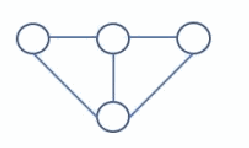
The transition function ' ' in multi-tape Turing machine is defined as:
- δ : 2Q × Γᵏ → 2^Q × Γᵏ × {L, R, S}ᵏ
- δ : Q × Q × Γᵏ → Q × Q × Γᵏ × {L, R, S}ᵏ
- δ : Q × Γᵏ → Q × Γᵏ × {L, R, S}ᵏ
- δ : Q × Γᵏ × 2^Q → Q × Γᵏ × 2^Q × {L, R, S}ᵏ
In Pumping Lemma for regular languages, to say a language is satistying pumping lemma, what is the mınımum length of ' y ' if you consider the string as ' x y z '?
- n
- 2
- 1
- 0 A →∈
In the ε-NFA M = ({q0, q1, q2, q3}, {a}, δ, q0, {q3}) with δ: q0 –ε→ q1, q1 –ε→ q2, q2 –a→ {q2, q3}, and no other moves, what is the minimum length of a string that reaches the final state?
- 0
- 1
- 2
- 3
010110100001000101010101000110001010101000001111
in binary, what is the address in hexadecimal notation?
- 5A:88:AA:18:55:F0
- 5A:81:BA:81:AA:08
- 5A:18:5A:18:55:0F
- 5A:11:55:18:AA:0F
A Computer on a 10Mbps network is regulated Q by a token bucket. The token bucket is filled at a rate of 2 Mbps. It is initially filled to capacity with 16 megabits. What is the maximum duration for which the computer can transmit at the full 10 Mbps ?
- 1.6 seconds
- 2 seconds
- 5 seconds
- 8 seconds Q
- 25.25 μs and 51.2 μs
- 51.2 μs and 12.5 μs
- 10.24 μs and 50.12 μs
- 12.5 μs and 51.2 μs
- 011111101
- 001010110
- 111111110
- 110111111
The A* algorithm is optimal when,
- It always finds the solution with the lowest total cost if the heuristic 'h' is admissible.
- Always finds the solution with the highest total cost if the heuristic 'h' is admissible.
- Finds the solution with the lowest total cost if the heuristic 'h' is not admissible.
- It always finds the solution with the highest total cost if the heuristic 'h' is not admissible.
Which Artificial intelligence technique enables computers to understand the associations and relationships between objects & Events?
- Heuristic Processing Q
- Cognitive Science
- Relative symbolism
- Pattern Matching
Where does the values of alpha-beta search get updated?
- Along the path of search.
- Initial state itself.
- At the end.
- None of these.
- 120
- 213
- 410
- 507
P: There exists no simple, undirected and connected graph with 80 vertices and 77 edges.
Q: All vertices of an Euler graph are of even degree.
R: Every simple, undirected, connected and acyclic graph with 50 vertices has at least two vertices of degree one.
S: There exists a bipartite graph with more than ten vertices which is 2-colourable.
What is the number of correct statements?
- 1
- 2
- 3
- 4
A. There exists a Boolean algebra with 5 elements.
B. Every element of a Boolean algebra has a unique complement.
C. If a lattice L is a Boolean algebra then L is not relatively complemented.
D. The direct product of two Boolean algebras is also a Boolean algebra.
Choose the correct answer about the four statements.
- Only A and D are correct
- Only B and D are correct
- All statements are NOT correct
- All statements are correct
Which of the statement is not true in regards to virtual memory?
- The main objective for using virtual memory is to increase the effective capacity of the memory system
- Size of the program can be as large as the size of the secondary memory Q
- Program and data are stored in the secondary memory
- None of these
1. It is slower than static RAM (SRAM)
2. Packing density is higher than static RAM (SRAM)
3. It is faster than static RAM (SRAM)
4. It requires data refreshing
Choose the correct answer from the options given below:
- 1, 2 and 4 only
- 1, 2 and 3 only
- 3 and 4 only
- 2 and 4 only
Which of the following statement is/are false? 1. The processor has direct access to both primary and secondary memory 2. Primary memory stores the active instructions and data for the program being executed on the Q process 3. Secondary memory is used as a backup memory 4. Memory system is implemented on a single- level memory
- 1 and 2 only
- 2 and 3 only
- 1, 2 and 3 only Q
- 1 and 4 only
Given a vector with Cartesian components (x, y), if scaling is done with the matrix [0.5 0; 0 1.5], which of the following are true? 1. Decreases the vertical by three halves 2. Increases the vertical by three halves 3. Doubles the horizontal 4. Halves the horizontal
- 1 and 3 only
- 1 and 4 only
- 2 and 3 only
- 2 and 4 only
1. Unordered lists
2. Ordered lists
3. Definition lists
4. Correlated lists
5. Enumerated lists
Choose the most appropriate answer from the options given below:
- 1, 2 only
- 1, 3, 5 only
- 1, 2, 3 only
- 1, 3, 4 only
1. Data inconsistency
2. Difficulty in accessing data
3. Data isolation
4. Atomicity of updates
Choose the correct answer from the options given below:
- 1, 2 only
- 2, 3, 4 only
- 1, 2, 3 only
- 1, 2, 3, 4
1. Hierarchical databases
2. Network databases
3. Relational databases
Choose the correct answer from the options given below:
- 1, 2
- 1, 3
- 2, 3
- 1, 2, 3
R1(Name, Class) = {(a1, 9), (b1, 5), (c1, 6), (d1, 11)} and R2(Name, Class) = {(b1, 5), (f1, 8)}. Which operation produces the output {(b1, 5)}?
- R1 R2
- R1-R2
- R 1-(R 1-R 2)
- R1 U R2
1. Shortest remaining time first scheduling may cause starvation
2. Preemptive scheduling may cause starvation
3. Round robin is better than FCFS in terms of response time
Choose the correct answer from the options given below:
- 1 only
- 2, 3 only
- 1, 2 only
- 1, 2, 3
In the design protocol of the critical section problem, each process must ask permission to enter the critical section in _______ code; it then executes in the critical section; once it finishes executing in the critical section it enters the _____ code. The process then enters the _____ code.
- entry section, remainder section, exit section Q
- entry section, exit section, remainder section
- remainder section, entry section, exit section
- remainder section, exit section, entry section
How do you create agile processes to manage unpredictability? 1.Requirements gathering must be conducted very carefully. 2.Risk analysis must be conducted before planning takes place. 3.Software increments must be delivered in short time periods. 4.Software processes must not adapt to changes incrementally.
Choose the correct answer from the options given below:
- 1 only
- 2 only
- 3 only
- 4 only Q
Software project manager is responsible for the following tasks:
A. Project Planning
B. Project status tracking
C. Resource management
D. Risk management
E. Project delivery within time & budget.
- All the statements are correct.
- Only B & C are correct.
- Only A & D are correct
- All the statements are not correct.
Mr. X designed open source software which must comply with some criteria. Choose the false statement in respect of the above. 1. No restriction on redistribution of the software as part or whole. 2. The integrity of the author's source code must be maintained. 3. The software can be sold after distribution.
- 1 only
- 2 only
- 3 only
- All statements are true.
Circuit satisfiability problem: given a Boolean combinational circuit of AND, OR and NOT gates, is it satisfiable (is there an input for which the output is 1)? 1. Circuit-SAT belongs to NP. 2. Circuit-SAT is at least as hard as any language in NP. 3. Circuit-SAT is NP-complete. 4. The size of the circuit is Θ(k² + 1). 5. If P ≠ NP, this would contradict the NP-completeness of the problem.
- 1, 3, 4 Only
- 2, 4, 5 Only
- 1, 2, 3 Only
- 2, 3, 4 Only
Given the expression (A + B * D)/(E − F) + G: 1. The prefix notation is + / + A * D B − E F G. 2. The prefix expression is the reverse of the postfix expression. 3. The order of operands in infix and postfix is the same. 4. The order of operands in infix, prefix and postfix is the same.
- 1, 3, and 4 Only
- 3 and 4 Only
- 1 and 2 Only
- 1 and 4 Only
Which of the following is (are) correct? 1. The language for the given expression is L = {aⁿbⁿcᵐdᵐ | n ≥ 1, m ≥ 1} ∪ {aⁿbᵐcᵐdⁿ | n ≥ 1, m ≥ 1}. 2. A context-free grammar for it is S → AB | C, A → aAb | ab, B → cBd | cd, C → aCd | aDd, D → bDc | bc. 3. The language has equal numbers of a's, b's, c's and d's in that order.
- Only 1 is correct
- Only 2 is correct
- Both 1 and 2 are correct
- All the three 1, 2 and 3 are correct
1. The first three-address instruction in the intermediate code is a leader.
2. The instruction exactly in the middle of the given three-address code is a leader.
3. Any instruction that is the target of a conditional or unconditional jump is a leader.
4. Any instruction that immediately follows a conditional or unconditional jump is a leader.
Choose the correct answer from the options given below:
- 1, 2 and 3
- 2, 3 and 4
- 1, 3, 4
- 1, 2, 3, 4
Which of the following are correct for regular expressions? a. ∅ + L = L + ∅ = L b. εL = Lε = L c. ∅L = L∅ = ∅ d. ∅L = L∅ = L
- a, b and d only
- a, b and c only
- b and d only
- a and d only
Consider two hosts P and Q are connected through a router R. The maximum transfer unit (MTU) value of the link between P and R is 1500 bytes and between R and Q is 820 bytes. A TCP segment of size of 1400 bytes is transferred from P to Q through R with IP identification value of 0x1234. Assume that IP header size is 20 bytes. Further, the packet is allowed to be fragmented that is Don't Fragment (DF) flag in the IP Header is not set by P. Which of the following statements is/are true
I. Two fragments are created at R and IP datagram size carrying the second fragment is 620 bytes
II. If the second fragment is lost then R resends the fragment with IP Identification value of 0x1234
III. If the second fragment is lost then P is required to resend the entire TCP segment
IV. TCP destination port can be determined by analyzing the second fragment only
- I, II, and III only
- I and III only
- III and IV only
- II and IV only
The Solution to Silly Window Syndrome problem is/are:
I. Nagle's Algorithm Q
II. Clark's Algorithm
III. Jacobson's Algorithm
IV. Piggy backing Algorithm
- I and II only
- I and III only
- III and IV only
- II and IV only
I. Self-organising neural network
II. Back-propagation neural network
III. Genetic algorithm
IV. Forward-propagation neural network
Choose the correct answer from the options given below:
- I only
- II only
- III only
- IV only
Consider the following Learning algorithms.
I. Logistic regression.
II. Back propagation.
III. Linear regression.
IV. Forward propagation. Which of the following options represents classification algorithm? Q
- I and III only
- II and IV only
- I and II only
- III and IV only
Which Boolean operation on two variables can be represented by a single perception layer?
I. X1 AND X2 II.X1 OR X2
III. X1 NOR X2
IV. X1 XOR X2
- I and II only
- II and III only
- I, II, and III only
- I,II,III, and IV only
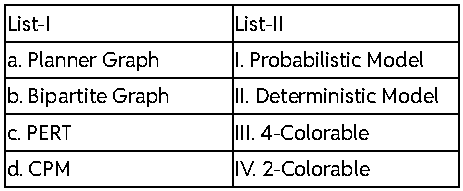
Match the List-I and List-II
- a-IV; b-III; c-I; d-II
- a-III; b-IV; c-II; d-I
- a-II; b-IV; c-I; d-III
- a-III; b-IV; c-I; d-II
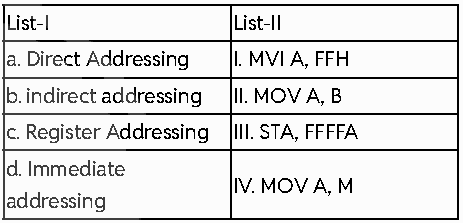
Match List-I and List-II
- a-I, b-II, c-III, d-IV
- a-II, b-III, c-IV, d-I
- a-III, b-IV, c-II, d-I
- a-IV, b-III, c-I, d-II
Match the List-I and List-II
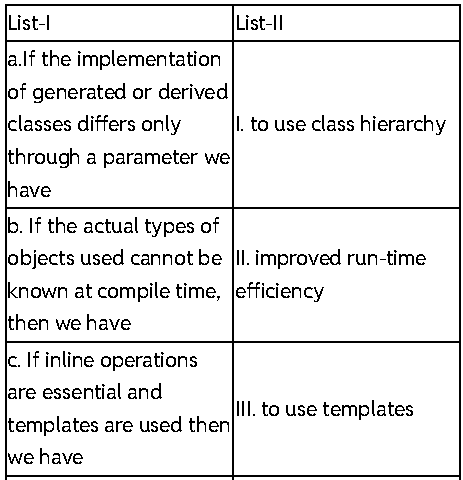
d.To gain access to IV. to use explicit differing instances for casting derived classes through base we have
Choose the correct answer from the options Q given below:
- a-I, b-II, c-IV, d-III
- a-III, b-I, c-II, d-IV
- a-I, b-III, c-II, d-IV
- a-II, b-I, c-III, d-IV
Match List I and List II
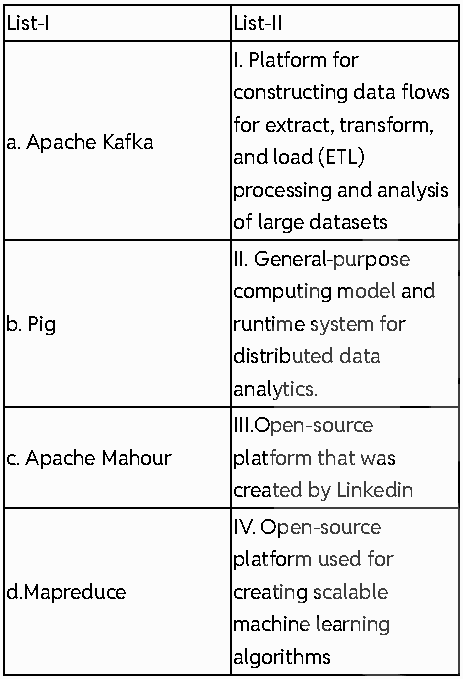
- a-II, b-IV, c-I, d-III
- a-II, b-I, c-IV, d-III
- a-III, b-I, c-IV, d-II
- a-I, b-II, c-IV, d-III Q
Match List I with List II
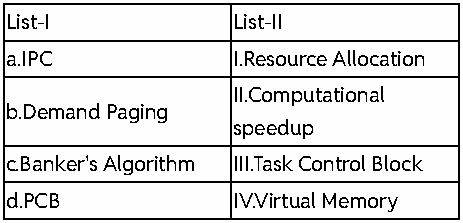
- a-II, b-I, c-IV, d-III
- a-II, b-IV, c-I, d-III
- a-I, b-II, c-III, d-IV
- a-II. b-III. c-I, d-IV
Match List I with List II
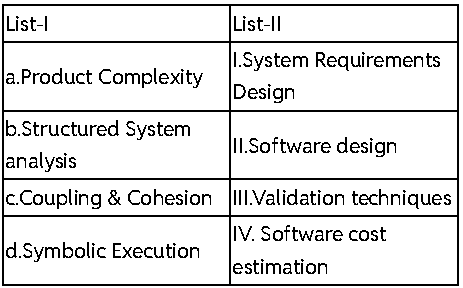
- a-II, b-III, c-IV, d-I
- a-III, b-I, c-IV, d-II
- a-IV, b-I, c-II, d-III
- a-III, b-IV, c-I, d-II
Match List I with List II
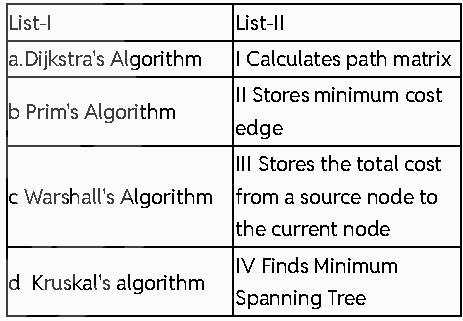
- a-I, b-II, c-III, d-IV
- a-III, b-II, c-I, d-IV
- a-II, b-I, c-IV, d-III
- a-III, b-IV, c-II, d-I
Match the following based on the language accepted by using brute force method of parsing.
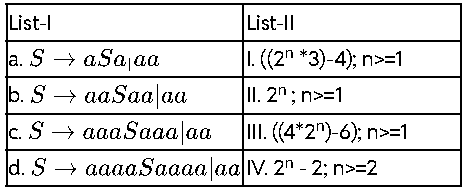
- a-IV, b-III , c-I, d-II
- a-II, b-IV, c-I, d-III
- a-I, b- IV, c-III, d-II
- a-II, b-III, c-I, d-IV
Match List I with List II
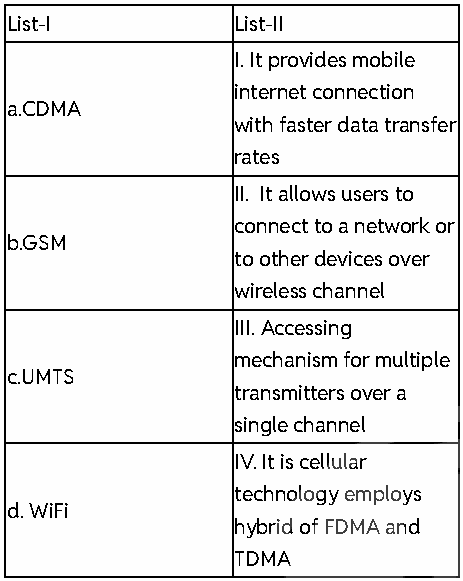
- a-III, b-IV, c-II, d-I Q
- a-III, b-IV, c-I, d-II
- a-II, b-III, c-IV, d-I
- a-II, b-I, c-IV, d-III
Match List I with List II
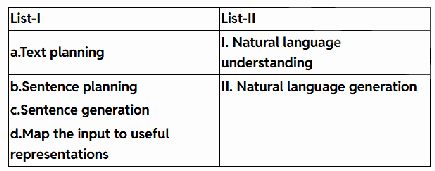
- a-I, b-II, c-I, d-II
- a-II, b-II, c-I, d-II
- a-I, b-II, c-II, d-I Q
- a-II, b-II, c-II, d-I
I. There does not exist a polynomial-time algorithm to solve integer linear programming problems.
II. The main focus of PERT is 'minimising time'.
Choose the correct option about statements I and II.
- I is true; II is true
- I is true; II is false
- I is false; II is true
- I is false; II is false
The correct sequence in the fetch-execute cycle is _______ .
I. Decode
II. Fetch
III. Execute Chose the correct answer from the following
- I-II-III
- II-III-I
- III-II-I
- II-I-III
In what sequence the initialization, testing and execution of body is done while using do-while loop?
I. Commenting
II. Execution of the body
III. Initialisation
IV. Testing the condition
Choose the correct answer from the following
- IV, II, III
- IV, III, II
- III, I, II
- III, II, IV
I. Recursively find all density-connected points and assign them to the same cluster as the core point.
II. Find all neighbour points within eps and identify the core points with more than MinPts neighbours.
III. Iterate through the remaining unvisited points in the dataset.
IV. For each core point, if it is not already assigned to a cluster, create a new cluster.
- II, IV, III, I
- IV, II, III, I
- II, IV, I, III
- IV, II, I, III
I. Bootstrap loader is loaded from the disk
II. Kernel is loaded into memory
III. Firmware ROM loads the boot block
Choose the correct answer from the options given below:
- II, III and I
- III, I and II
- I, II and III
- I, III and II
Given below are two statements: one is labeled as Assertion A and the other is labeled as Reason R.
Assertion A: Cohesion is a qualitative indication of the degree to which a module can be written more compactly and is able to complete its function in a timely manner.
Reason R: Cohesion is a qualitative indication of the degree to which a module is connected to other modules and the outside world. In the light of the above statements, choose the most appropriate answer from the options given below.
- Both A and R are correct and R is the correct Q explanation of A.
- Both A and R are correct but R is NOT the correct explanation of A.
- A is correct but R is not correct.
- A is not correct but R is correct.
Given the graph below one of the following edges cannot be added in that order to find a minimum spanning tree algorithm.
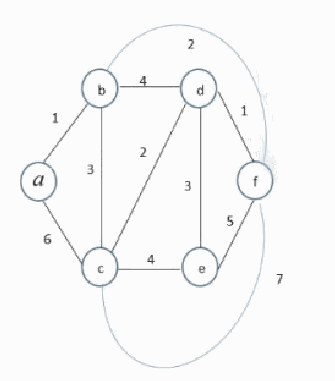
Q
I. a-b
II. d-f
III. b-f
IV. d-c
V. d-e
- I, II , III, IV,V
- I, II, IV, III, V
- II, I, III, V, IV
- II, I, IV, III, V Q
What is the safest order while simplifying Context Free Grammar? ∈
- Elimination of -productions, Unit productions, and then Useless symbols & productions. ∈
- Elimination of useless symbols productions, -productions, and then Unit productions. ∈
- Elimination of Unit productions, - productions and then Useless symbols and productions. ∈
- Elimination of -productions, Useless symbols and productions, and then Unit productions.
Rearrange the following sequence in the context of OSI Layers:
I. Transforming the raw bits in the form of frame for transmission
II. Transmission of raw bits over communication channel
III. Handling user interfaces
IV. Control and monitoring of subnet
V. Transmission data through connection oriented or connection less using datagrams
- I-II-III-IV-V
- II-III-IV-V-I
- II-I-IV-V-III
- I-II-IV-V-III
Choose the correct option describing the features of Artificial neural network
I. It is essentially machine learning algorithm.
II. It is useful when solving the problems for which the data set is very large.
III. They are able to extract features without input from the programmer. Iv. These are systems modeled on the human brain and nervous system
- All the statements are correct.
- Only II & III are correct.
- Only I & IV are correct.
- All the statements are not correct.
Four persons: P, Q, R and S are in police custody and one of them has committed a crime. They confess as follows:
A. Person P: Q did it.
B. Person Q: S did it.
C. Person R: I did not do it.
D. Person S: Q lied. If exactly one of the statements is false, which of the following is the guilty person.
- P
- Q
- R
- S
Assertion A: A Raster scan device is a CRT graphic device and can use a television monitor for display
Reason R: In Raster scan display the picture is composed of Q a series of dots. These dots are traced out as a series of horizontal lines. Television works in a similar fashion. In the light of the above statements, choose the correct answer from the options given below:
- Both A and R are true and R is the correct explanation of A
- Both A and R are true but R is not the correct explanation of A
- A is true but R is false
- A is false but R is true
An OS follows round-robin scheduling with time quantum of 4 ms. Assuming that the CPU is free now and there are 20 processes waiting in the ready queue, the maximum amount of time that a process waits before getting into the CPU is _____.
- 80 ms
- 76 ms D
- 84 ms an
- None of the above A /
Statement 1: su Given a graph G=(V, E) in which each vertex v € V has an associated positive weight w(v), we can Q use linear programming to find the lower bound on the weight of the minimum-weight vertex cover.
Statement 2 : Q The lower bound can be found by maximizing the following ∑n w(v)x(v) v∈V subject to Q x(u) + x(v) ≥ 1 for each (u, v) ∈ V x(v) ≤ 1 for each v ∈ V x(v) ≥ 0 for each v ∈ V In the light of the above statements, choose the most appropriate answer from the options given below:
- Both statement I and Statement II are correct
- Both Statement I and Statement II are incorrect
- Statement I is correct but Statement II is incorrect
- Statement I is incorrect and Statement II is correct
A TCP Server application is programmed to listen on port P on Host S. A TCP Client is connected to the TCP Server over the network. Considered that while TCP Connection is active the server is crashed and rebooted. Assume that the client does not use TCP keepalive timer. Which of the following behaviours is/are possible?
Statement I: If client is waiting to receive a packet, it may wait indefinitely
Statement II: If the client sends a packet after the server reboot, it will receive the FIN segment In the light of the above statements, choose the correct answer from the options given below
- Both Statement I and Statement II are true
- Both Statement I and Statement II are false
- Statement I is true but Statement II is false
- Statement I is false but Statement II is true Directions (91-95) Read the following passage nd answer the given questions. An organization is granted the block 130.56 .0 .0 16. The administrator wants to create 1024 ubnets.
Directions (Q91–95): An organisation is granted the block 130.56.0.0/16. The administrator wants to create 1024 subnets.
Directions (Q91–95): An organization is granted the block 130.56.0.0/16. The administrator wants to create 1024 subnets.
Find first and last addresses of First subnet. q
- 130.56 .0 .0 & 130.56 .254 .254
- 130.56 .0 .0 & 130.56 .0 .63
- 130.0 .0 .0 & 130.255 .255 .255 q
- 130.56 .0 .0 & 130.56 .255 .63
Find subnet mask. q
- 255 .255 .255.192
- 130.56 .255 .255 q
- 130.56 .0 .255 q
- 130.56 .155 .192
Find first and last addresses of last subnet. Q
- 130 .56 .0 .0 & 130.56 .254 .255
- 130 .56 .255 .0 & 130.56 .255 .255
- 130 .56 .0 .192 & 130.255 .255 .255
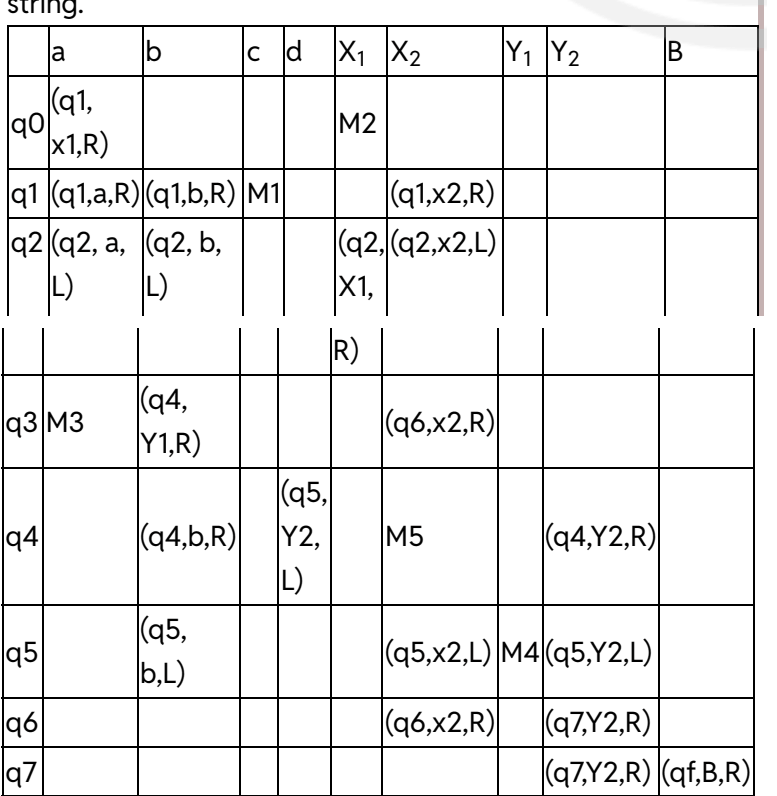
- 130 .56 .255 .192 & 130.56 .255 .255 Q Directions (96-100) Read the following passage and answer the given questions. A Turing Machine for the language L=anbmcndm|n ≥1, m≥1 is designed. The resultant model is M=({q ,q ,q ,q ,q ,q ,q ,q ,q }),{a,b,c,d}, 0 1 2 3 4 5 6 7 f {a,b, c,d,X , X ,Y ,Y }, δ, q , B,{ q } and part of ' δ ' is 1 2 1 2 0 f Q given in the transition table. You need to write the following questions based on design of Turing Machine for the given language. Note that, while designing the Turing Machine X and 1 X are used to work with 'a's and 'c's and Y and 2 1 Q Y are used to handle 'b's and 'd's of the given 2 string. q2 (q2, a, (q2, b, (q2, (q2,x2,L) L) L) X1, R)
Directions (Q96–100): A Turing machine for L = {aⁿbᵐcⁿdᵐ | n ≥ 1, m ≥ 1} is designed as M = ({q0, …, q7, qf}, {a, b, c, d}, {a, b, c, d, X1, X2, Y1, Y2, B}, δ, q0, B, {qf}). X1 and X2 mark matched a's and c's; Y1 and Y2 mark matched b's and d's. Part of δ is given in the transition table (shown with each question); cells M1–M5 are to be filled.
What is the Move in the cell with number 'M1' of the resultant Table?
- (q2,X2,R)
- (q2,X2,L)
- (q3,X2,L)
- Error Entry
What is the Move in the cell with the number 'M2' of the resultant Table?
- (q1, X1, R)
- (q1, a, R)
- (q2, X1, R)
- Error entry
What is the Move in the cell with number 'M3' of the resultant Table?
- (q1,x1, L)
- (q4, X1, R)
- (q1,x1, R)
- Error Entry
What is the Move in the cell with number 'M4' of the resultant Table?
- (q5, Y1, L)
- (q3, Y1, R)
- (q4, Y1, L)
- Error entry
What is the Move in the cell with number 'M5' of the resultant Table?
- (q4,X2, R)
- (q5,X2, R)
- (q5,X2, L)
- Error Entry
Answer key
- 1 – B
- 2 – A
- 3 – C
- 4 – B
- 5 – B
- 6 – C
- 7 – A
- 8 – B
- 9 – B
- 10 – C
- 11 – A
- 12 – D
- 13 – B
- 14 – B
- 15 – B
- 16 – C
- 17 – B
- 18 – C
- 19 – D
- 20 – B
- 21 – D
- 22 – B
- 23 – A
- 24 – B
- 25 – D
- 26 – A
- 27 – B
- 28 – D
- 29 – C
- 30 – C
- 31 – A
- 32 – B
- 33 – D
- 34 – B
- 35 – B
- 36 – C
- 37 – A
- 38 – D
- 39 – A
- 40 – D
- 41 – D
- 42 – B
- 43 – D
- 44 – A
- 45 – D
- 46 – D
- 47 – A
- 48 – D
- 49 – A
- 50 – A
- 51 – D
- 52 – B
- 53 – C
- 54 – A
- 55 – D
- 56 – C
- 57 – B
- 58 – C
- 59 – C
- 60 – B
- 61 – B
- 62 – A
- 63 – C
- 64 – C
- 65 – C
- 66 – D
- 67 – C
- 68 – B
- 69 – C
- 70 – B
- 71 – C
- 72 – B
- 73 – B
- 74 – B
- 75 – D
- 76 – A
- 77 – D
- 78 – D
- 79 – C
- 80 – B
- 81 – C
- 82 – C
- 83 – A
- 84 – C
- 85 – A
- 86 – B
- 87 – A
- 88 – B
- 89 – C
- 90 – C
- 91 – B
- 92 – A
- 93 – B
- 94 – A
- 95 – D
- 96 – B
- 97 – D
- 98 – C
- 99 – B
- 100 – A