
UGC NET Paper 2 Computer Science – December 2019 – Question Paper with Answer Key
Solved by The Binary Brothers: every question has the correct answer and an explanation. Open any question for its full solution, or practise it in the unit-wise mock tests.
A basic feasible solution of an transportation problem is said to be non- degenerate, if basic feasible solution contains exactly------------- number of individual allocation in-------------- positions.
- m + n + 1, independent
- m + n − 1, independent
- m + n − 1, appropriate
- m − n + 1, independent
Maximize z = x₁ + x₂ subject to x₁ + 2x₂ ≤ 2000, x₁ + x₂ ≤ 1500, x₂ ≤ 600, x₁, x₂ ≥ 0. The solution is
- x₁ = 750, x₂ = 750, z = 1500
- x₁ = 500, x₂ = 1000, z = 1500
- x₁ = 1000, x₂ = 500, z = 1500
- x₁ = 900, x₂ = 600, z = 1500
The Boolean expression AB′ + AB + A′C + AC is unaffected by the value of the Boolean variable
- A
- B
- C
- A , B and C
What are the GLB and LUB of the sets A = {3, 9, 12} and B = {1, 2, 4, 5, 10}, if they exist, in the poset (Z⁺, /)?
- A (GLB 3, LUB 36); B (GLB 1, LUB 20)
- A (GLB 3, LUB 12); B (GLB 1, LUB 10)
- A (GLB 1, LUB 36); B (GLB 2, LUB 20)
- A (GLB 1, LUB 12); B (GLB 2, LUB 10)
Let (P) be the set of all people. Let (R) be a binary relation on (P) such that (a, b) is in R if a is a brother of b. Is (R) symmetric transitive, an equivalence relation, a partial order relation?
- NO,NO,NO,NO
- NO,NO,YES,NO
- NO,YES,NO,NO
- NO,YES,YES,NO
The weight of minimum spanning tree in graph G, calculated using Kruskal's algorithm is :
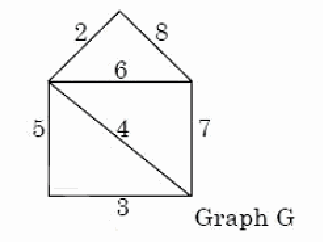
- 14
- 15
- 17
- 18
A tree has 2 n vertices of degree 1,3 n vertices of degree 2, n vertices of degree 3 . Determine the number of vertices and edges in tree.
- 12,11
- 11,12
- 10,11
- 9,10
How many reflexive relations are there on a set with 4 elements?
- 2⁴
- 2¹²
- 4²
- 2
A non-pipelined system takes 30 ns to process a task. The same task can be processed in a four- segment pipeline with a clock cycle of 10 ns . Determine the speed up of the pipeline for 100 tasks.
- 3
- 4
- 3.91
- 2.91
A computer uses a memory unit of 512 K words of 32 bits each. A binary instruction code is stored in one word of the memory. The instruction has four parts: an addressing mode field to specify one of the two-addresssing mode (direct and indirect), an operation code, a register code part to specify one of the 256 registers and an address part. How many bits are there in addressing mode part, opcode part, register code part and the address part?
- 1, 3, 9, 19
- 1, 4, 9, 18
- 1, 4, 8, 19
- 1, 3, 8, 20
A micro instruction format has microoperation field which is divided into 2 subfields F1 and F2, each having 15 distinct microoperations, condition field CD for four status bits, branch field B R having four options used in conjunction AD with address field . The address space is of 128 memory words. The size of micro instruction is :
- 19
- 18
- 17
- 20 (142) + (112) = (75)
The following program is stored in the basic computer: 010 CLA; 011 ADD 016; 012 BUN 014; 013 HLT; 014 AND 017; 015 BUN 013; 016 C1A5; 017 93C6. Give the accumulator contents (hex) after execution.
- A1B4
- 81 B 4
- A184
- 8184
What is the output? int i, j, x = 0; for (i = 0; i < 5; ++i) for (j = 0; j < i; ++j) { x += (i + j − 1); break; } printf("%d", x);
- 6
- 5
- 4
- 3
Let A be the base class in C ++ and B be the derived class from A with protected inheritance. Which of the following statement is false for class B?
- Member function of class B can access protected data of class A
- Member function of Class B can access public data of class A
- Member function of class B cannot access private data of class A
- Object of derived class B can access public base class data
Which tag is used to enclose any number of javascript statements in HTML document?
- <code>
- <script>
- <title>
- <body>
A rectangle is bounded by x = 0, y = 0, x = 5 and y = 3. The segment joining (−1, 0) and (4, 5), clipped against this window, connects the points
- (0, 1) and (3, 3)
- (0, 1) and (2, 3)
- (0, 1) and (4, 5)
- (0, 1) and (3, 5)
Which of the following algorithms is not used for line clipping?
- Cohen-Sutherland algorithm
- Southerland-Hodgeman algorithm
- Liang-Barsky algorithm
- Nicholl-Lee-Nicholl algorithm
1024 × 768 If we want to resize a pixels image to one that is 640 pixels wide with the same aspect ratio, what would be the height of the resized image?
- 420 Pixels
- 460 Pixels
- 480 Pixels
- 540 Pixels
Which of the component module of DBMS does rearrangement and possible ordering of operations, eliminate redundancy in query and use efficient algorithms and indexes during the exceution of a query?
- query compiler
- query optimizer
- Stored data manager
- Database processor
Given two tables R1(x,y) and R2(y,z) with 50 and 30 numbers of tuples respectively. Find the maximum number of tuples in the output of natural join between tables R1 and R2 i.e. R1 * R2. (* - Natural Join)
- 30
- 20
- 50
- 1500
Given two tables EMPLOYEE (EID, ENAME, DEPTNO) DEPARTMENT (DEPTNO, DEPTNAME) Find the most appropriate statement of the given query : Select count (*) 'total' from EMPLOYEE where DEPTNO IN (D1, D2) group by DEPTNO having count (*) > 5.
- Total number of employees in each department D1 and D2
- Total number of employees of departments D1 and D2 if their total is > 5.
- Display total number of employees in both departments D1 and D2
- The output of the query must have atleast two rows
Find the minimum number of tables required for converting the following entity relationship diagram into a relational database.
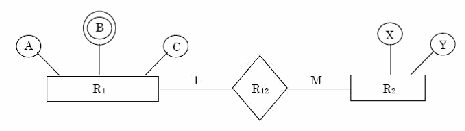
- 2
- 4
- 3
- 5
A counting semaphore is initialized to 8. 3 wait ( ) operations and 4 signal () operations are applied. Find the current value of the semaphore variable.
- 9
- 5
- 1
- 4
Which of the following is not needed by an encryption algorithm used in Cryptography?
- KEY
- Message
- Ciphertext
- User details
Which of the following CPU scheduling algorithms is/are supported by LINUX operating system?
- Non-preemptive priority scheduling
- Preemptive priority scheduling and time- sharing CPU scheduling
- Time sharing scheduling only
- Priority scheduling only
Consider a paging system where translation looks aside buffer (TLB) a special type of associative memory is used with a hit ratio of 80%.. Assume that memory reference takes 80 nanoseconds and reference time to TLB is 20 nanoseconds. What will be the effective memory access time given an 80 % hit ratio?
- 110 nanoseconds
- 116 nanoseconds
- 200 nanoseconds
- 100 nanoseconds
A system has 12 tape drives. At time t0, p0 has maximum need 10 and holds 5, p1 needs 4 and holds 2, p2 needs 9 and holds 2. The system is in a safe state. Which is a safe sequence?
- <p0, p1, p2>
- <p1, p0, p2>
- <p2, p1, p0>
- <p0, p2, p1>
Which of the following interprocess communication model is used to exchange messages among co-operative processes?
- Shared memory model
- Message passing model
- Shared memory and message passing model
- Queues
With a 2 ms time slice and processes P1 (burst 3, arrival 0), P2 (4, 2), P3 (5, 5), find the average turnaround and waiting times under round robin.
- 4,0
- 5.66,1.66
- 5.66,0
- 7,2
Which of the following methods are used to pass any number of parameters to the operating system through system calls?
- Registers
- Block or table in main memory
- Stack
- Block in main memory and stack
Java Virtual Machine (JVM) is used to execute architectural neutral byte code. Which of the following is needed by the JVM for execution of Java Code?
- Class loader only
- Class loader and Java Interpreter
- Class loader, Java Interpreter and API
- Java Interpreter only
In a system for a restaurant, the main scenario for placing an order is given below :
(a) Customer reads menu
(b) Customer places order
(c) Order is sent to the kitchen for preparation
(d) Ordered items are served
(e) Customer requests for a bill for the order (f) Bill is prepared for this order (g) Customer is given the bill (h) Customer pays the bill A sequence diagram for the scenario will have at least how many objects among whom the messages will be exchanged.
- 3
- 4
- 5
- 6
An --------------- chart is a project schedule representation that presents project plan as a directed graph. The critical path is--------------- the sequence of ---------------tasks and it defines project---------------
- Activity, Shortest, Independent, Cost
- Activity, Longest, Dependent, Duration
- Activity, Longest, Independent, Duration
- Activity, Shortest, Dependent, Duration a2c mod n = (ac)2 mod n
Using a^(2c) mod n = (a^c)² mod n and a^(2c+1) mod n = a·(a^c)² mod n, for a = 7, b = 17 and n = 561, what is a^b mod n?
- 160
- 166
- 157
- 67 G = ⟨V , E⟩
A clique in an undirected graph is a V ′ ⊆ V subset of vertices, such that u, v) ∈ E u ∈ V ′ v ∈ V ′
- If ( then and (u, v) ∈ E u ∈ V ′ v ∈ V ′
- If then or
- Each pair of vertices in V' is connected by an edge
- All pairs of vertices in V' are not connected by an edge
What is the worst case running time of Insert and Extract-min, in an implementation of a priority queue using an unsorted array? Assume that all insertions can be accomodated.
- Θ(1), Θ(n)
- Θ(n), Θ(1)
- Θ(1), Θ(1)
- Θ(n), Θ(n)
In a B-Tree, each node represents a disk block. Suppose one block holds 8192 bytes. Each key uses 32 bytes. In a B-tree of order M there are M - 1 keys. Since each branch is on another disk block, we assume a branch is of 4 bytes. The total memory requirement for a non-leaf node is
- 32M − 32
- 36M − 32
- 36M − 36
- 32M − 36
Give tight bounds for T(n) = 4T(√n) + lg²n, with T(n) constant for n ≤ 2.
- Θ(lg(lg² n) lg n)
- Θ(lg² n lg n)
- Θ(lg² n lg lg n)
- Θ(lg(lg n) lg n)
Consider a weighted directed graph. The current shortest distance from source S to node x is represented by d[x]. Let d[v]= 29, d[u]= 15, w[u,v]=12. What is the updated value of d[v] based on current information?
- 29
- 27
- 25
- 17
When using Dijkstra's algorithm to find shortest path in a graph, which of the following statement is not true?
- It can find shortest path within the same graph data structure
- Every time a new node is visited, we choose the node with smallest known distance/ cost (weight) to visit first
- Shortest path always passes through least number of vertices
- The graph needs to have a non-negative weight on every edge
The time complexity to multiply two polynomials of degree n using Fast Fourier transform method is :
- θ(n lg n)
- θ (n2)
- θ(n)
- θ(lg n)
Consider the following grammars : G : S → aSb|bSa|aa 1 G : S → aSb|bSa|SS ∣ λ 2 G : S → aSb|bSa|SS ∣ a 3 G : S → aSb|bSa|SS|SSS|λ 4 Which of the following is correct w.r.t. the above grammars? G G
- 1 and 3 are equivalent G G
- 2 and 3 are equivalent G G
- 2 and 4 are equivalent G G
- 3 and 4 are equivalent L = {anbn−3 ∣ n > 2}
Which grammar generates L = {aⁿbⁿ⁻³ | n > 2} over Σ = {a, b}?
- S → aA|a, A → aAb|b
- S → aaA|λ, A → aAb|λ
- S → aaaA|a, A → aAb|λ
- S → aaaA, A → aAb ∣ λ
Consider the following grammar :
S → 0A ∣ 0BB
A → 00A ∣ λ
B → 1B ∣ 11C
C → B Which language does this grammar generate?
- L((00)*0 + (11)*1)
- L(0(11)* + 1(00)*)
- L((00)*0)
- L(0(11)*1)
Let Σ = {w, x} and T = {x, y, z}, with homomorphism h(x) = xzy and h(w) = zxyy. If L is denoted by r = (w + x*)(ww)*, then h(L) is denoted by
- (zxyy + xzy)(zxyy)
- (zxyy + (xzy)*)(zxyyzxyy)*
- (zxyy + xzy)(zxyy)*
- (zxyy + (xzy)*)(zxyyzxyy)
Consider the following statements with respect L = {anbn ∣ n ≥ 0} to the language
S : L2 1 is context free language
S : Lk 2 is conext-free language for any given k ≥ 1 ¯¯¯
S : L L∗ 3 and are context free languages Which one of the following is correct? S S
- only 1 and 2 S S
- only 1 and 3 S S
- only 2 and 3 S , S S
- 1 2 and 3
Consider the following languages : L = {anbncm} ∪ {anbmcm}, n, m ≥ 0 1 L = {wwR ∣ w ∈ {a, b}*} 2 Where R represents reversible operation. Which one of the following is (are) inherently ambiguous language(s)? L
- only 1 L
- only 2 L L
- both 1 and 2 L L
- neither 1 nor 2
Let G=(V, T, S, P) be any context-free grammar λ without any -productions or unit productions. Let K be the maximum number of symbols on the right of any production in P. The maximum number of production rules for any equivalent grammar in Chomsky normal form is given by: 1 − I Where denotes the cardinality of the set.
- (K − 1)|P| + |T| − 1
- (K − 1)|P| + |T|
- K|P| + |T| − 1
- K|P| + |T|
Consider the following language families : L ≡ The context - free languages 1 L ≡ The context - sensitive languages 2 L 3 ≡ The recursively enumerable languages L ≡ The recursive languages 4 Which one of the following options is correct? L ⊆ L ⊆ L ⊆ L
- 1 2 3 4 L ⊆ L ⊆ L ⊆ L
- 2 1 3 4 L ⊆ L ⊆ L ⊆ L
- 1 2 4 3 L ⊆ L ⊆ L ⊆ L
- 2 1 4 3
Consider the following statements : S
1 : These exists no algorithm for deciding if any M M two Turing machines 1 and 2 accept the same language. S M M
2 : Let 1 and 2 be arbitrary Turing ⊆ L (M ) machines. The problem to determine 2 is undecidable. Which of the statements is (are) correct? S
- Only 1 S
- Only 2 S S
- Both 1 and 2 S S
- Neither 1 nor 2 A = {001, 0011, 11, 101}
Let A = {001, 0011, 11, 101} and B = {01, 111, 111, 010}; C = {00, 001, 1000} and D = {0, 11, 011}. Which pairs have a Post correspondence solution?
- Only pair (C, D)
- Only pair (A, B)
- Both (A, B) and (C, D)
- Neither (A, B) nor (C, D)
Which of the following class of IP address has the last address as 223.255 .255 .255 ?
- Class A
- Class B
- Class C
- Class D
Consider a subnet with 720 routers. If a three- level hierarchy is chosen, with eight clusters, each containing 9 regions of 10 routers, then total number of entries in hierarchical table of each router is
- 25
- 27
- 53
- 72
Piconet is a basic unit of a bluetooth system consisting of------------ master node and up to ---- ---------- active slave nodes.
- one, five
- one, seven
- two, eight
- one, eight
A network with bandwidth of 10 Mbps can pass only an average of 12.000 frames per minute with each frame carrying an average of 10,000 bits. What is the throughput of this network?
- 1,000,000 bps
- 2,000,000 bps
- 12,000,000 bps
- 120,000,000 bps
The full form of ICANN is
- Internet Corporation for Assigned Names and Numbers
- Internet Corporation for Assigned Numbers and Names
- Institute of Cooperation for Assigned Names and Numbers
- Internet Connection for Assigned Names and Numbers
According to Dempster-Shafer theory for uncertainty management, Bel(A) Where denotes Belief of event A.
- Bel(A) + Bel(¬A) ≤ 1
- Bel(A) + Bel(¬A) ≥ 1
- Bel(A) + Bel(¬A) = 1
- Bel(A) + Bel(¬A) = 0
Consider the following statements:
S : ∀xP(x) ∨ ∀xQ(x) 1 and ∀x(P(x) ∨ Q(x)) are not logically equivalent.
S : ∃xP(x) ∧ ∃xQ(x) 2 and ∃x(P(x) ∧ Q(x)) are not logically equivalent Which of the following statements is/are correct?
- Only S S
- Only 2 S S
- Both 1 and 2 S S
- Neither 1 nor 2
Consider the game tree given below
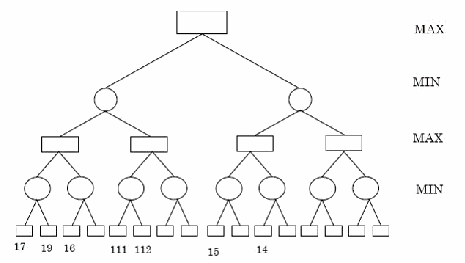
□ Here ○ and represent MIN and MAX nodes respectively. The value of the root node of the game tree is:
- 14
- 17
- 111
- 112
Consider the following models: M1: Mamdani model M
2 : Takagi - Sugeno-Kang model M3: Kosko's additive model (SAM) Which of the following option contains examples of additive rule model? M M
- Only 1 and 2 M M
- Only 2 and 3 M M
- Only 1 and 3 M , M M
- 1 2, and 3 t(x, y)
A fuzzy conjunction t(x, y) and disjunction s(x, y) form a pair if t(x, y) = 1 − s(1 − x, 1 − y). If t(x, y) = xy/(x + y − xy), then s(x, y) is
- (x + y)/(1 − xy)
- (x + y − 2xy)/(1 − xy)
- (x + y − xy)/(1 − xy)
- (x + y − xy)/(1 + xy)
Let W_ij represent the weight between node i at layer k and node j at layer (k − 1) of a given multilayer perceptron. The weight updation using the gradient descent method is given by
- W(t+1) = W(t) + α ∂E/∂W
- W(t+1) = W(t) − α ∂E/∂W
- W(t+1) = α ∂E/∂W
- W(t+1) = −α ∂E/∂W
The order of schema ?10?101? and ???0??1 are---- ----------- and --------------respectively.
- 5.3
- 5,2
- 7,5
- 8,7
Let the population of chromosomes in genetic algorithm is represented in terms of binary number. The strength of fitness of a chromosome x in decimal form, , is given by f(x) Sf(x) = where f(x) = x2 Σf(x) P The population is given by where: P = {(01101, (11000), (01000), (10011)} The strength of fitness of chromosome (11000) is -------------
- 24
- 576
- 14.4
- 49.2
Consider the following statements : S (G, *) a ∈ G
1 : If a group is of order n, and is am = e m ≤ n such that for some integer , then m must divide n. S (G, *)
2 : If a group is of even order, then there a ∈ G a ≠ e must be an element such that and a * a = e . Which of the statements is (are) correct? S
- Only 1 S
- Only 2 S S
- Both 1 and 2 S S
- Neither 1 nor 2
Consider the following statements with respect to duality in LPP :
(a) The final simplex table giving optimal solution of the primal also contains optimal solution of its dual in itself.
(b) If either the primal or the dual problem has a finite optimal solution, then the other problem also has a finite optimal solution.
(c) If either problem has an unbounded optimum solution, then the other problem has no feasible solution at all. Which of the statements is (are) correct?
- only (a) and (b)
- only (a) and (c)
- only (b) and (c)
- (a). (b) and (c)
The Reduced Instruction Set Computer (RISC) characteristics are :
(a) Single cycle instruction execution
(b) Variable length instruction formats
(c) Instructions that manipulates operands in memory
(d) Efficient instruction pipeline
Choose the correct characteristics from the options given below :
- (a) and (b)
- (b) and (c)
- (a) and (d)
- (c) and (d)
Which of the following binary codes for decimal digits are self complementing?
(a) 8421 code
(b) 2421 code
(c) excess-3 code
(d) excess-3 gray code
Choose the correct option :
- (a) and (b)
- (b) and (c)
- (c) and (d)
- (d) and (a)
Consider the following statements with respect to approaches to fill areas on raster systems : P: To determine the overlap intervals for scan lines that cross the area. Q: To start from a given interior position and paint outward from this point until we encounter the specified boundary conditions. Select the correct answer from the options given below :
- P only
- Q only
- Both P and Q
- Neither P nor Q
Which of the following statements are true regarding C ++ ?
(a) Overloading gives the capability to an existing operator to operate on other data types.
(b) Inheritance in object oriented programming provides support to reusability.
(c) When object of a derived class is defined, first the constructor of derived class is executed then constructor of a base class is executed.
(d) Overloading is a type of polymorphism.
- (a) and (b) only
- (a), (b) and (c) only
- (a), (b) and (d) only
- (b), (c) and (d) only
Which of the following are legal C statements? (a) int *P = &44; (b) int *P = &r; (c) int P = &a; (d) int P = a;
- (a) and (b)
- (b) and (c)
- (b) and (d)
- (a) and (d) T
Two concurrent executing transactions 1 and T 2 are allowed to update same stock item say ' A ' in an uncontrolled manner. In such scenario, following problems may occur :
(a) Dirty read problem
(b) Lost update problem
(c) Transaction failure
(d) Inconsistent database state Which of the following option is correct if database system has no concurrency module and allows concurrent execution of above two transactions?
- (a), (b) and (c) only
- (c) and (d) only
- (a) and (b) only
- (a), (b) and (d) only
Identify the circumstances under which pre- emptive CPU scheduling is used :
(a) A process switches from Running state to Ready state
(b) A process switches from Waiting state to Ready state
(c) A process completes its execution
(d) A process switches from Ready to Waiting state
Choose the correct option :
- (a) and (b) only
- (a) and (d) only
- (c) and (d) only
- (a). (b), (c) only
The following multithreaded algorithm computes transpose of a matrix in parallel : p Trans (X, Y, N) if N = 1 ← then Y[1,1] X[1,1] else partition X into four (N/2) x (N/2) X X X X submatrices 11, 12, 21, 22 partition Y into four (N/2) x (N/2) submatrices Y Y Y Y 11, 12, 21, 22 X Y spawn p Trans ( 11. 11.N/2) X Y spawn p Trans ( 12. 12.N/2) X Y spawn p Trans ( 21. 21.N/2) X Y spawn p Trans ( 22. 22.N/2) What is the asymptotic parallelism of the algorithm?
- T₁/T∞ = Θ(N²/lg N)
- T₁/T∞ = Θ(N/lg N)
- T₁/T∞ = Θ(lg N/N²)
- T₁/T∞ = Θ(lg N/N)
Consider the following statements :
(a) The running time of dynamic programming θ(ρ) ρ algorithm is alway where is number of subproblems.
(b) When a recurrence relation has cyclic dependency, it is impossible to use that recurrence relation (unmodified) in a correct dynamic program.
(c) For a dynamic programming algorithm, computing all values in a bottom-up fashion is asymptotically faster than using recursion and memorization. X
(d) If a problem can be reduced to a known X NP-hard problem, then must be NP-hard. Which of the statement(s) is (are) true?
- Only (b) and (a)
- Only (b)
- Only (b) and (c)
- Only (b) and (d)
Consider the following statements :
(a) Fiber optic cable is much lighter than copper cable.
(b) Fiber optic cable is not affected by power surges or electromagnetic interference.
(c) Optical transmission is inherently bidirectional. Which of the statements is (are) correct?
- Only (a) and (b)
- Only (a) and (c)
- Only (b) and (c)
- (a), (b) and (c)
Consider the following statements :
(a) Windows Azure is a cloud-based operating system.
(b) Google App Engine is an integrated set of online services for consumers to communicate and share with others.
(c) Amazon Cloud Front is a web service for content delivery. Which of the statements is (are) correct?
- Only (a) and (b)
- Only (a) and (c)
- Only (b) and (c)
- (a), (b) and (c)
Consider the following statements with respect to network security :
(a) Message confidentiality means that the sender and the receiver expect privacy.
(b) Message integrity means that the data must arrive at the receiver exactly as they were sent.
(c) Message authentication means the receiver is ensured that the message is coming from the intended sender. Which of the statements is (are) correct?
- Only (a) and (b)
- Only (a) and (c)
- Only (b) and (c)
- (a), (b) and (c)
Consider the following:
(a) Trapping at local maxima
(b) Reaching a plateau
(c) Traversal along the ridge. Which of the following option represents shortcomings of the hill climbing algorithm?
- (a) and (b) only
- (a) and (c) only
- (b) and (c) only
- (a), (b) and (c)
Consider the following learning algorithms :
(a) Logistic repression
(b) Back propogation
(c) Linear repression Which of the following option represents classification algorithms?
- (a) and (b) only
- (a) and (c) only
- (b) and (c) only
- (a), (b) and (c)
Match List I with List II. List I: (a) Physical layer, (b) Transport layer, (c) Session layer, (d) Presentation layer. List II: (i) Provides token management service, (ii) Concerned with transmitting raw bits over a communication channel, (iii) Concerned with the syntax and semantics of the information transmitted, (iv) True end-to-end layer from source to destination.
- (a)-(ii), (b)-(iv), (c)-(iii), (d)-(i)
- (a)-(iv), (b)-(iii), (c)-(ii), (d)-(i)
- (a)-(ii), (b)-(iv), (c)-(i), (d)-(iii)
- (a)-(iv), (b)-(ii), (c)-(i), (d)-(iii)
According to ISO 9126, match List I with List II. List I: (a) Functionality, (b) Reliability, (c) Efficiency, (d) Maintainability. List II: (i) Relationship between level of performance and amount of resources, (ii) Characteristics related to achievement of purpose, (iii) Effort needed to make improvements, (iv) Capability of software to maintain its performance.
- (a)-(i), (b)-(ii), (c)-(iii), (d)-(iv)
- (a)-(ii), (b)-(i), (c)-(iv), (d)-(iii)
- (a)-(ii), (b)-(iv), (c)-(i), (d)-(iii)
- (a)-(i), (b)-(ii), (c)-(iv), (d)-(iii)
Match the agile process models with their tasks. List I: (a) Scrum, (b) Adaptive software development, (c) Extreme programming, (d) Feature-driven development. List II: (i) CRC cards, (ii) Sprint backlog, (iii) the <action> the <result> <by/for/of/to> a(n) <object>, (iv) Time-box release plan.
- (a)-(ii), (b)-(iv), (c)-(i), (d)-(iii)
- (a)-(i), (b)-(iii), (c)-(ii), (d)-(iv)
- (a)-(ii), (b)-(i), (c)-(iv), (d)-(iii)
- (a)-(i), (b)-(iv), (c)-(ii), (d)-(iii)
Match List I with List II. List I: (a) Frame attribute, (b) <tr> tag, (c) Valign attribute, (d) <a> tag. List II: (i) To create a link in HTML, (ii) For vertical alignment of content in a cell, (iii) To enclose each row in a table, (iv) To specify the side of the table frame that displays a border.
- (a)-(i), (b)-(ii), (c)-(iii), (d)-(iv)
- (a)-(ii), (b)-(i), (c)-(iii), (d)-(iv)
- (a)-(iv), (b)-(iii), (c)-(ii), (d)-(i)
- (a)-(iii), (b)-(iv), (c)-(ii), (d)-(i)
An instruction at location 500 has its address field at 501, holding the value 400. Register R1 contains 200. Match each addressing mode with its effective address: (a) Direct, (b) Register indirect, (c) Indexed with R1 as index register, (d) Relative. Values: (i) 200, (ii) 902, (iii) 400, (iv) 600.
- (a)-(iii), (b)-(i), (c)-(iv), (d)-(ii)
- (a)-(i), (b)-(ii), (c)-(iii), (d)-(iv)
- (a)-(iv), (b)-(ii), (c)-(iii), (d)-(i)
- (a)-(iv), (b)-(iii), (c)-(ii), (d)-(i)
Match List I with List II. List I: (a) Isolated I/O, (b) Memory-mapped I/O, (c) I/O interface, (d) Asynchronous data transfer. List II: (i) Same set of control signals for I/O and memory communication, (ii) Separate instructions for I/O and memory communication, (iii) Requires control signals between the communicating units, (iv) Resolves the differences between the central computer and peripherals.
- (a)-(ii), (b)-(iii), (c)-(iv), (d)-(i)
- (a)-(i), (b)-(ii), (c)-(iii), (d)-(iv)
- (a)-(ii), (b)-(i), (c)-(iv), (d)-(iii)
- (a)-(i), (b)-(ii), (c)-(iv), (d)-(iii)
Match List I with List II. List I: (a) Micro-operation, (b) Microprogrammed control unit, (c) Interrupts, (d) Microinstruction. List II: (i) Specify micro-operations, (ii) Improve CPU utilization, (iii) Control memory, (iv) Elementary operation performed on data stored in registers.
- (a)-(iv), (b)-(iii), (c)-(ii), (d)-(i)
- (a)-(iv), (b)-(iii), (c)-(i), (d)-(ii)
- (a)-(iii), (b)-(iv), (c)-(i), (d)-(ii)
- (a)-(iii), (b)-(iv), (c)-(ii), (d)-(i)
The sequence diagram given in Figure 1 for the Weather Information System takes place when an external system requests the summarized data from the weather station. The increasing order of lifeline for the objects in the system are:
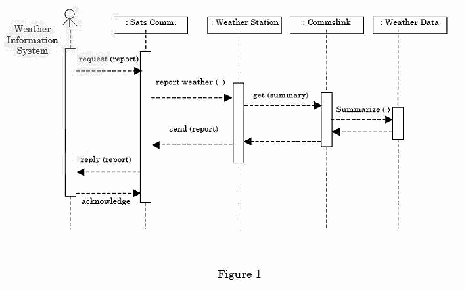
- SatComms → Weather station → Commslink → Weather data
- SatComms → Commslink → Weather station → Weather data
- Weather data → Commslink → Weather station → SatComms
- Weather data → Weather station → Commslink → SatComms
The Data Encryption Standard (DES) has a function consists of four steps. Which of the following is correct order of these four steps?
- an expansion permutation, S-boxes, an XOR operation, a straight permutation
- an expansion permutation, an XOR operation, S-boxes, a straight permutation
- a straight permutation. S-boxes, an XOR operation, an expansion permutation
- a straight permutation, an XOR operation, S- boxes, an expansion permutation Directions (91-95) Read the following passage and answer the given questions. A flow graph F with entry node (1) and exit node (11) is shown below :
Directions (Q91–95): A flow graph F with entry node 1 and exit node 11 is shown (figure with Q91). Its nodes are 1, (2,3), (4,5), 6, 7, 8, 9, 10 and 11, with edges 1→(2,3), (2,3)→6, (2,3)→(4,5), 6→7, 6→8, 7→9, 8→9, 9→10, (4,5)→10, 10→1 and 1→11.
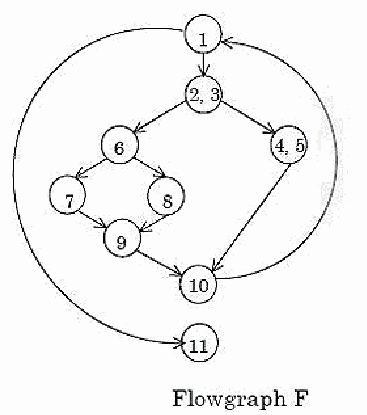
How many predicate nodes are there and what are their names?
- Three: 1, (2,3), 6
- Three: 1, 4, 6
- Four: (2,3), 6, 10, 11
- Four: (2,3), 6, 9, 10
Directions (Q96–100): An organization maintains a database with five attributes A, B, C, D, E. Consider the universal relation R(A, B, C, D, E) with functional dependency set F = {A → BC, D → E, BC → D, A → D}. All attributes are simple and atomic.
Minimal cover of functional F dependency set is
- F′ = {A → B, A → C, BC → D, D → E}
- F′ = {A → BC, B → D, D → E}
- F′ = {A → B, A → C, A → D, D → E}
- F′ = {A → B, A → C, B → D, C → D, D → E}
Identify the normal form in which relation R belong to
- 1 NF
- 2 NF
- 3 N F
- B C N F
Identify the redundant functional dependency in F
- BC → D
- D → E
- A → D
- A → BC
Assume that given table R is decomposed in two tables R (A, B, C) 1 with functional dependency set f = {A → B, A → C} 1 and R (A, D, E) FD 2 with set F = {A → D, D → E} 2 . Which of the following option is true w.r.t. given decomposition?
- Dependency preservation property is followed
- R1 and R2 are both in 2NF
- R1 is in 2NF and R2 is in 3NF
- R1 is in 3NF and R2 is in 2NF
Answer key
- 1 – B
- 2 – C
- 3 – B
- 4 – A
- 5 – C
- 6 – B
- 7 – A
- 8 – B
- 9 – D
- 10 – C
- 11 – A
- 12 – D
- 13 – D
- 14 – A
- 15 – D
- 16 – B
- 17 – B
- 18 – B
- 19 – C
- 20 – B
- 21 – D
- 22 – B
- 23 – C
- 24 – A
- 25 – D
- 26 – B
- 27 – B
- 28 – B
- 29 – C
- 30 – B
- 31 – D
- 32 – B
- 33 – C
- 34 – B
- 35 – A
- 36 – C
- 37 – A
- 38 – B
- 39 – C
- 40 – B
- 41 – C
- 42 – A
- 43 – C
- 44 – D
- 45 – C
- 46 – B
- 47 – D
- 48 – A
- 49 – B
- 50 – C
- 51 – C
- 52 – A
- 53 – C
- 54 – A
- 55 – B
- 56 – B
- 57 – A
- 58 – A
- 59 – C
- 60 – B
- 61 – B
- 62 – B
- 63 – B
- 64 – B
- 65 – D
- 66 – C
- 67 – D
- 68 – C
- 69 – B
- 70 – C
- 71 – C
- 72 – C
- 73 – D
- 74 – A
- 75 – A
- 76 – B
- 77 – A
- 78 – B
- 79 – D
- 80 – D
- 81 – A
- 82 – C
- 83 – C
- 84 – A
- 85 – C
- 86 – A
- 87 – C
- 88 – A
- 89 – C
- 90 – B
- 91 – A
- 92 – C
- 93 – C
- 94 – C
- 95 – A
- 96 – A
- 97 – C
- 98 – B
- 99 – C
- 100 – D